Travel

Final Thoughts on our Trip to the Arctic

I love warm weather and sunshine.  I don’t like going into a pool or a lake or an ocean unless it’s around 85 degrees.  You can imagine Brad’s surprise when I said one morning, “I think we should go on an expedition to the Arctic!!”  Once I put it out there, the whole idea of the trip began to intrigue both of us.  We signed up to go on a National Geographic ship that went around Svalbard, far north of the Arctic Circle. Brad loved the idea because the trip had a focus on photography and it gave him a chance/excuse to upgrade his camera so he could learn with the best.  I threw in a few days of travel to Copenhagen and Oslo so we could see some new Scandinavian countries and experience new cultures.

After a long shopping trip to REI where we bought a pile of base layers and waterproof everything, we were ready to head to the Arctic.  We really didn’t quite know what to expect but went with eager anticipation and a willingness to learn about Svalbard!

Here are a few of our reflections on the voyage:

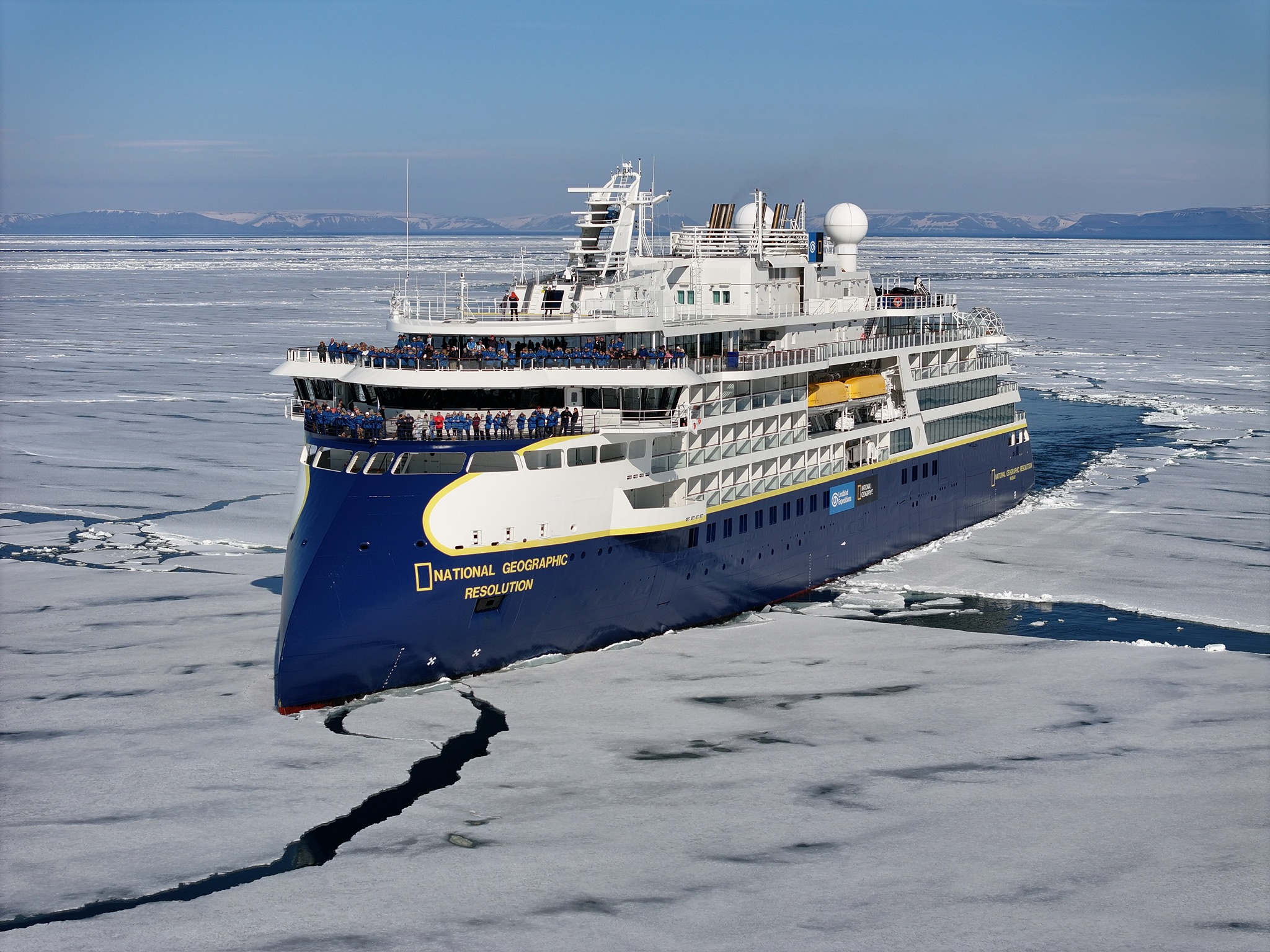
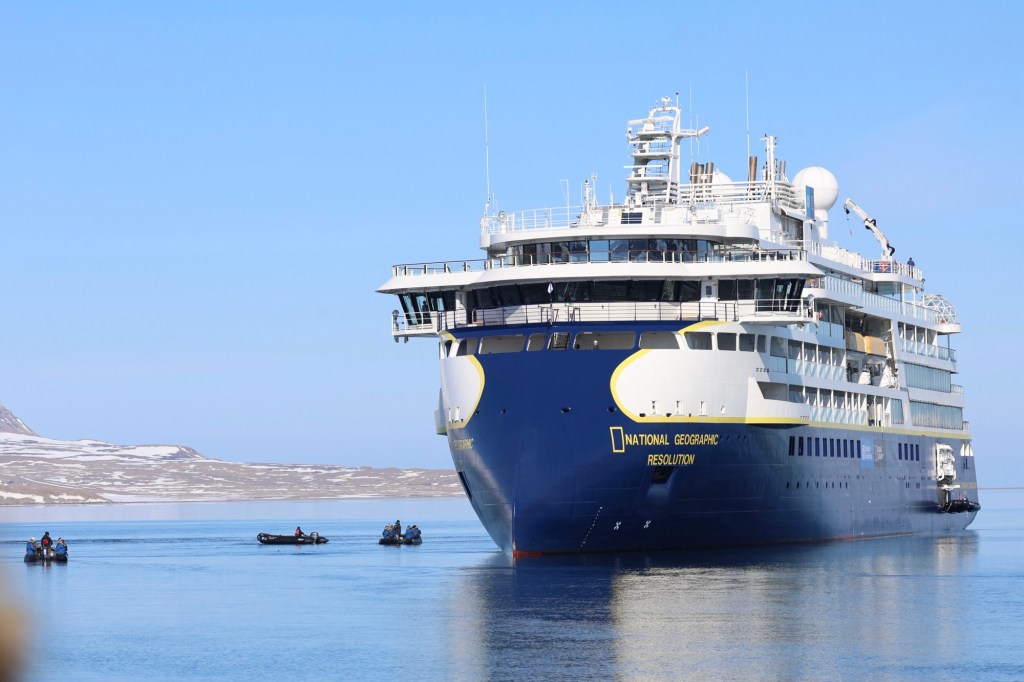
Experiencing the Wonder of the National Geographic Resolution:  We were on the Nat. Geo.  Resolution with about 130 of our fellow expedition travelers for seven days.    The vessel was a next-generation expedition ship designed for polar ice exploration and it was beautiful.  We were NOT on a cruise ship with a set schedule of events.   We went exploring looking for wildlife and ice and what we did each day depended on the weather, the wind, the ice, and the conditions on land.  The Captain changed his navigation frequently due to weather conditions.  We were the only ship in the areas we explored for virtually the entire trip.  
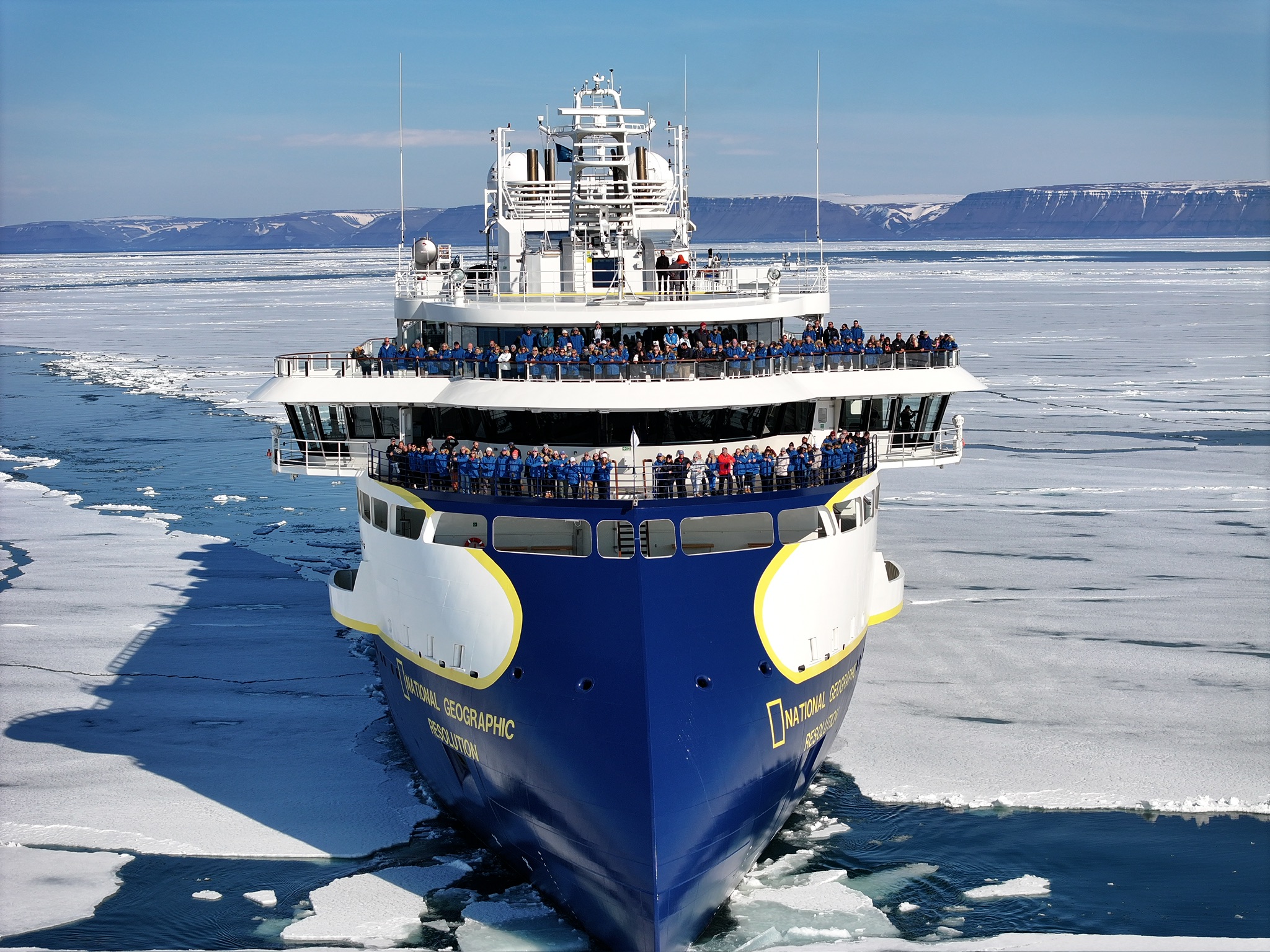
Our ship mates on the Resolution
Resolution on Ice

A Typical Day on the ship — there were no Typical Days on the ship: 

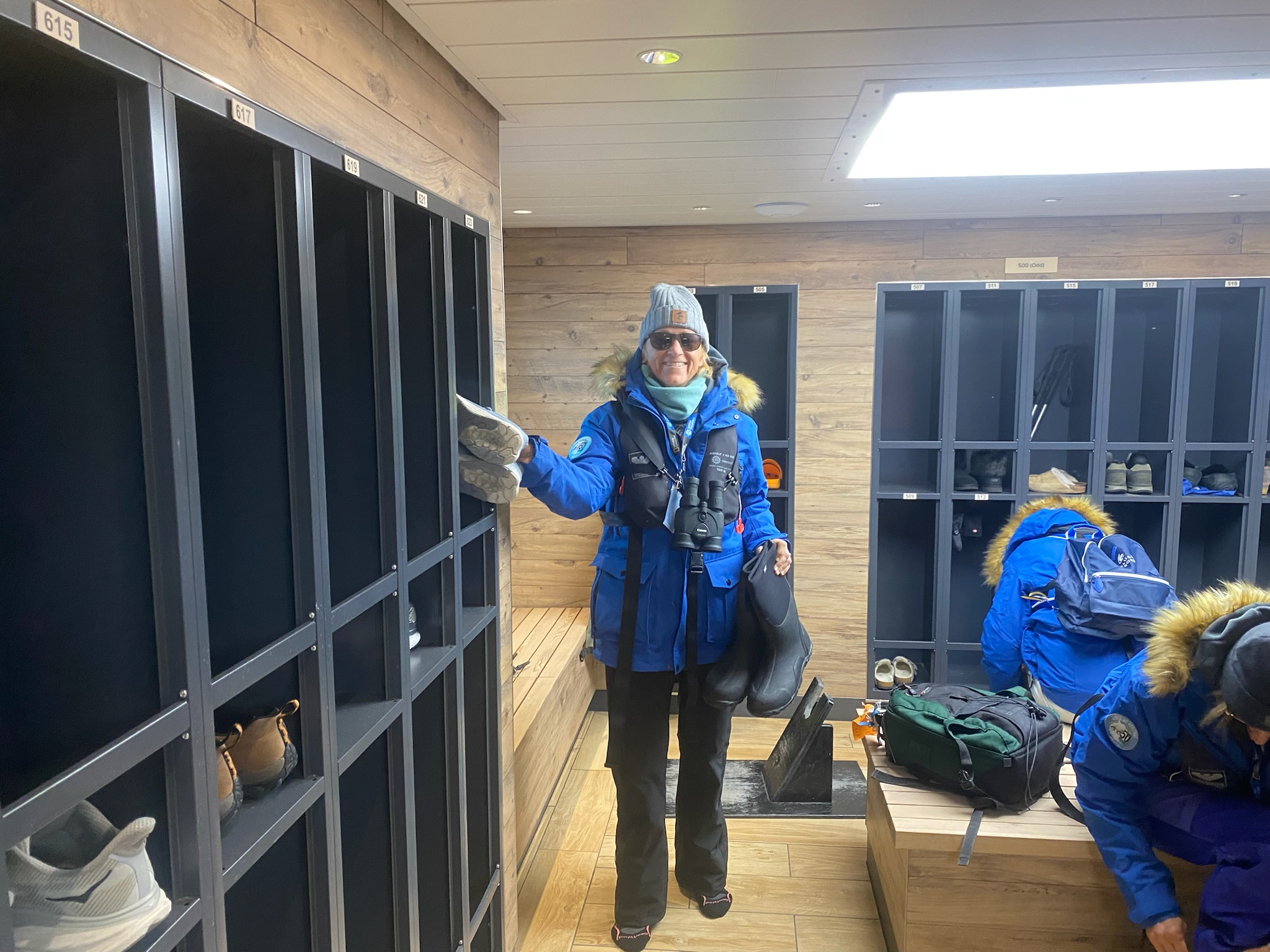
An example of a typical day started with a 7:00 am cheery wake-up call letting us know what “operation” we were trying to do that morning.  An “operation” could be a zodiac trip, a hike, or kayaking.  Our leader would then give us an approximate time that we might get to go ashore.  The reason that it was approximate was because the staff had to go on shore first-equipped with guns and search for polar bears before they would take 130 people to shore (Despite their cute appearance, polar bears are quite dangerous). They also made sure the conditions weren’t too icy or muddy.  We did have a few episodes with people getting stuck in the mud up to their thighs  (the mud was like quick -sand) and they were hoping to avoid any future mud-sucking events.  Of course, there was always a wonderful breakfast waiting for us as we waited to hear about our morning.  Some days things went as planned and other days we made other arrangements.  We all had to be flexible because as soon as we found out an operation was going to happen, we had to put on all of our layers  (I wore a LOT of layers as I was channeling my inner Mary Frandsen on a chilly day playing golf), our binoculars, our life jackets, and head to Base Camp to go out on a Zodiac.  We did a lot of clothes-changing in the week on the trip but we got good at it by the end.

A guide keeping a lookout for Polar Bears
Getting ready to go out onto a zodiac in Base Camp

After our morning “operation”, we would have a delicious lunch.  One day we even had a barbecue and people could sit outside on the deck of the ship!  Post-lunch, we would find about a new operation in a new location.  Again, flexibility was the key.  Sometimes the excursions happened  as planned and sometimes they didn’t.
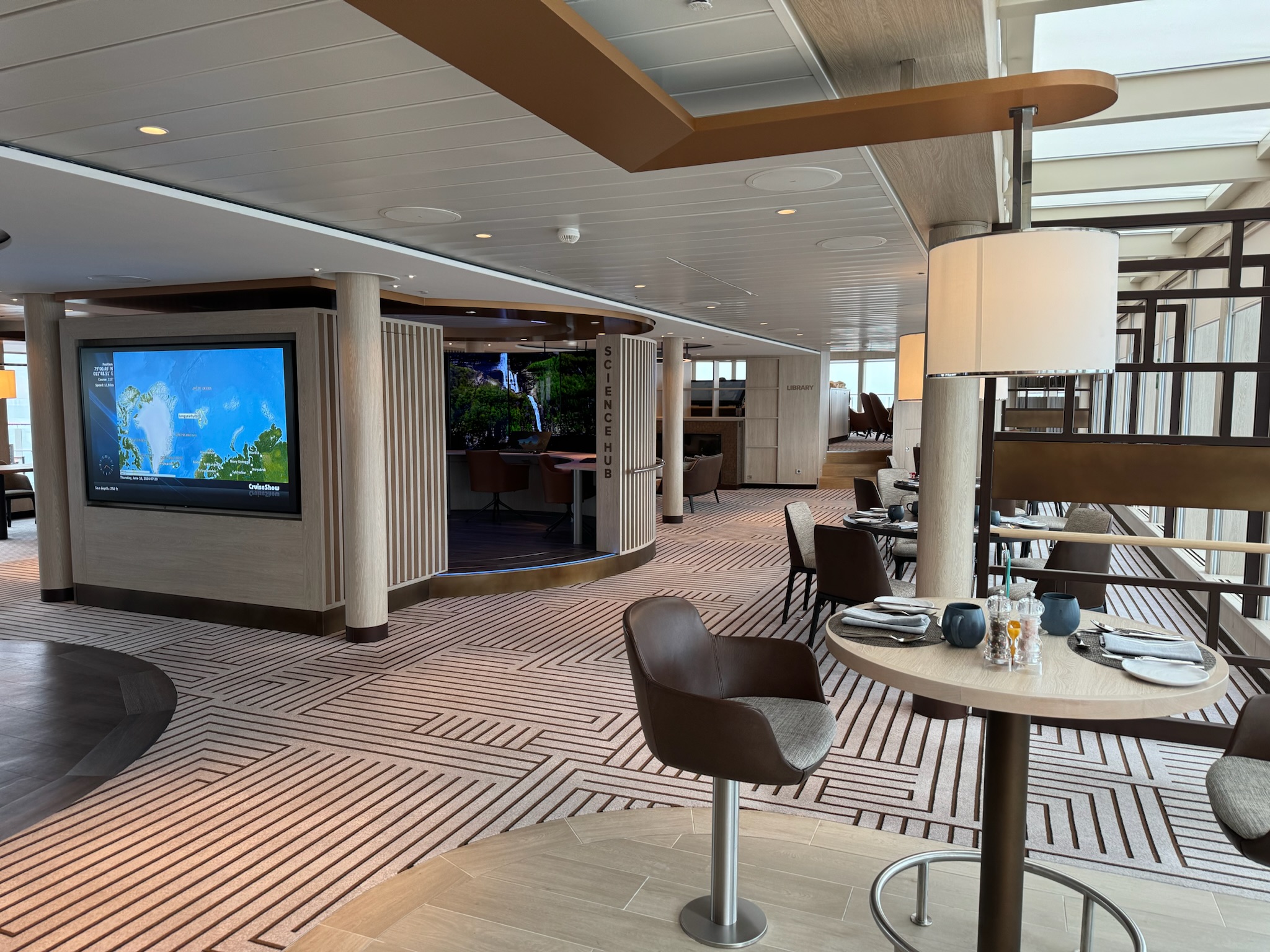
Inside the ship in one of the dining areas

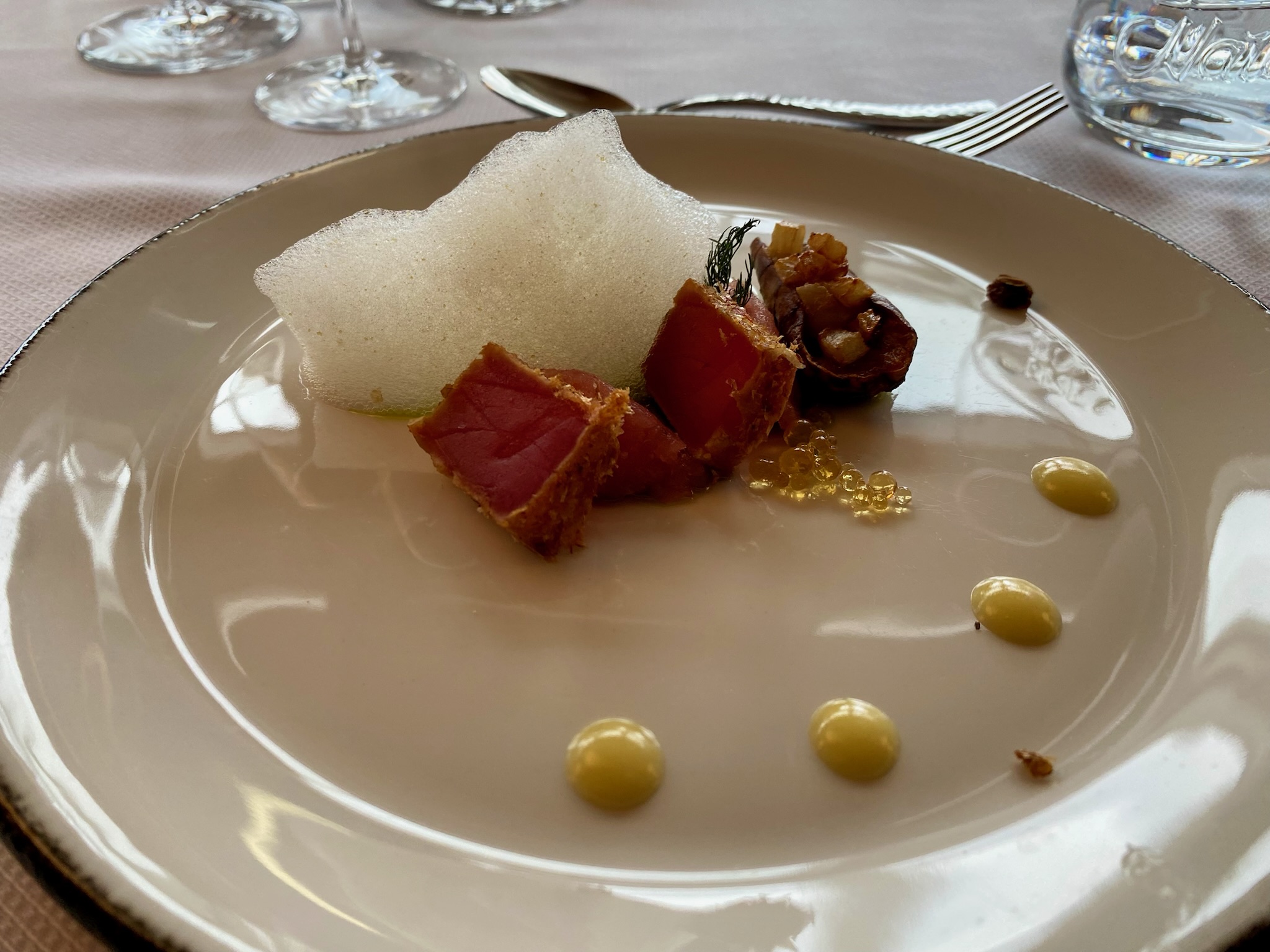
In the evenings, we had cocktail hours, a recap of the day, some great photographs of the day by the Nat Geo Photographers, trivia night, or a Polar Bear Party.  They even had a seven course meal with wine pairings that we attended with a small group.  The ship food and service were beyond our expectations!  We enjoyed our fellow travelers immensely who all had a sense of adventure and openness to learning.  
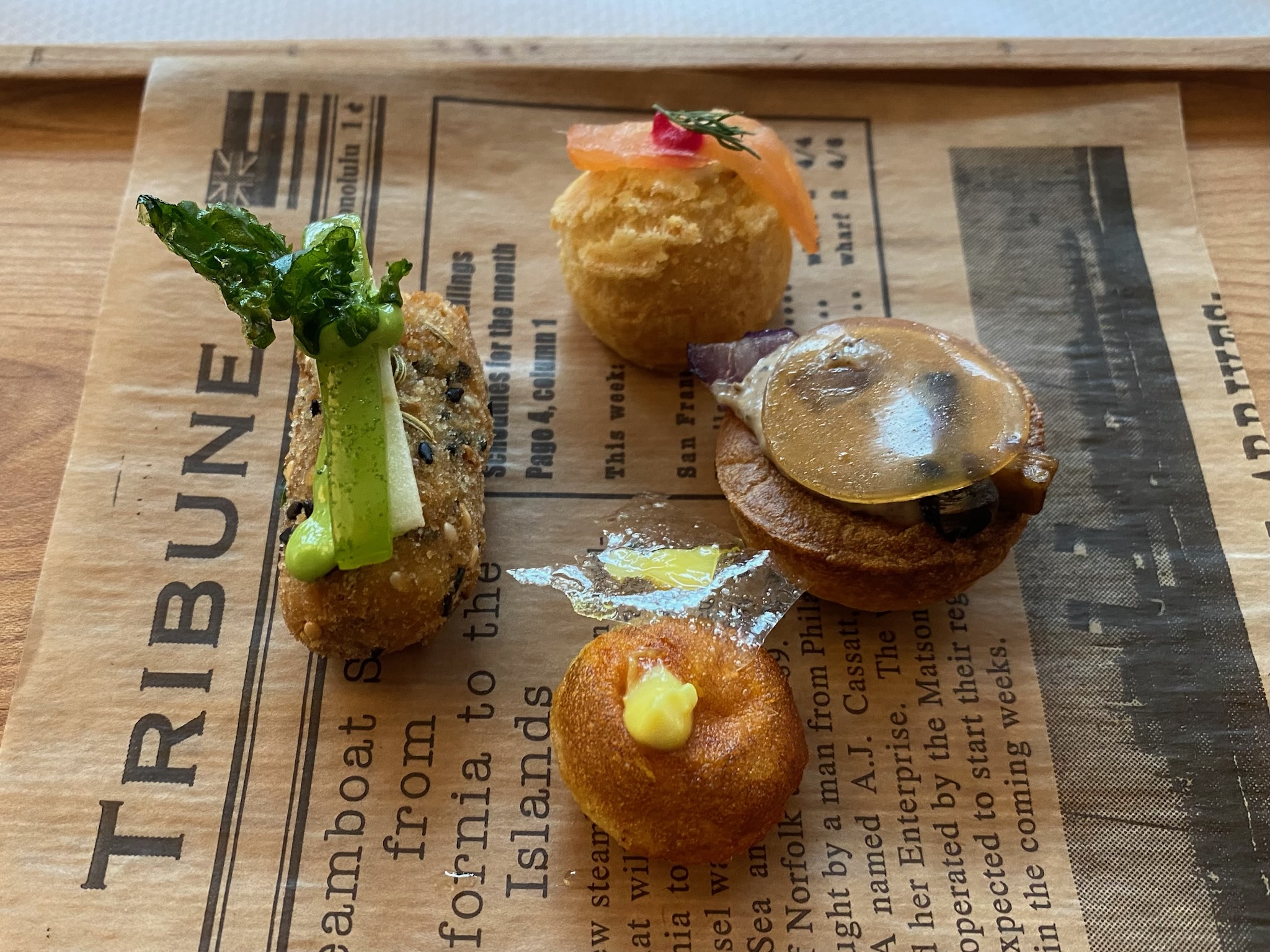
Fancy food at our seven course meal
Don’t think I’ll be making this back home!
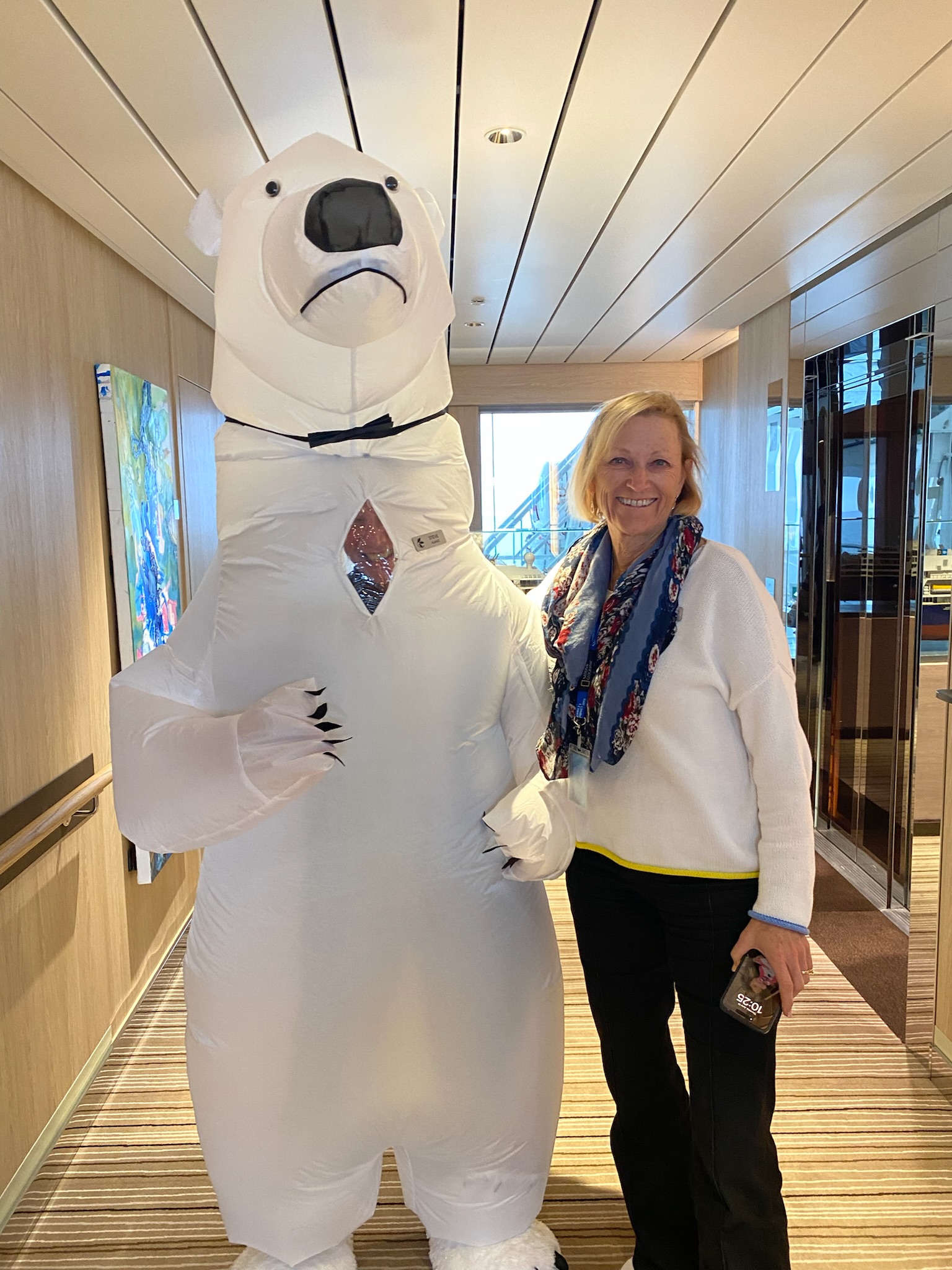
Fun at the Polar Bear Party

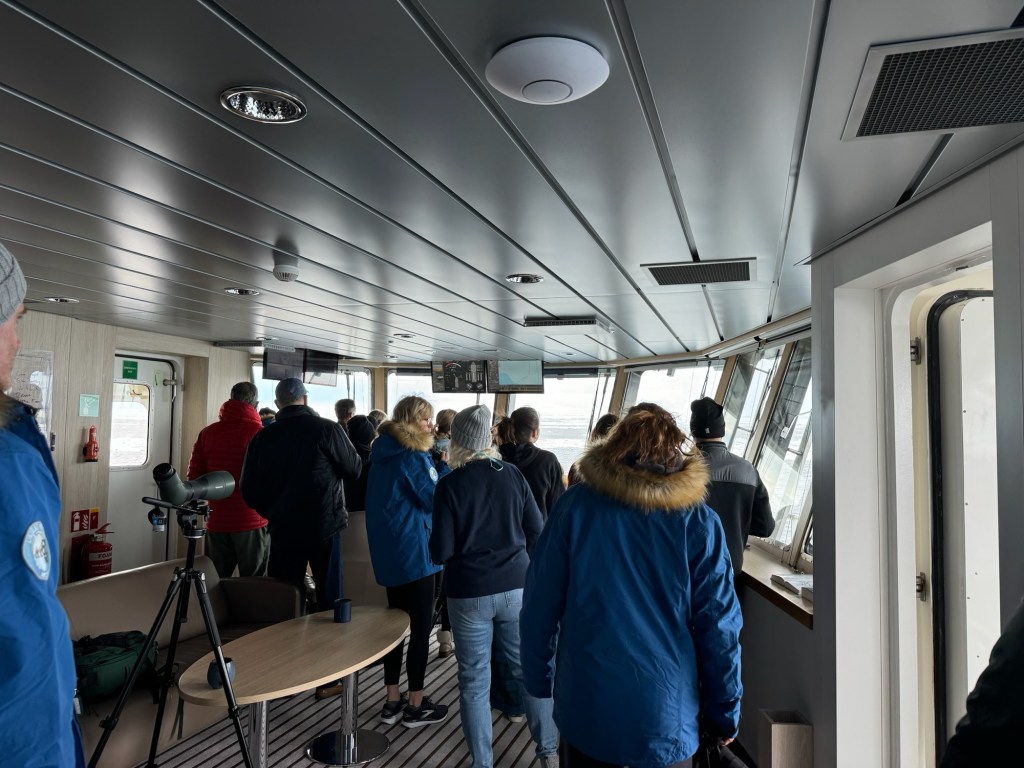
Excitement on the Bridge: When we weren’t dressing or undressing to go outside, Brad and I loved to hang out at the bridge.  The bridge was where the action happened and the Captain navigated the ship.  The fun days, of course, were when we spotted polar bears or were going through ice.  It was a fascinating place to experience ship life.  We traveled 1200 miles on our voyage and even made it to 80 degrees north.  Look it up. That’s very, very far north.

Our Captain showing us where we were when we hit 80 degrees North

Yes, A Bird Lecture can be Funny:   We loved the lectures and went to them all.  The naturalists on birds made every topic interesting and entertaining.  Who knew you could laugh so much at a bird lecture by Javier or learn all of the secrets of the iPhone camera with Bryan or see amazing underwater sea life by Annie?  Nat Geo. Ships use their platform to educate the public about all things wildlife but also on the serious issue of global warming.  Those lectures were very enlightening and sobering.

Our very intelligent, impassioned naturalists, guides, and photographers

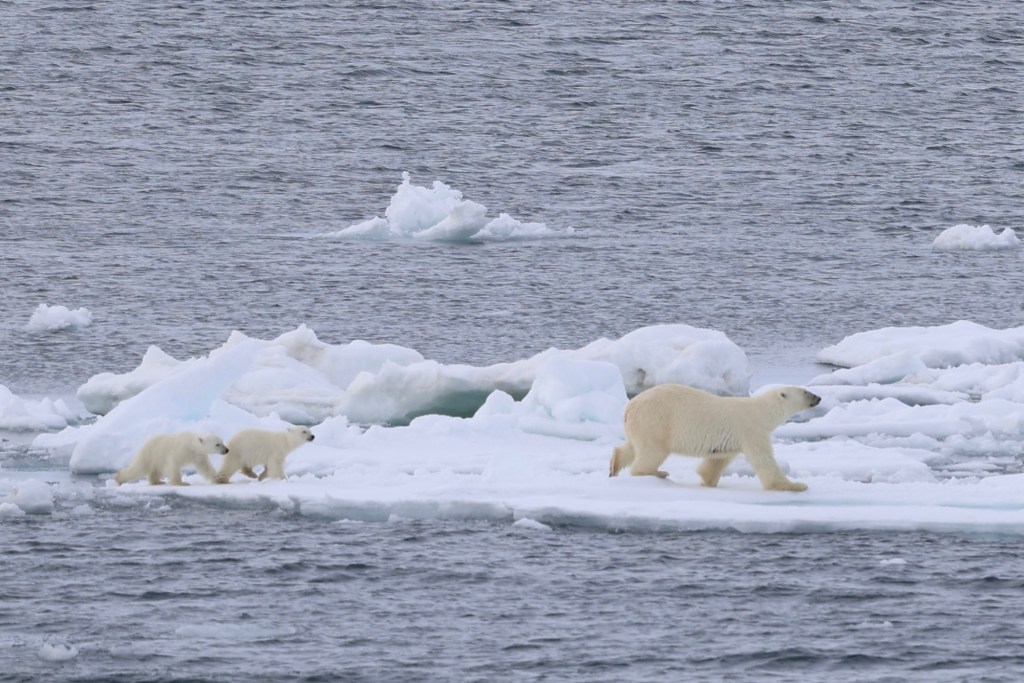
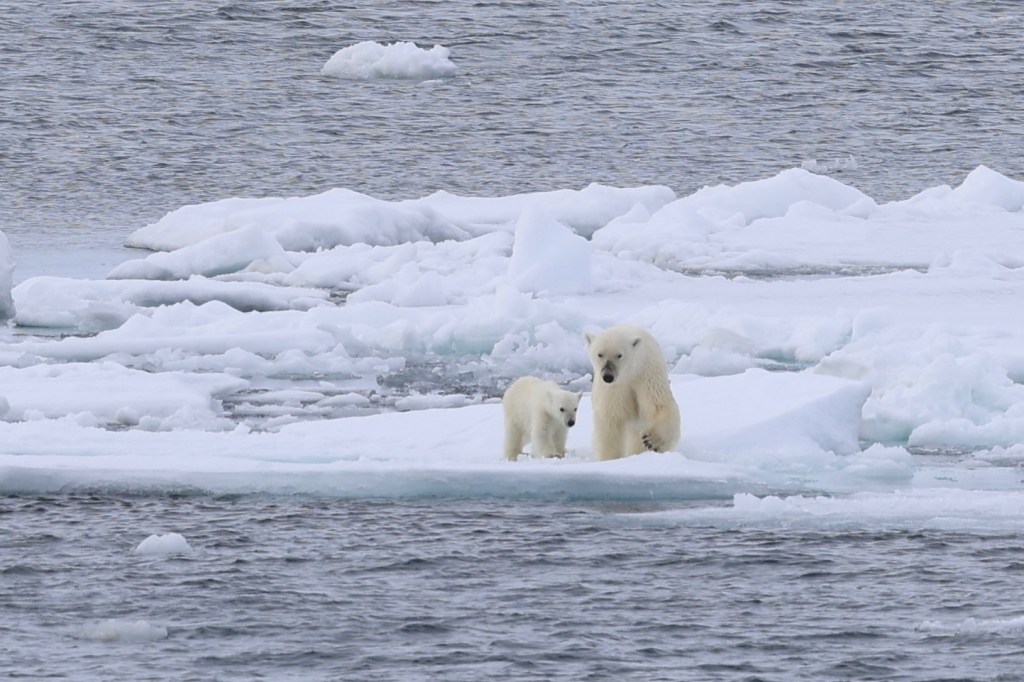
Polar Bears are getting more and more rare to find:  Polar Bears are not as easy to spot as we thought when we signed up for the trip.  Their numbers are decreasing annually due to melting icescapes and the ships are not allowed to get close to the fast ice.  We were very lucky to see that mama and her cubs. It doesn’t happen on every expedition.  Normally, they see a lot of “pixel” bears that you can only see through a strong binocular or very large camera lens.
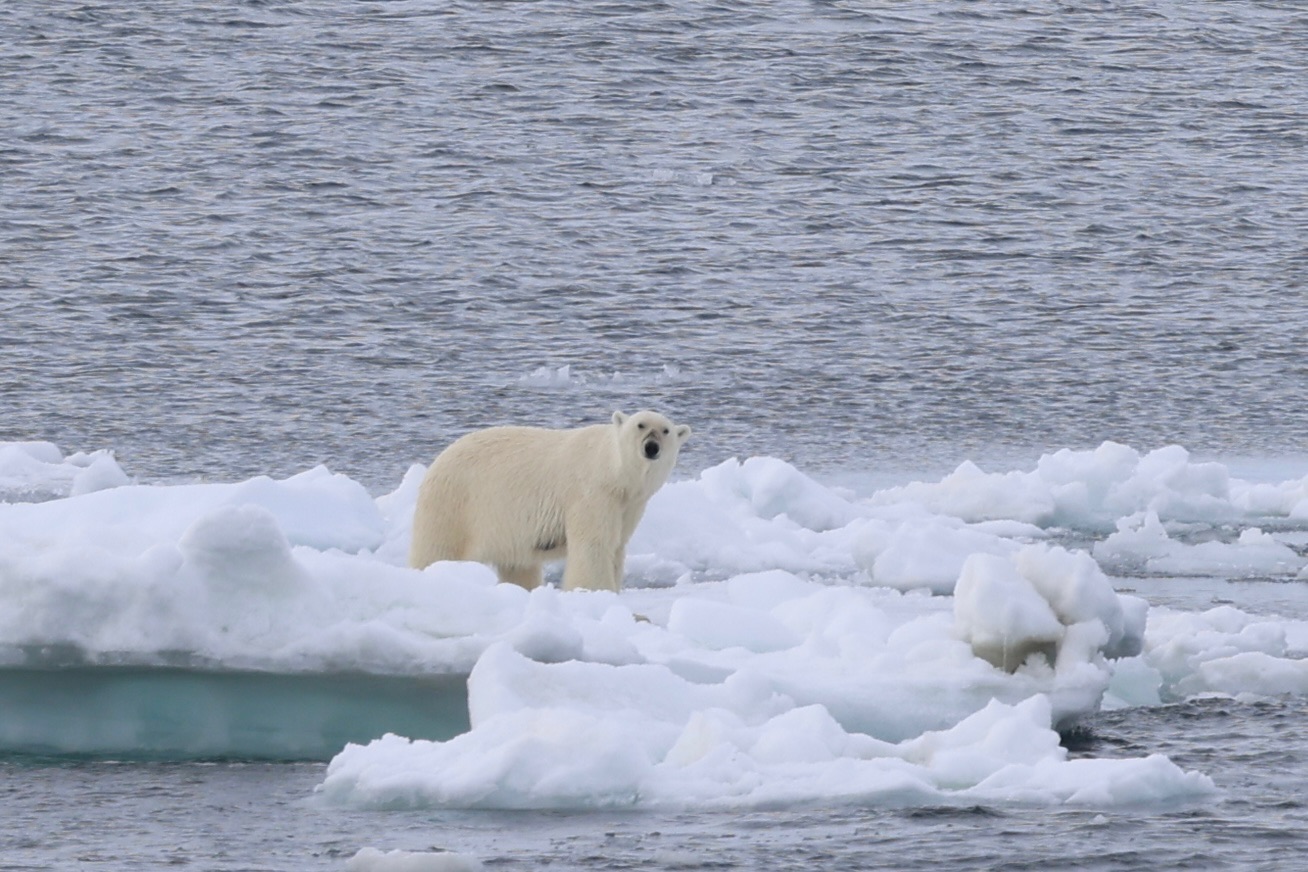
Polar Bears have now become a vulnerable species due to melting sea ice

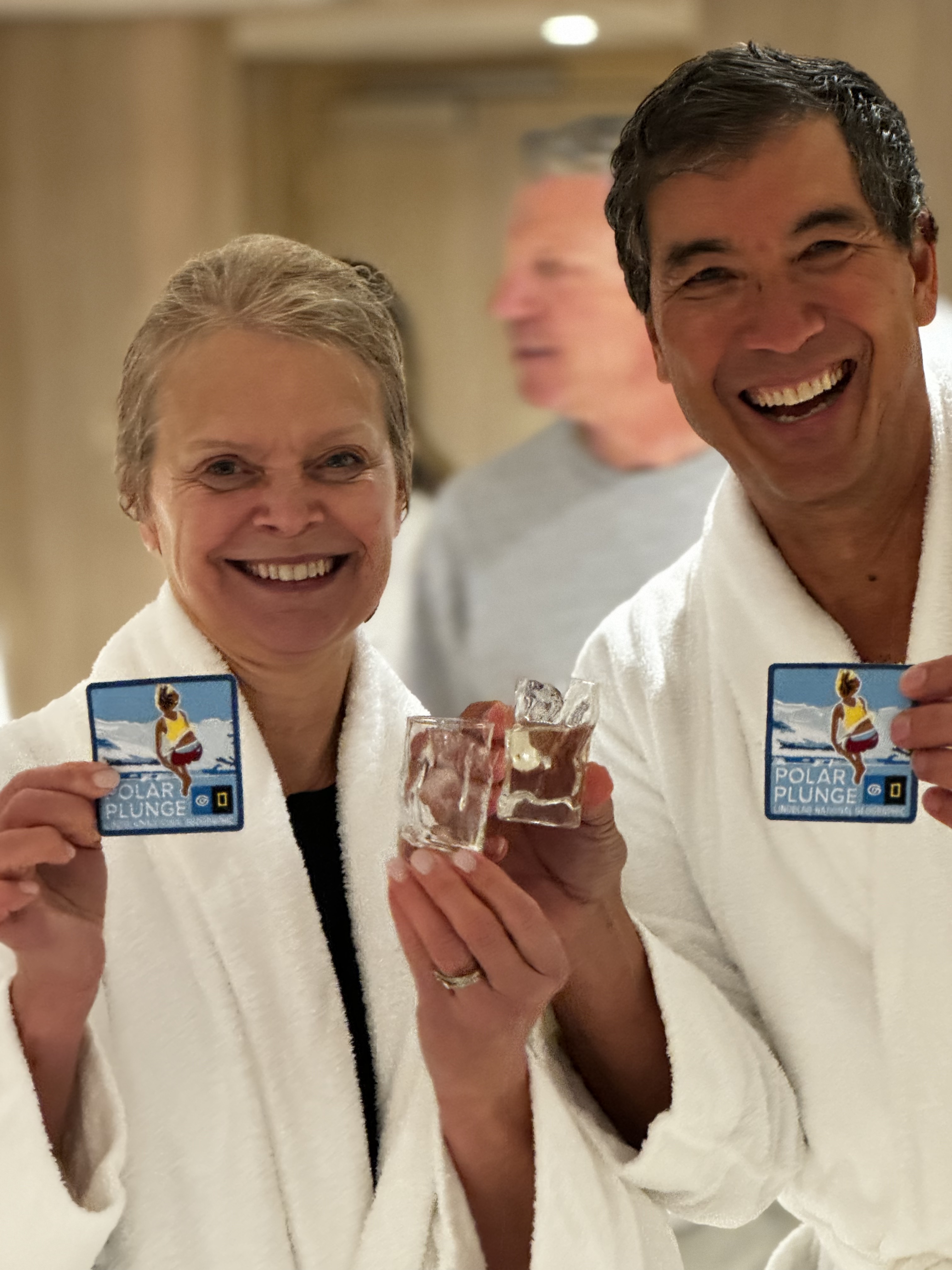
Polar Plunge:  One afternoon the brave and hearty in the group were invited to do a Polar Plunge in the frigid waters of the Arctic.  I think the water was about 31 degrees Fahrenheit.  Brad joyfully went down to take his turn while I happily went to the fifth deck to photograph him and cheer him on with the other sane people.  (Reference the part about 85 degree water in the first paragraph.)  There was lots of cheering and whooping-it-up and shot-taking with the Polar Plunge Party.  The patch Brad received was certainly warranted.
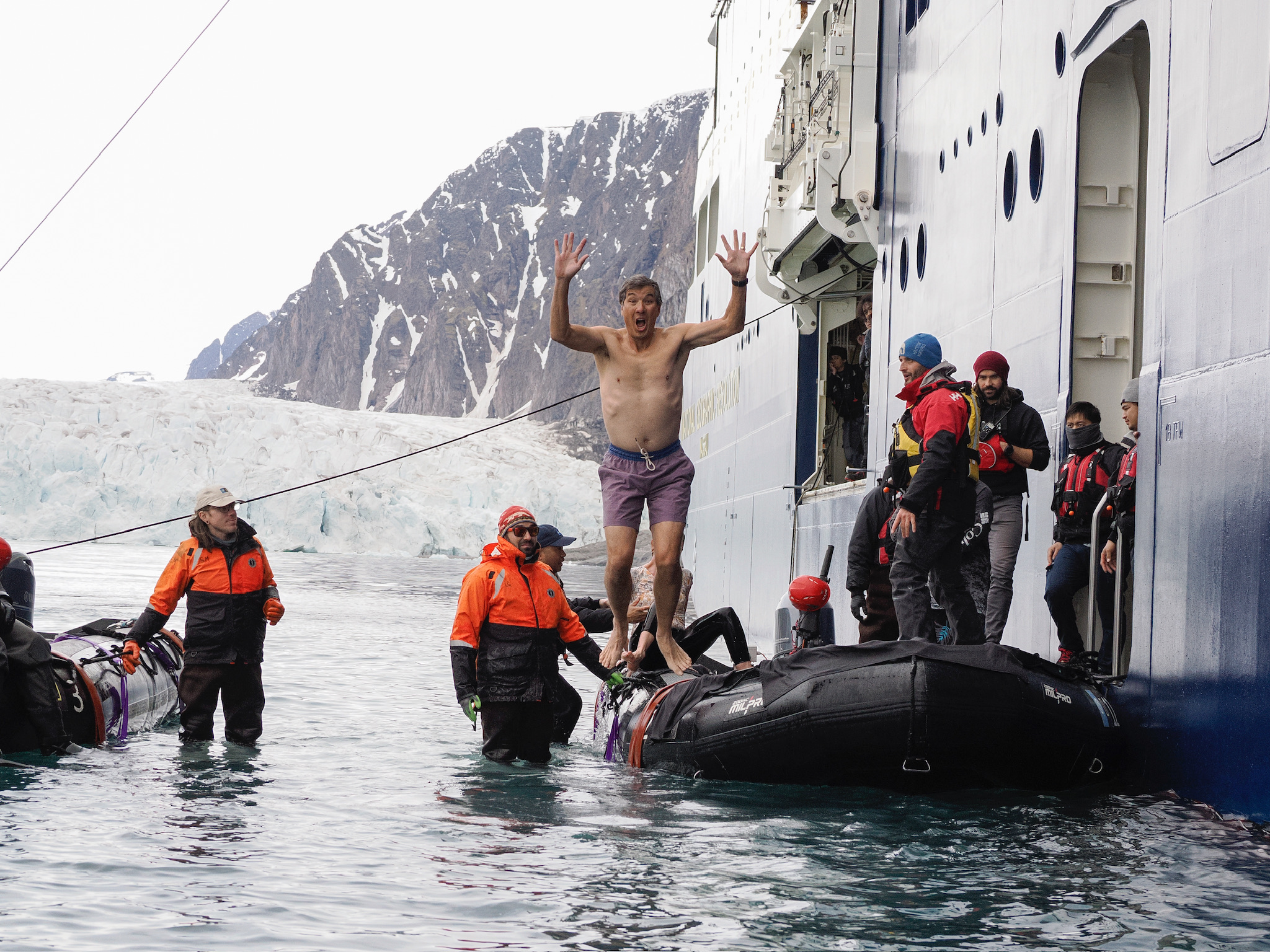
Brad jumping in to 31 degree weather
Brad celebrating with a fellow polar plunger!

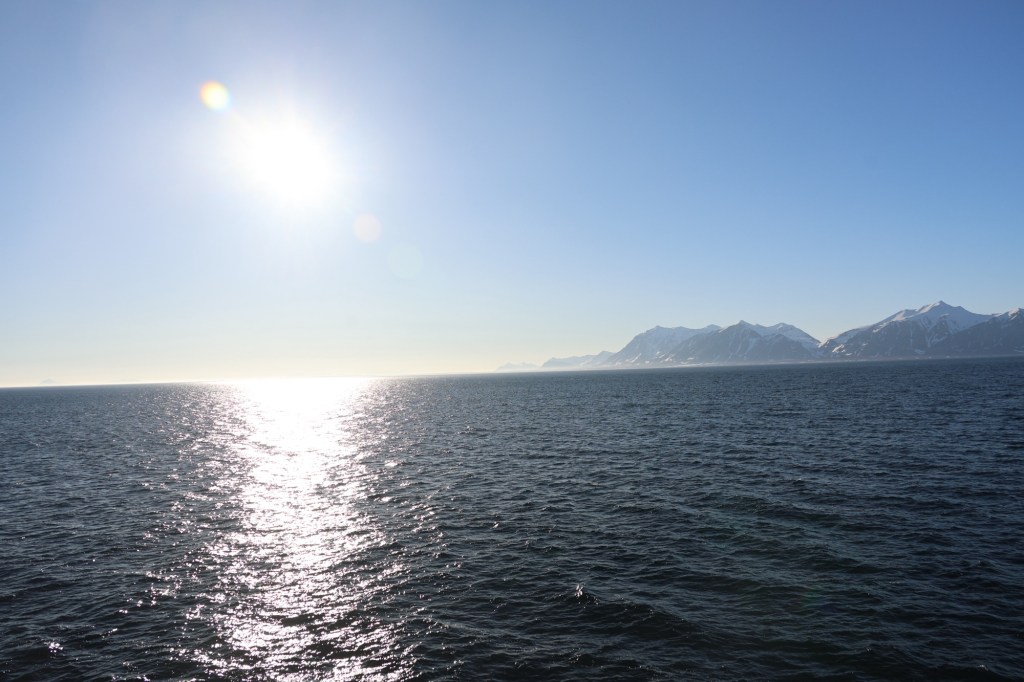
Life Without a Sunrise or Sunset:  Never seeing a sunset or  sunrise really messes with your biorhythms.  The sun has not been setting since April 19 and will not set again until August 21.  Being out at 11:00 pm in a zodiac with bright light is something that is hard to get used to.  On the flip side, the  2700 residents who live  in Longyearbyen  year-round have complete darkness (and frigid temps) from Oct.19-to mid-February.  No sunlight  at all ever during that time.  Not sure how they do it but we met many young people who love living there and studying at the University Centre of Svalbard.
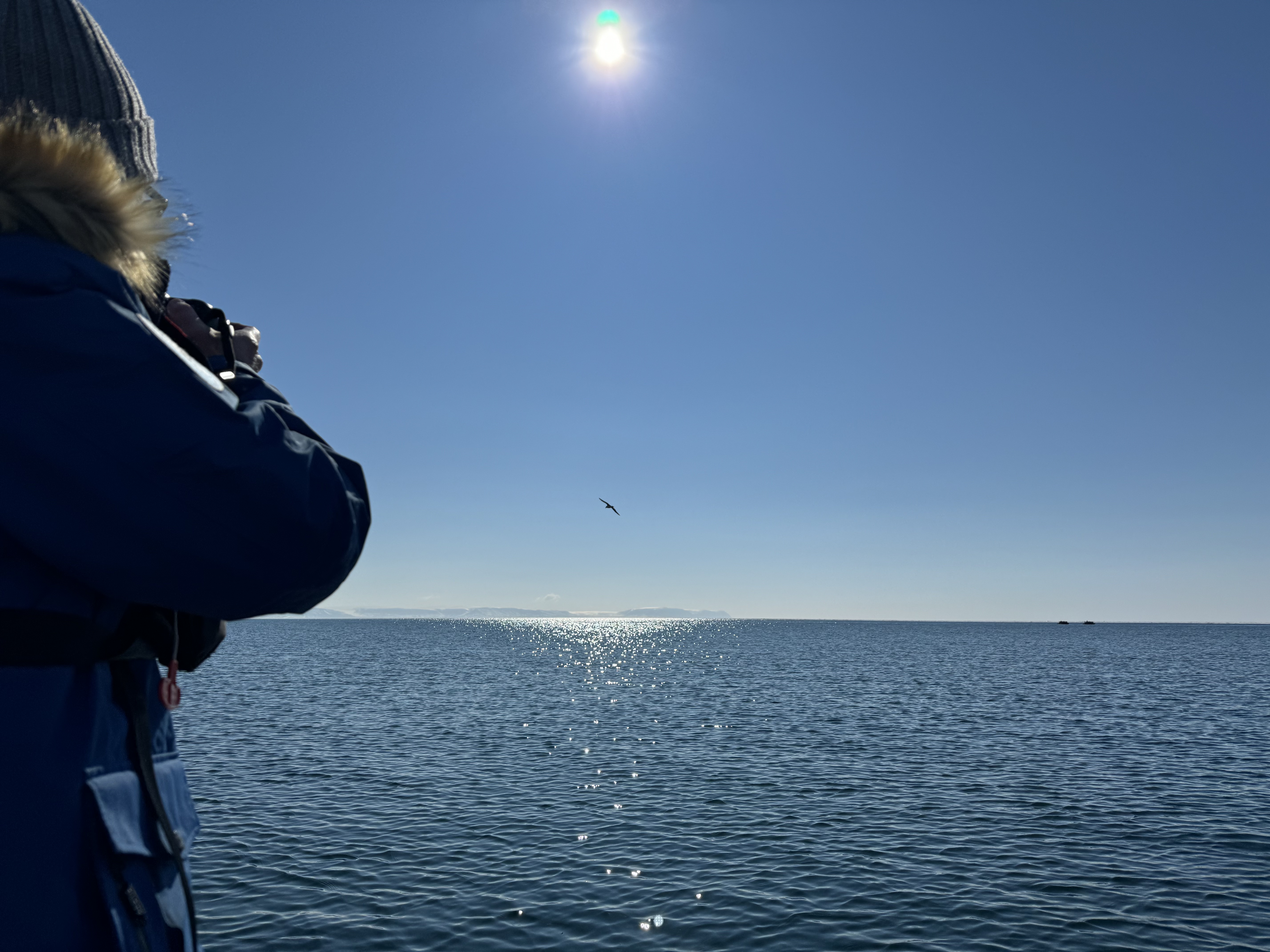
Land of the Midnight Sun

Go Now:  An Arctic Expedition may not be for everyone but if you are considering it, plan your trip now in 2024.  New regulations will take effect in 2025 that will make it even harder to get close to the polar bears.  The regulations will also only allow about 40 people on shore per operation to do hikes.  That regulation would have greatly impacted our ability to all get out on the islands as well as would have slowed down the trip dramatically.  Nat Geo ships are stewards of the environment but sadly not all ships are so careful and have been disturbing the polar bears and getting too close to them hence the new regulations.

Nat Geo Ships:  I can’t say enough good things about  Nat Geo Ships and am already looking at where we can go in a couple of years.  Their mission is to teach their passengers about the environment, wildlife, geology, photography, and, of course, global warming.  We came home a lot more educated and aware of the Arctic landscape.  The ship was luxurious in a very under-stated way.  There are no kaoroke bars or all-night buffets or limbo dancing!  There is simply fantastic service and really, really smart people on board.  (Big thanks to smiling Adrian, who always greeted me at cocktail hour with my glass of chardonnay!  It’s the little things).  There was no need for the Dramamine we brought or any of the motion sickness pills or patches.  The ride was smooth (except for the ice-breaking earthquakes) and we slept like babies every night as we were gently rocked to sleep.
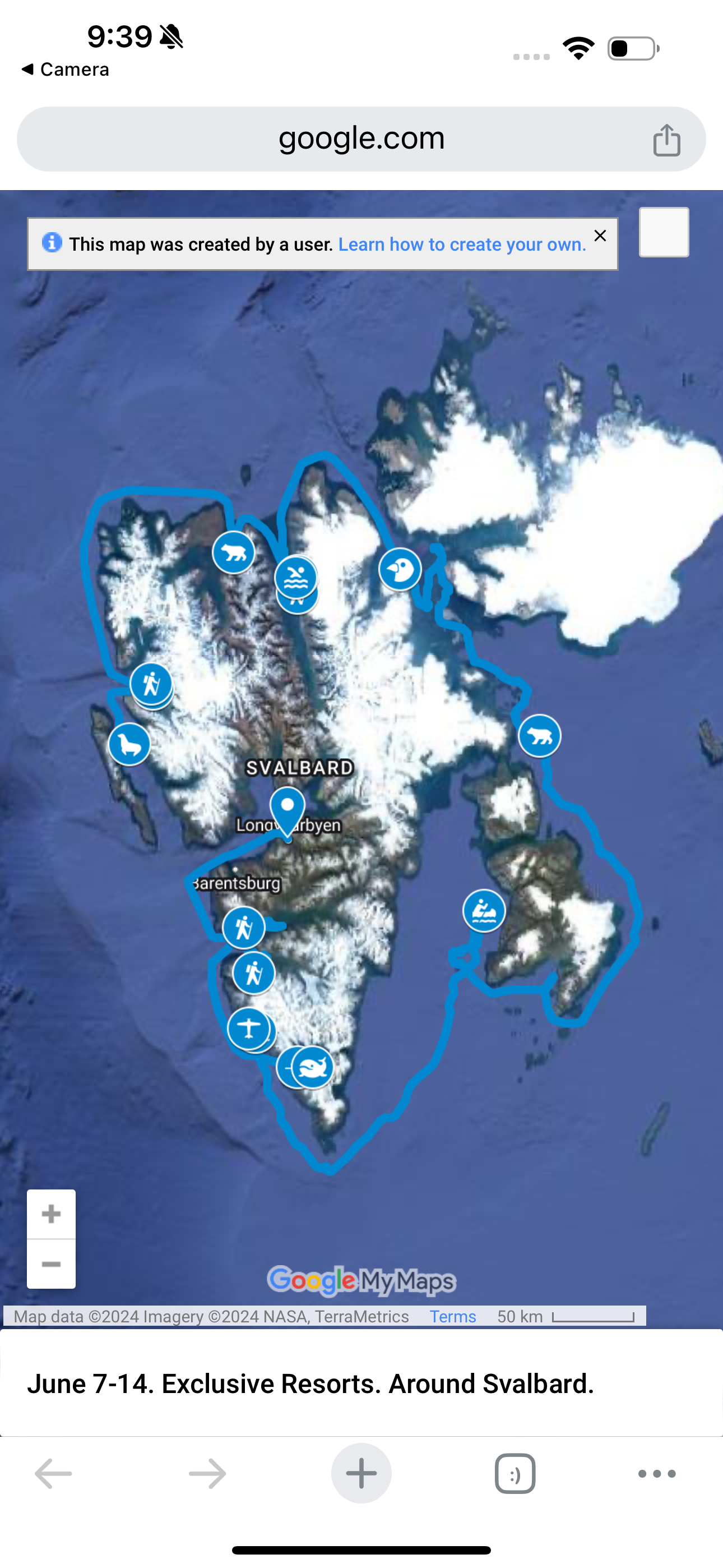
Our Seven Day Voyage

Home:  As the saying goes there is no place like home. We are looking forward to getting home to see the dogs and the grandkids and family but also I can’t wait to see a sunset and a sunrise again and feel the warmth of a summer day!  Life in the Far North was fascinating  and we will miss our fun, adventurous traveling companions but it’s time to celebrate summer back home!

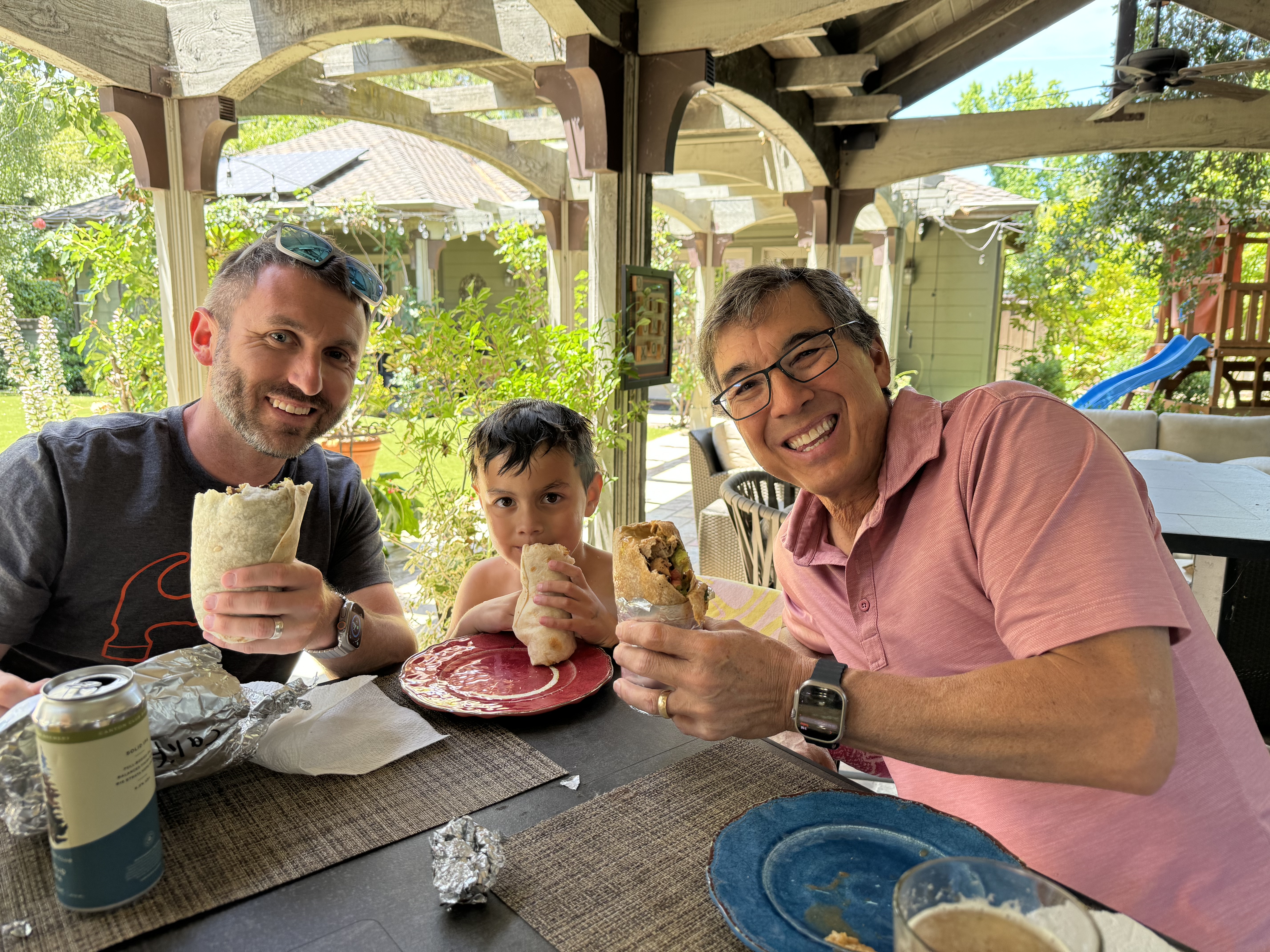
Made it home in time for Father’s Day!!
Categories: Arctic, Norway, Travel | Tags: , , , , , , , , , | 1 Comment

Apartment Living — Avian Style

We boarded our Zodiacs at 9pm in cold damp weather with a light snow falling. It’s really not about the weather, it’s what you wear. And, we were definitely bundled up.

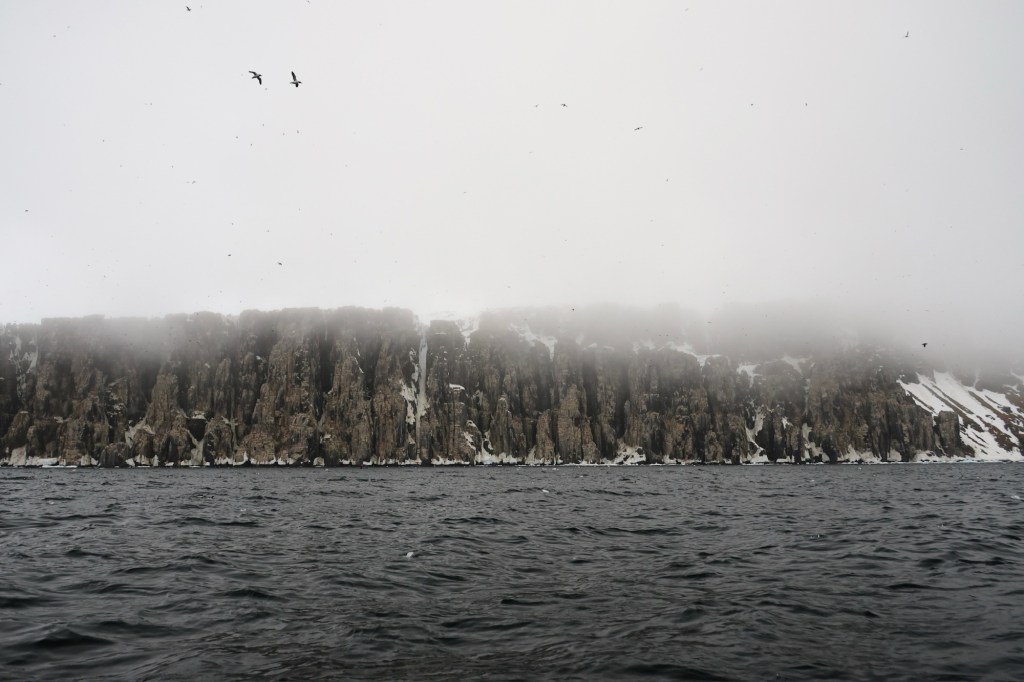
We started out toward a beautiful, massive cliffside called Alkefjellet (say that three times fast). The mountain rose straight out of the sea and had spectacular columns that rose over 300 feet into the low cloud cover above.

The Alkefjellet Cliffs
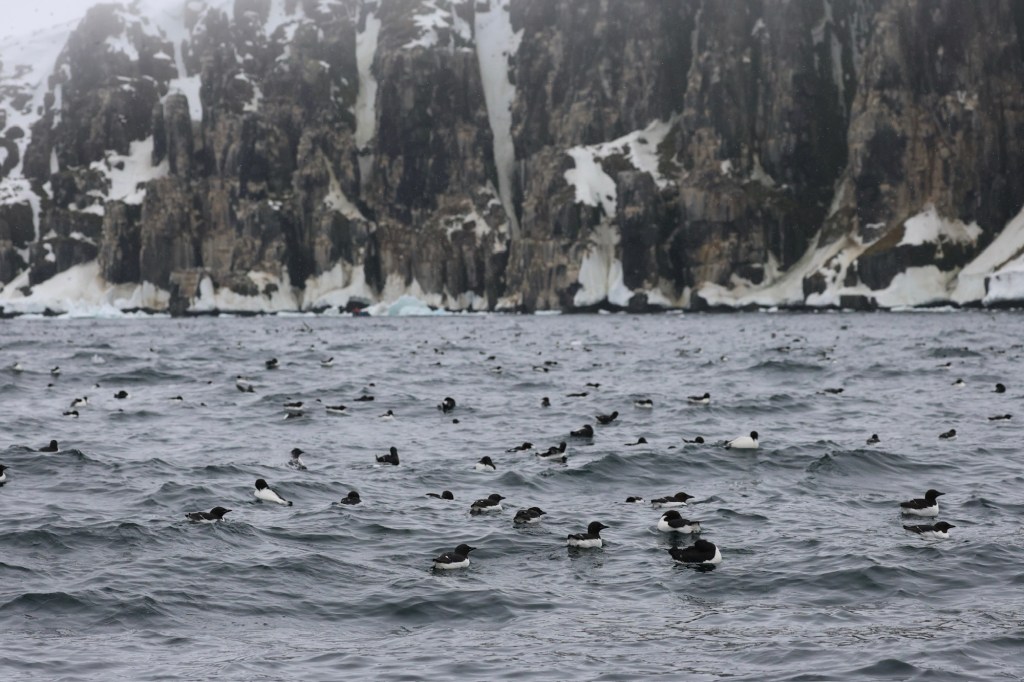
There were a number of guillemots on the water as we got closer to the cliffs.

As we approached the cliffs we started noticing many birds in the water. Our birding expert told us they were called the common guillemot. We learned that Alkefjellet means Mount Guillemot. Creative name.

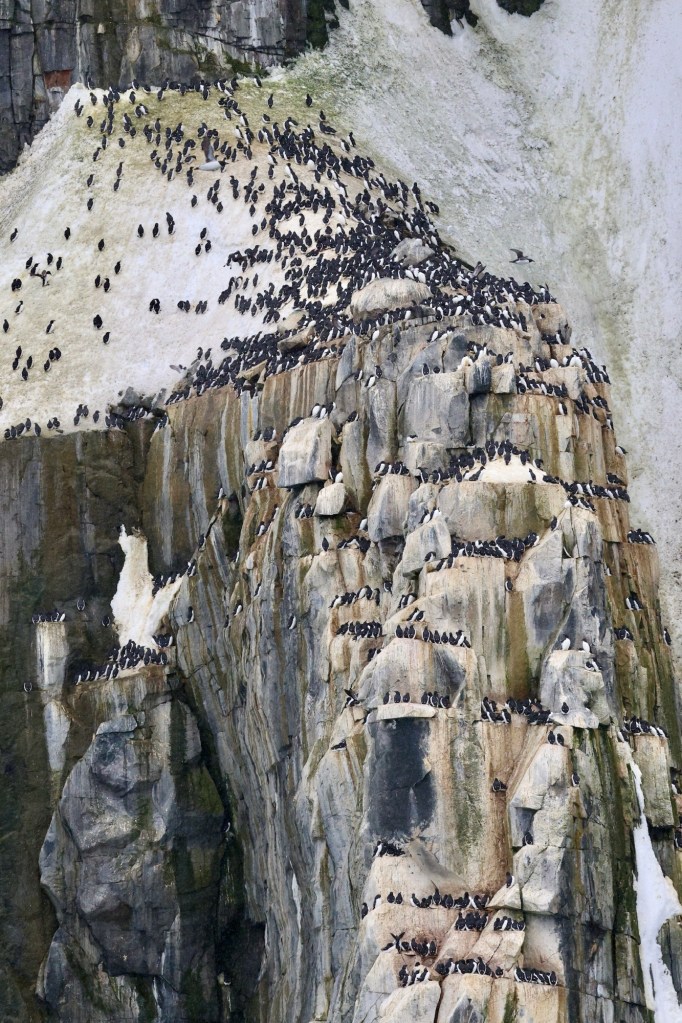
As we grew even closer to the cliffs it appeared as if the walls were moving. Soon it became clear that the cliff was covered with these black and white birds. I mean covered. Experts estimate that there are over 120,000 guillemots on the cliffs above. We didn’t count, but, after seeing the massive numbers across the full width of the cliffs, I would almost think that is a low number. Guillemots come back to this same spot every year to nest. Each couple has one egg. Once the chick is ready to leave the nest the birds head out to sea and don’t return until the following year. I wonder if they rent the place out to other birds while they’re gone.

Click on this photo and zoom in on it. There are thousands of birds on this small section of the cliffs.
A closer look.
It’s like they live on different floors of an apartment building. The penthouse looks a bit crowded, though.
I’m not sure how they nest in such close quarters.

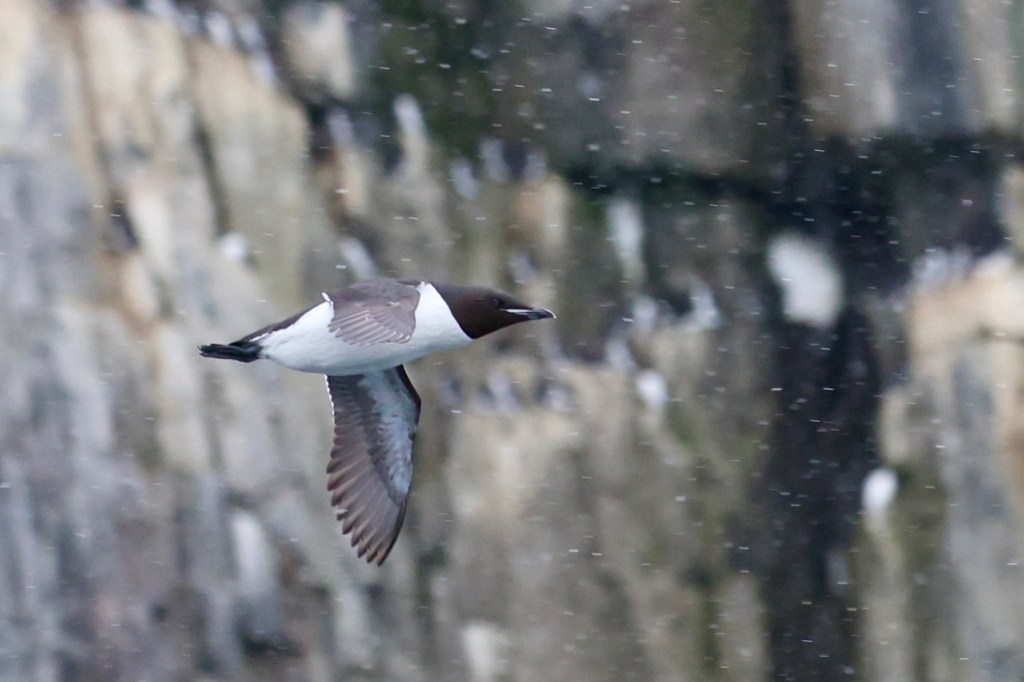
One benefit of being with National Geographic photographers is that they teach you a lot about wildlife photography. I was having difficulty getting in-focus photos of birds in flight. Bryan, one of the photographers on our trip, gave me a few pointers:

I was particularly proud of this photo of a guillemot in flight. You can even see the light snow falling around it.

After about an hour we headed back to the ship. As we embarked they handed us a hot toddy with dark rum which put a nice finish on the enlightening excursion.

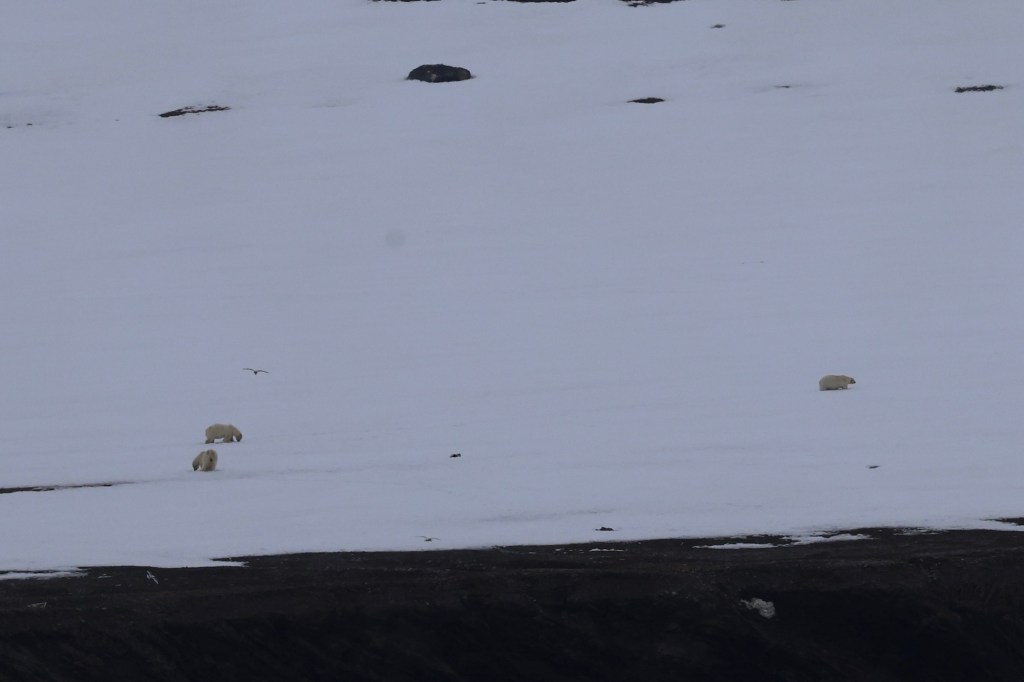
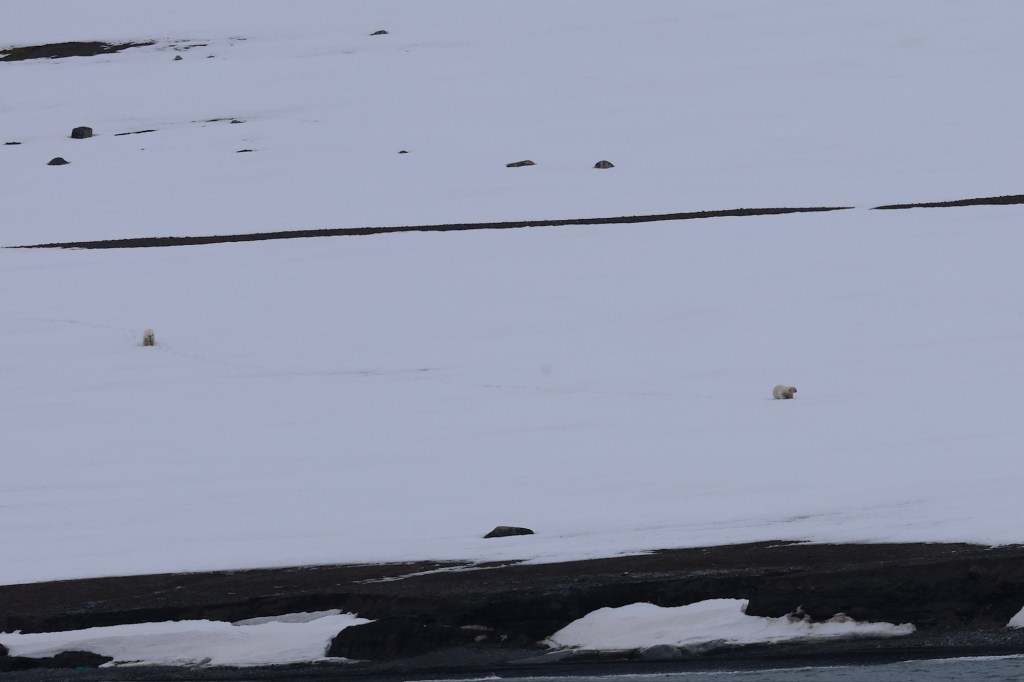
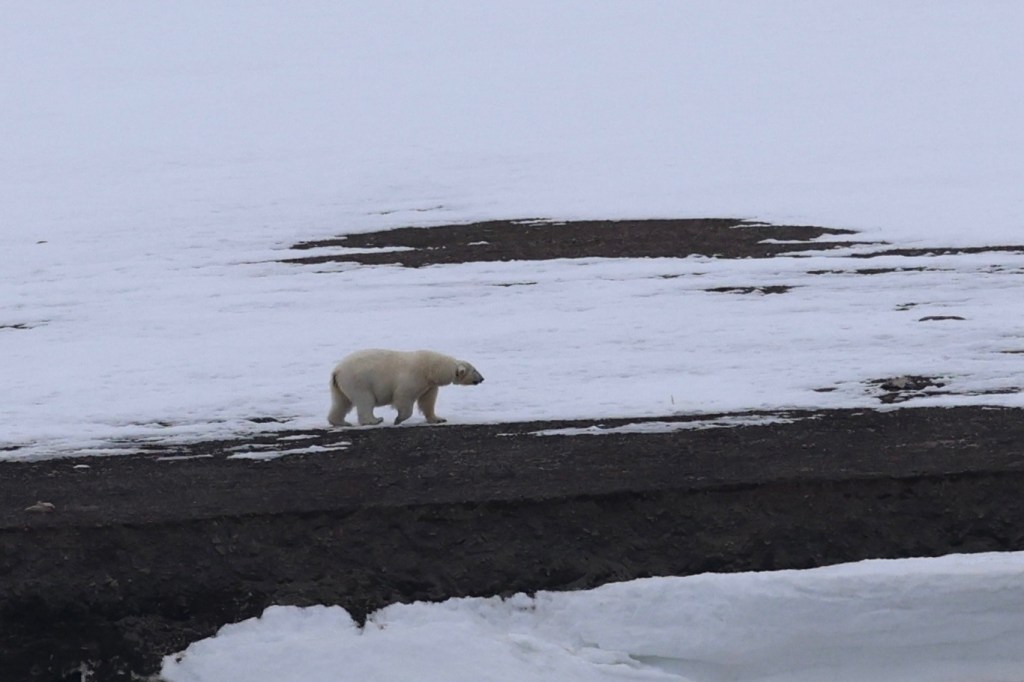
The expedition (we were told not to call it a cruise) went quickly and on our last day we saw more polar bears. Not as exciting as the momma and her new cubs. This was a mom with two two-year-old cubs. They were huge rather than cute. And, they really didn’t stay too close to mom. After a while, they laid down to sleep and she kept going. I think she was trying to ditch them. Two years is long enough!

Here are all three bears. Mom on the right. The kids on the left.
The young ones seemed to be ready to call it a night.
But, mom just kept on walking along the shore. Before long she was out of sight. I wonder if the kids ever caught back up with her.

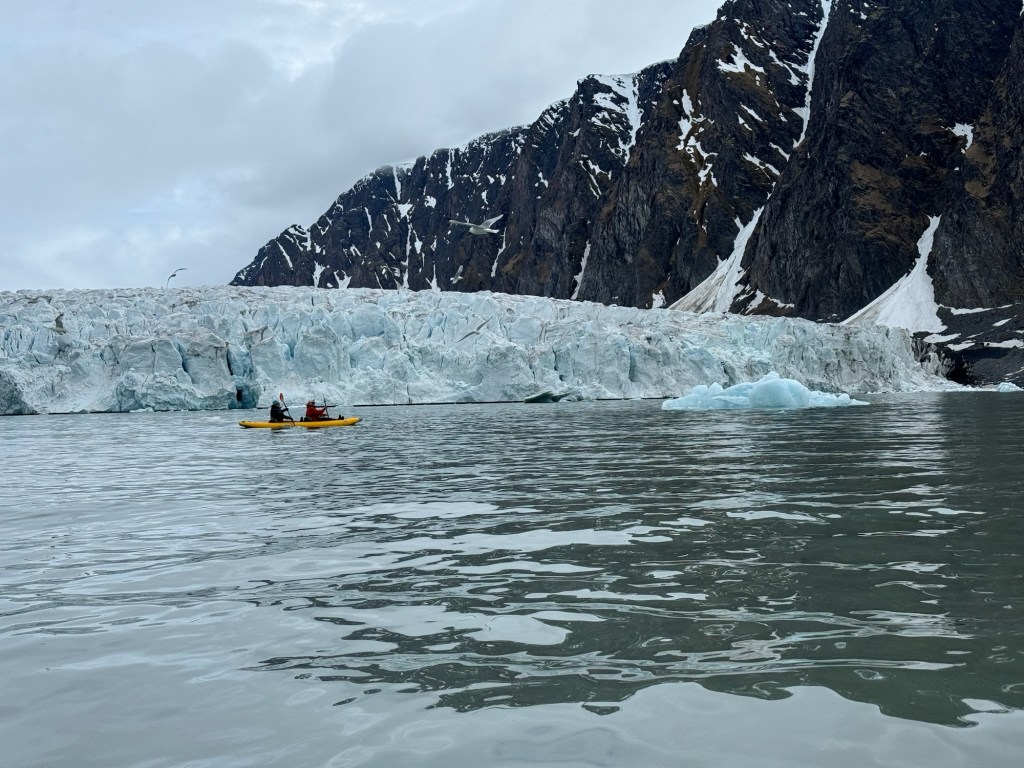
Finally, Lisa and I had a chance to kayak out to a beautiful glacier. We were warned not to get too close to the glacier or surrounding ice as the glacier could calve (big pieces falling off) and the mini-icebergs could flip over causing it to fall on us. Since neither option sounded good to us, we kept our distance.

Heading out in our kayak!
The glacier (I think that couple might be too close!)
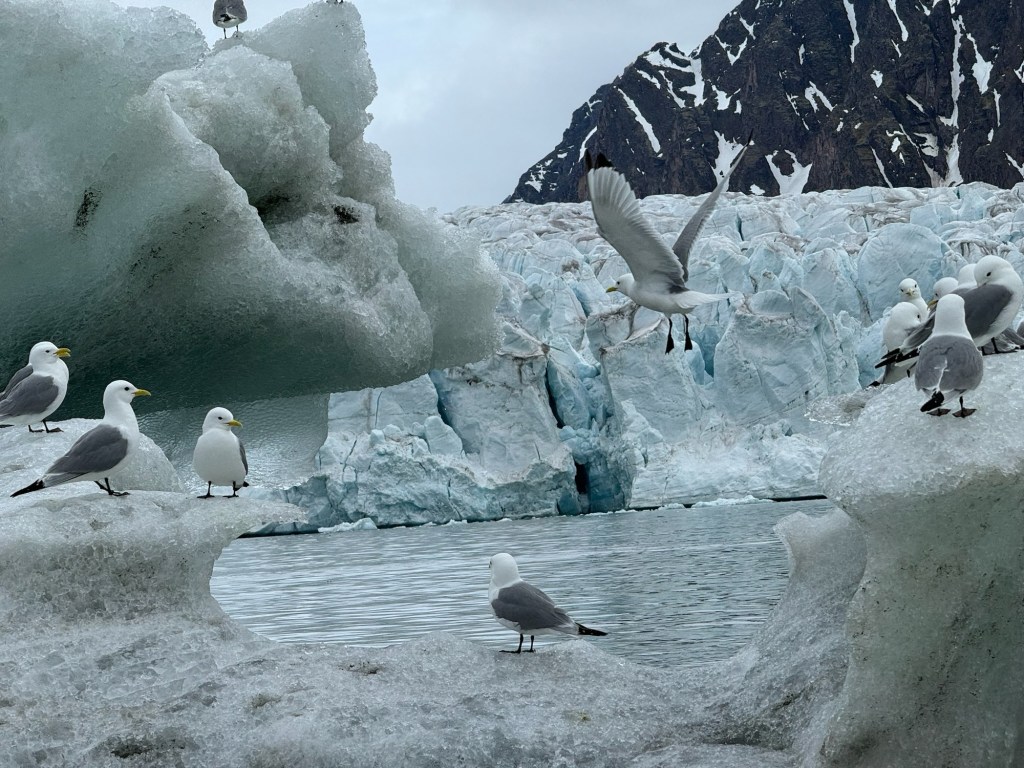
One of the icebergs with kittiwakes on it.
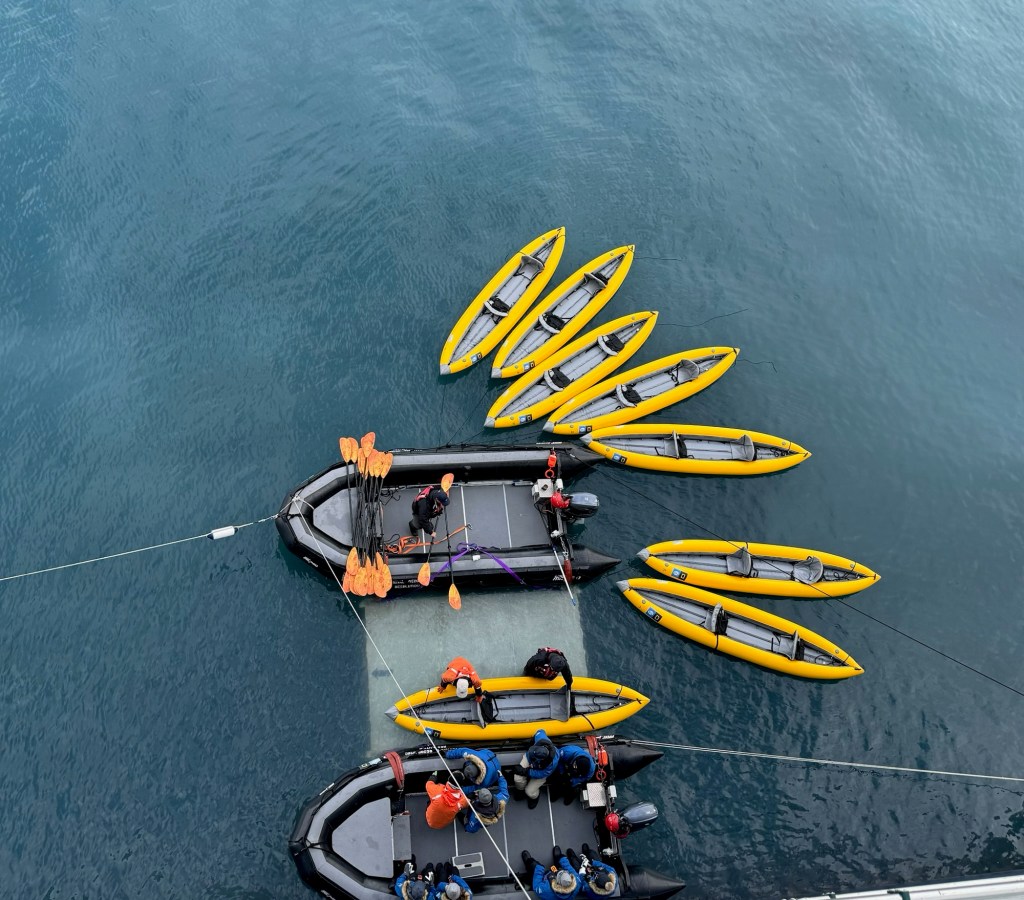
The kayaks lined up outside the ship.

We’re now sitting in our hotel after disembarking the ship and flying to Oslo. We head home tomorrow. It has been an amazing experience. We learned so much and got an appreciation for the environment, the wildlife, and the history of this remote part of the world. On our second to last day we crossed over the 80th parallel. We will likely never be this far north again. But, we will never forget our time here.

Stay tuned for Lisa’s wrap-up of our visit to the Arctic.

Categories: Arctic, Norway, Scandinavia, Travel | Tags: , , , , , , | Leave a comment

Finally — Polar Bears!

“Gooooood morning, good morning”

It was supposed to be a late start to the morning. Lisa and I had gotten up a bit early because the ship had reentered the ice and it shook us awake. As we headed out to find breakfast we decided to grab our cameras and binoculars — just in case.

That was when we heard the familiar “good morning” announcement from the expedition director. He was earlier than usual. “We have spotted polar bears on the port side of the ship. Go to the outside decks. But, keep quiet so as not to scare them off.”

“Let’s go to the bridge,” Lisa suggested. So, we headed up one floor to the 7th deck. It was buzzing with excitement.

Many of us hurried to the bridge.

The crew had been searching for bears using their infrared cameras, telescopes, high mag cameras, and binoculars. They weren’t spotting anything. Then they got a call from the ship’s sous chef. He had gone out to one of the balconies for a break. He saw something on the ice. It was polar bears! While the high-tech-laden crew was looking right, he was looking left. Thank goodness he needed a break from preparing our lunch!

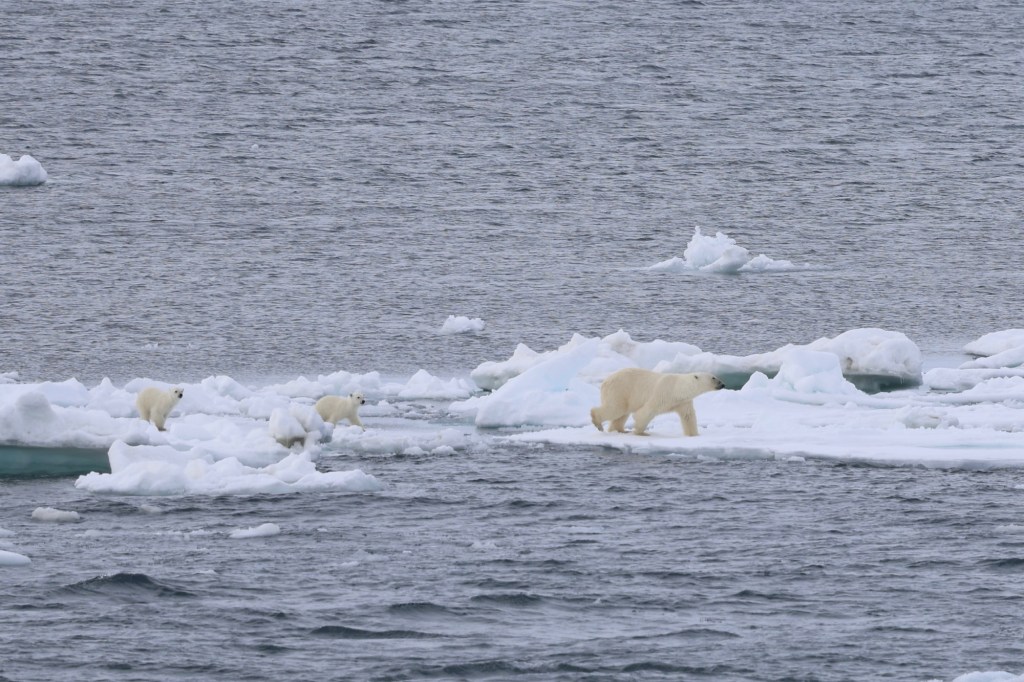
Suddenly, the morning was filled with oooohs, aaahs, and clicking cameras. It was a mama bear with her two cubs crossing the ice floes.

The mama polar bear being trailed by her two cubs.

Polar bears are considered to be marine mammals (I thought that designation belonged only to whale and seals). This is because they spend most of their time in the water or on the ice and are dependent on the ocean for their livelihood.

While the polar bears appears white, if you shaved it, you would see it has black skin — and it would be pretty angry at you for shaving it. If you look closely at their nose area where their fur is thin, you can see that it is black. They weigh between 650 and 1750 pounds with the males being on the heavier end.

Polar bears are the apex predator of the arctic (shoutout to our 4-year old grandson Noa who loves apex predators). They primarily hunt seals, particularly the ringed seal. But, they will eat other mammals like walruses, beluga whales, or even reindeer. Their sense of smell is acute. They can small a seal in its 3-foot-deep den in the snow from over a mile away. They primarily hunt on sea ice high is why the disappearance of the ice is such a threat to polar bears. This is why they are called a vulnerable species.

Polar bears are quite dangerous to humans as well. Every time we go ashore, a scout crew goes first to ensure none are in the area. Then they carry guns for protection, just in case. We are instructed to stay with our guides for safety purposes, and because no one ants to have to shoot a bear.

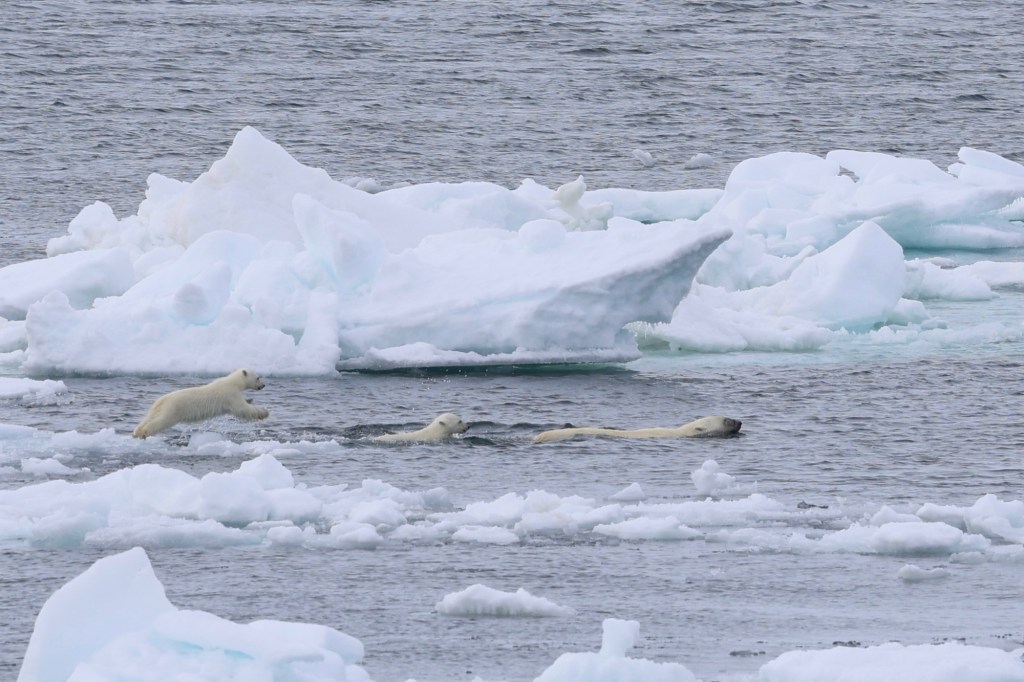
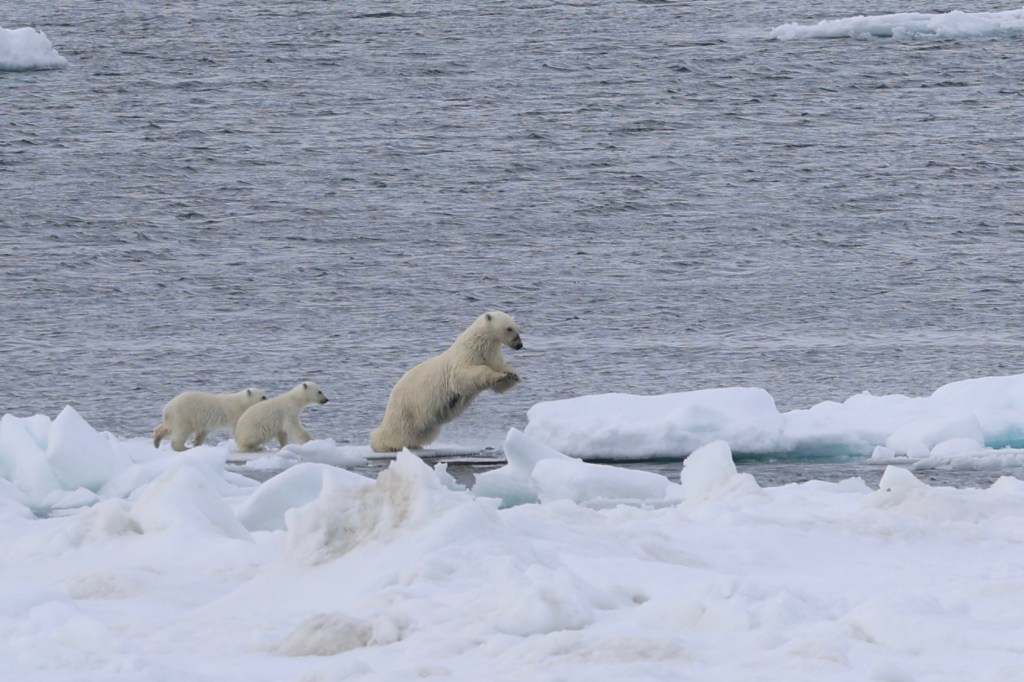
As we watched the bears trod along the ice, they would hop in the water to swim to the next ice floe. They were constantly on the move. We followed them for quite a while.

A shipmate took video through one of the telescopes on the bridge.
Swimming to the next ice floe. The little one at the end always seemed to lag behind.
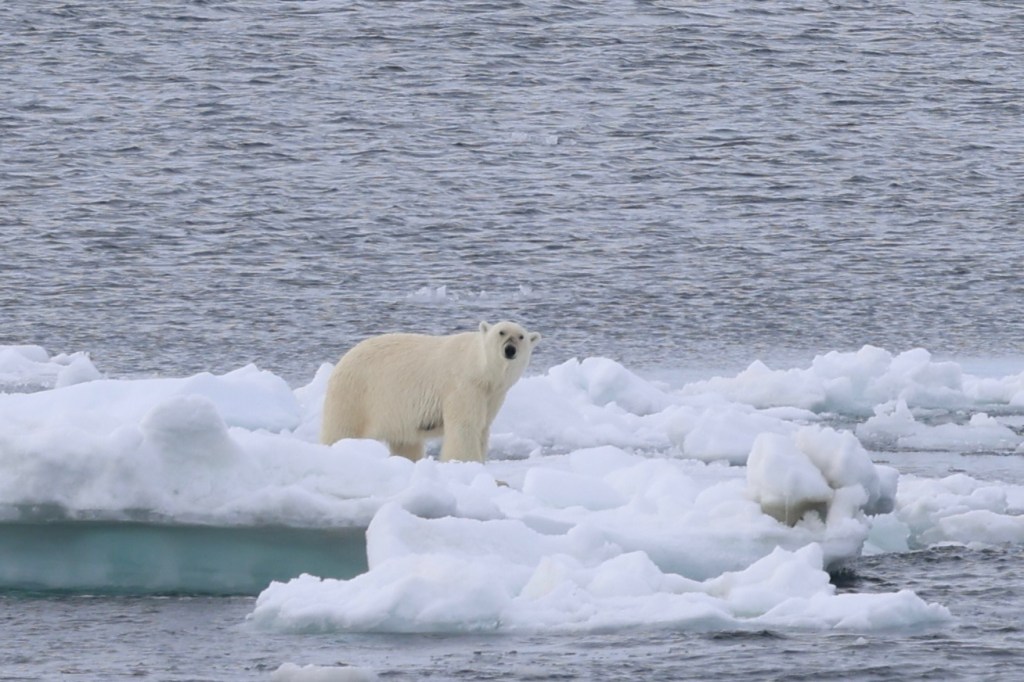
Mamá taking a look at us.
Take a look at mamas paw. They’re huge. Good for both hunting and swimming.
Mom expected the babies to keep up.
Hopping onto the next ice floe.

As we sailed away from the bears we felt in awe of nature and the beauty of these creatures. That evening we celebrated our good fortune with a polar bear party. And, we toasted to the continued good health of these magnificent animals.

Categories: Arctic, Norway, Travel | Tags: , , , , | 1 Comment

Walruses, Whales, Glaciers and Auks

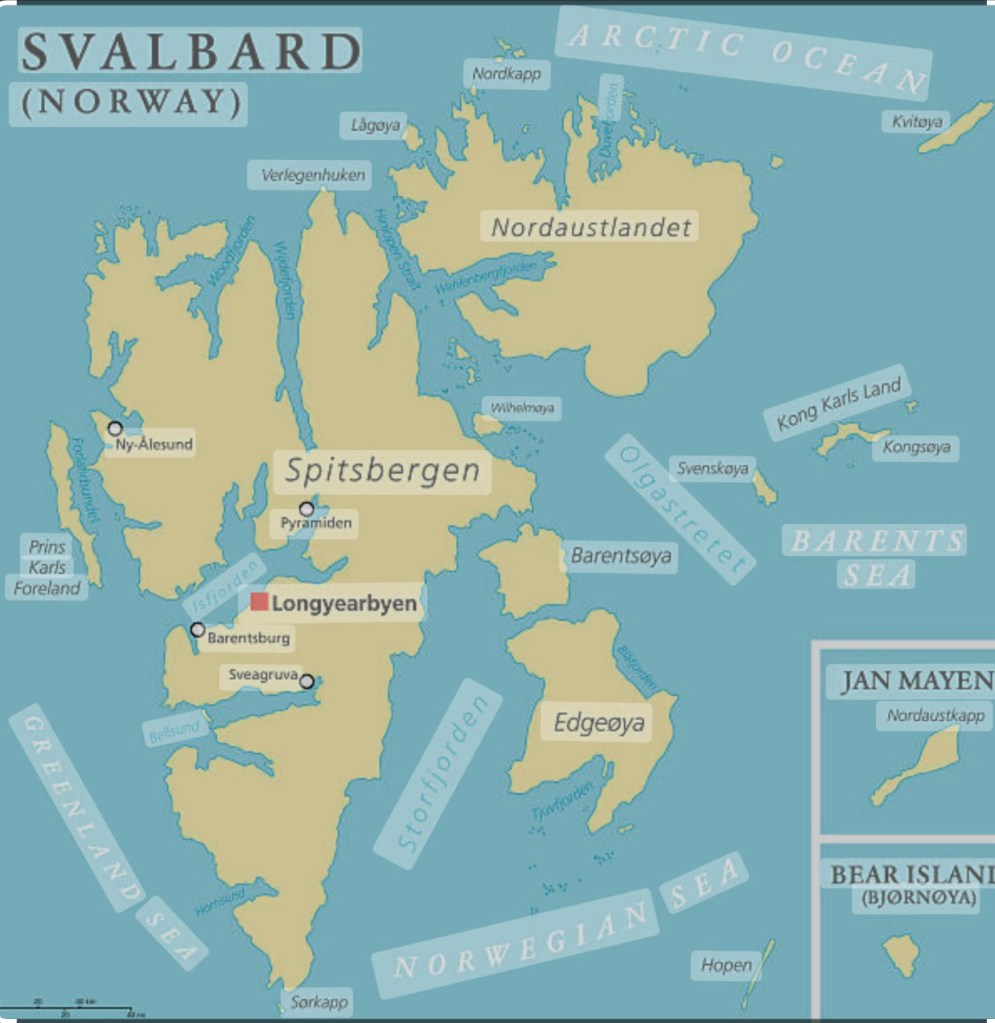
Lisa and I boarded the National Geographic Resolution on Friday. We departed from the town of Longyearbyen and started our counterclockwise circumnavigation of Spitsbergen, Svalbard’s largest island. We’ll explore the island’s fjords and bays. We’re told there is quite a bit of sea ice on the eastern side. The resolution has good icebreaking capability so it should be interesting to see that area. Sea ice is often where polar bears hang out in search of their primary prey, seals.

A map of Svalbard. We’re sailing counterclockwise around the island of Spitsbergen.

Our first day was sunny and warm — almost too warm for the heavy clothing we were wearing. By the second day the temperature had fallen and the wind came up. We know we’re in the Arctic today!

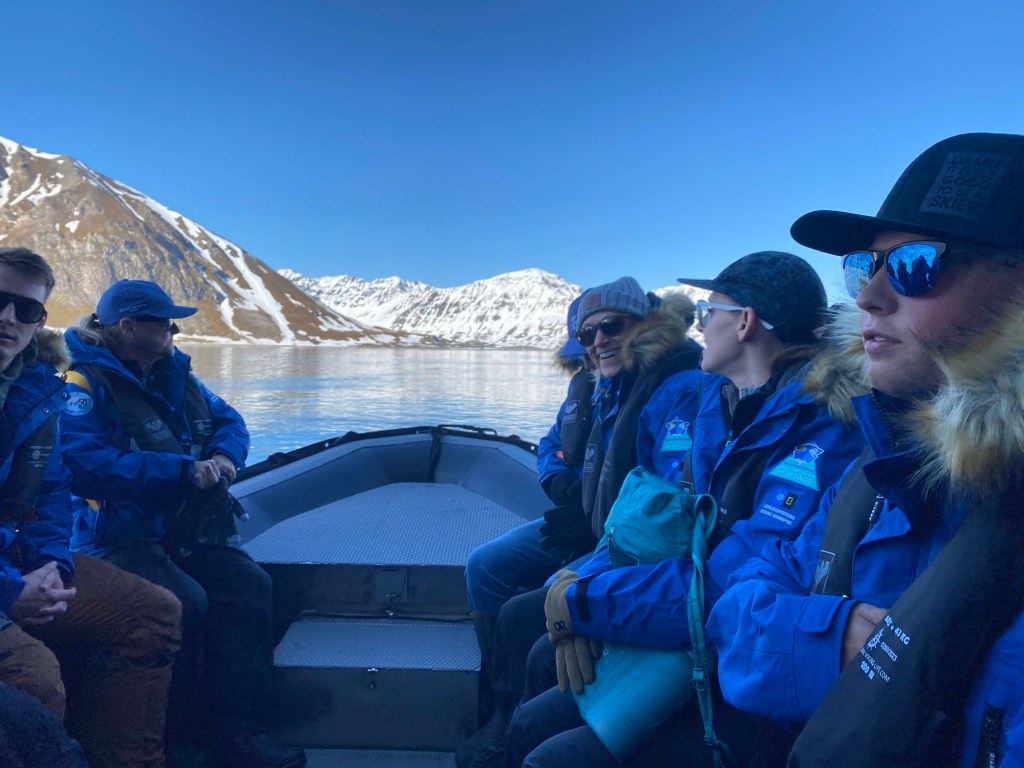
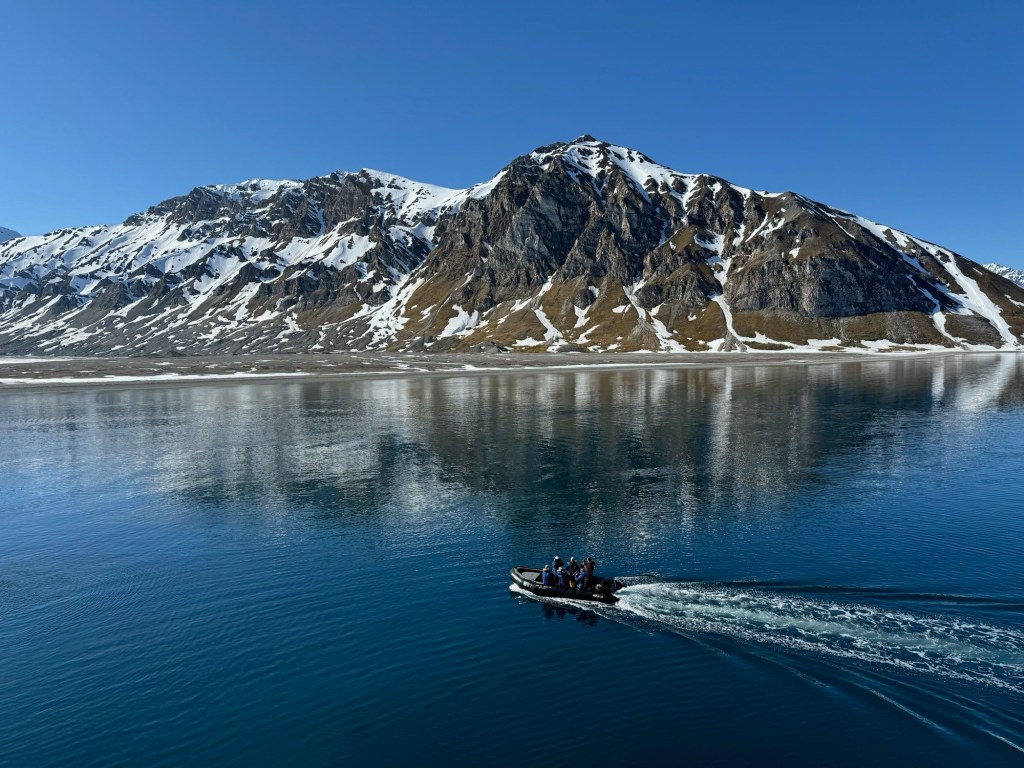
Since Svalbard is mostly uninhabited (a total population of 2500, most of them in Longyearbyen that we just left behind), there are no places to dock. So, we get to shore on Zodiacs, small inflatable motorboats.

Lisa eagerly awaiting our departure to shore by Zodiac.
The Resolution with Zodiacs coming and going.
A Zodiac heading to shore.

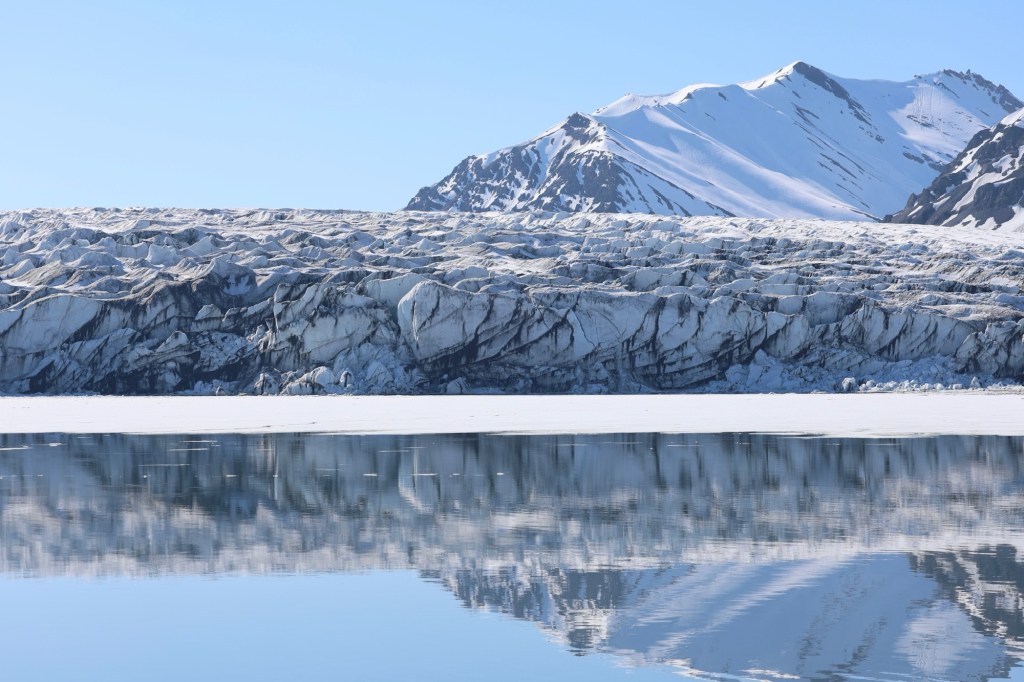
We came to shore in front of a large glacier. We had a chance to see the geologic impact the glacier has over ages. It was a beautiful site. We were shown photos of the same glacier over the past hundred years. It has receded noticeably over that period. Apparently, global warming is occurring three times faster at the poles than it is in warmer climates. Not a good omen for the retention of sea ice.

The glacier we visited on our first day at sea.

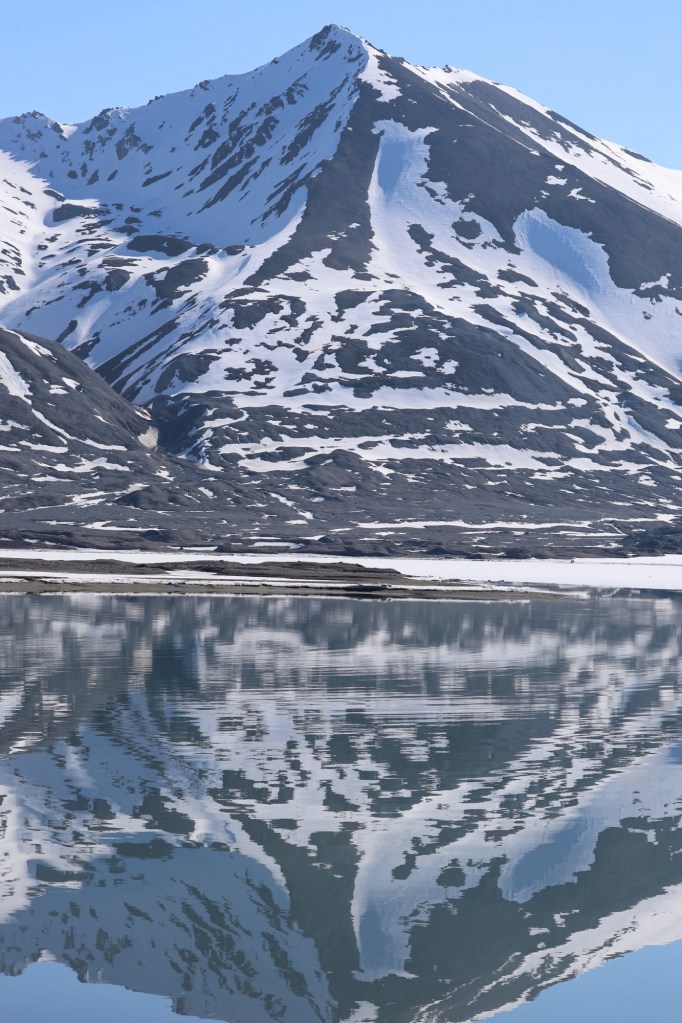
An adjacent mountain with its reflection in the water below.

Wildflowers emerging in the Arctic summer.

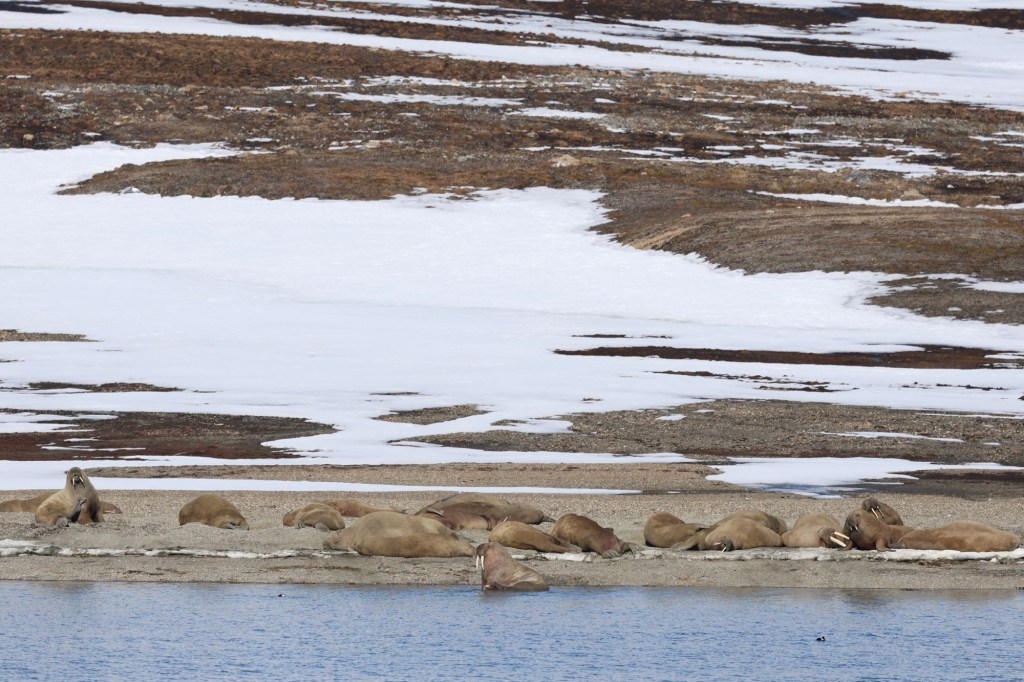
As we left the glacier and sailed back up the fjord, we came across a herd of walruses lounging on shore.

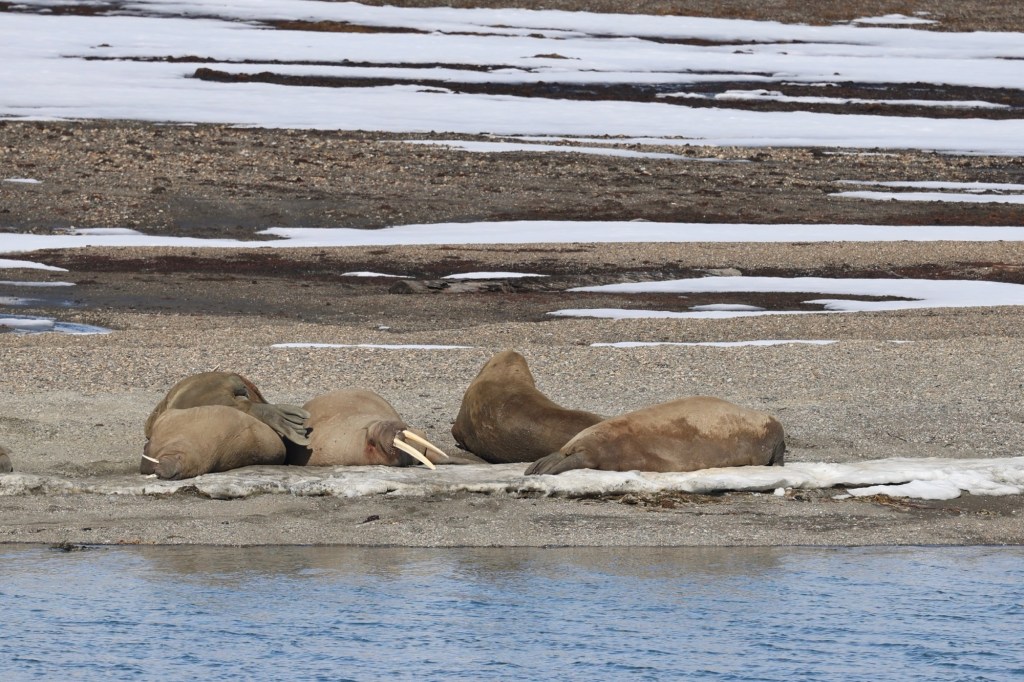
Walruses hanging at the beach.
Note the size of the tusks on the big one in the middle.

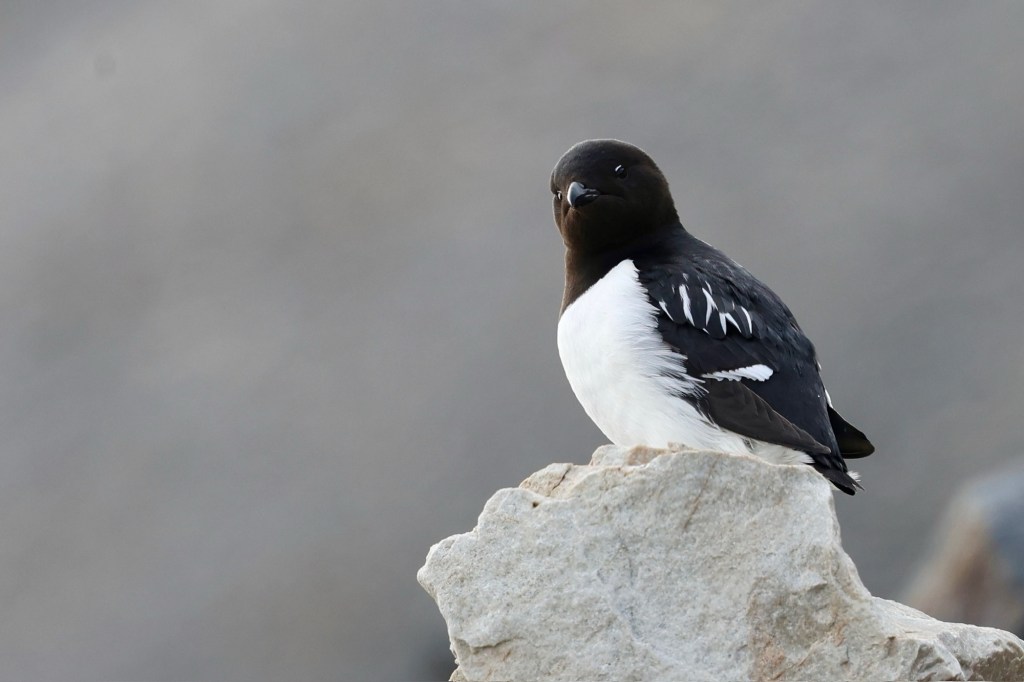
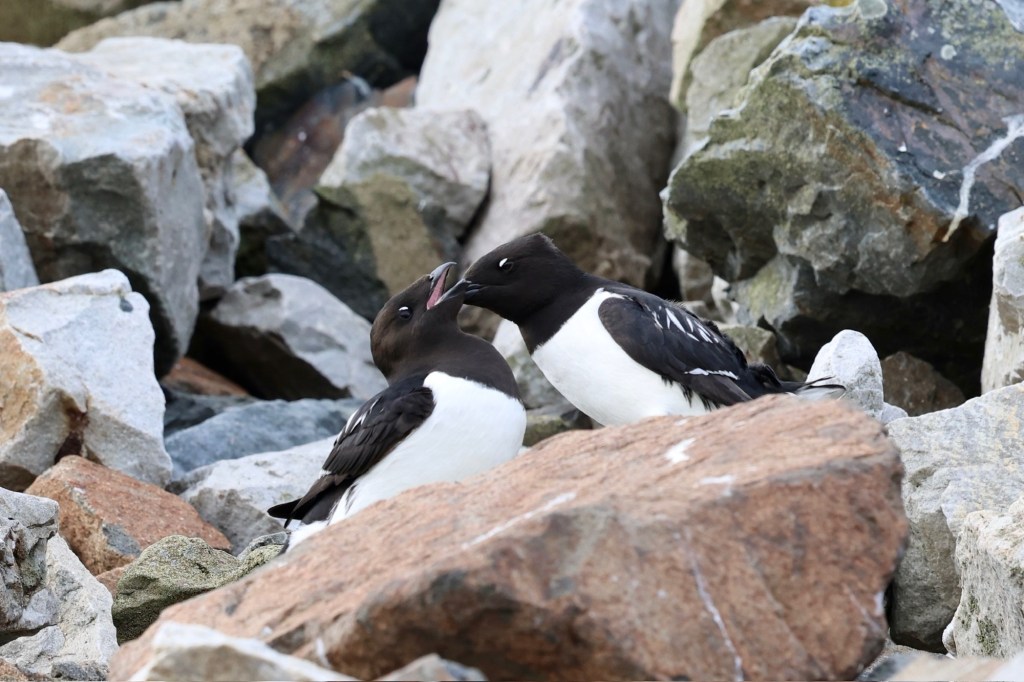
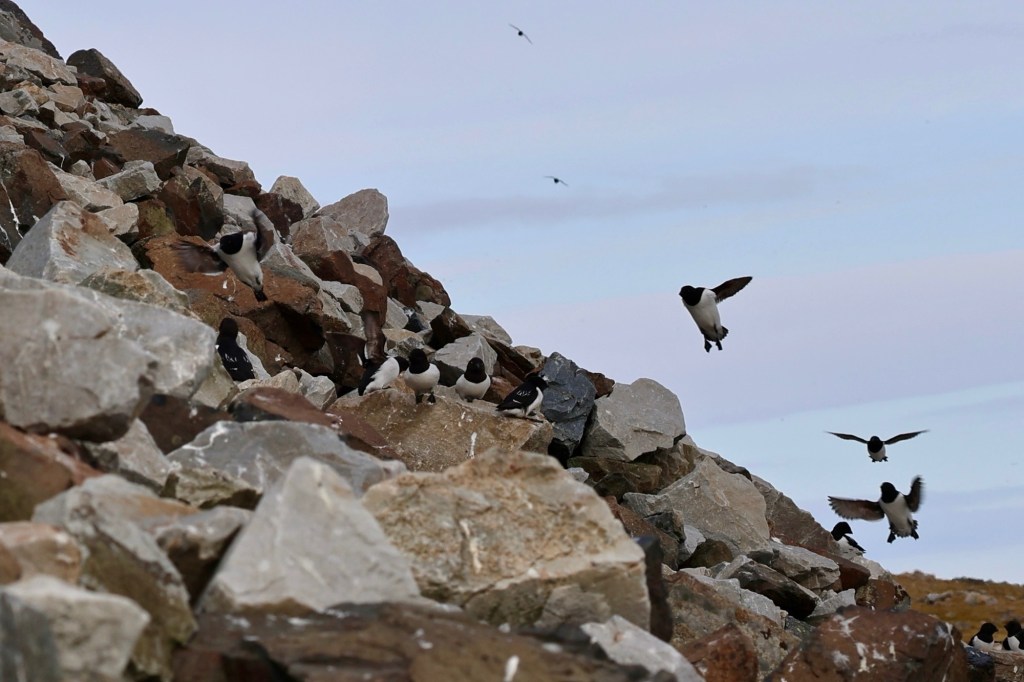
We then left for another fjord where we hiked up to see one of the world’s largest colonies of Little Auks. These small birds are cute, squatty little creatures with plump bodies (for diving for their food) and small wings. They come to Svalbard every year to mate and nest, preferring steep rocky areas. So, to see them, we, of course, climbed up a steep rocky area. As we approached, the racket of birds in courtship got very loud. Apparently, little auks are relatively silent except during their mating season when the trills and shrieks are impossible to miss.

We came upon thousands of birds on the mountainside. They didn’t seem to mind our presence. We sat and watched them for about a half hour. It was fascinating.

A Little Auk
The Courtship
And, um, success.
There were thousands of birds at this site.
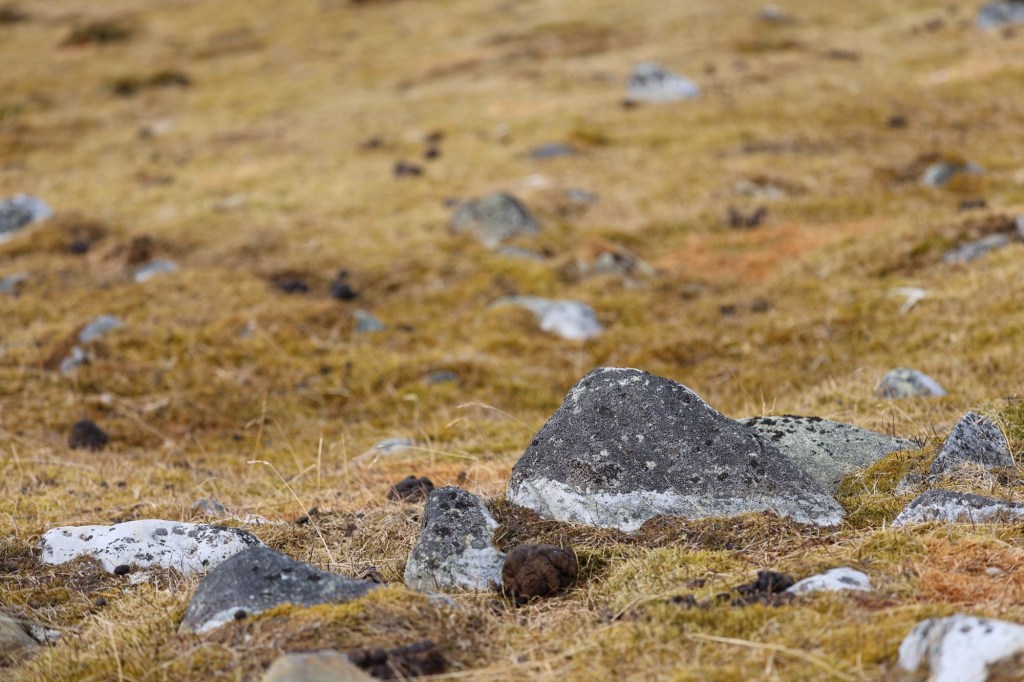
The tundra in the area was beautiful.

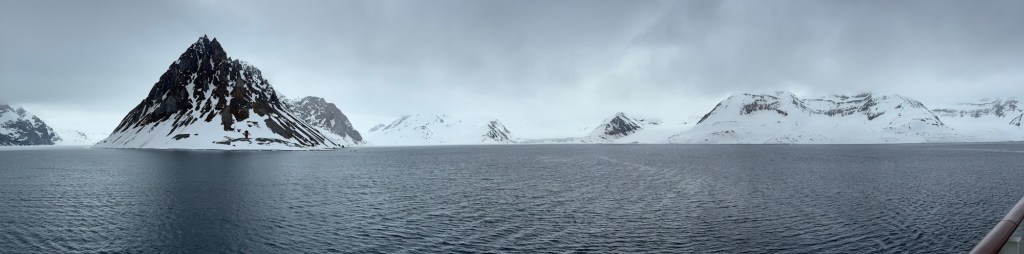
The landscape in Svalbard consists of mountains, glaciers and fjords. The views are breathtaking.

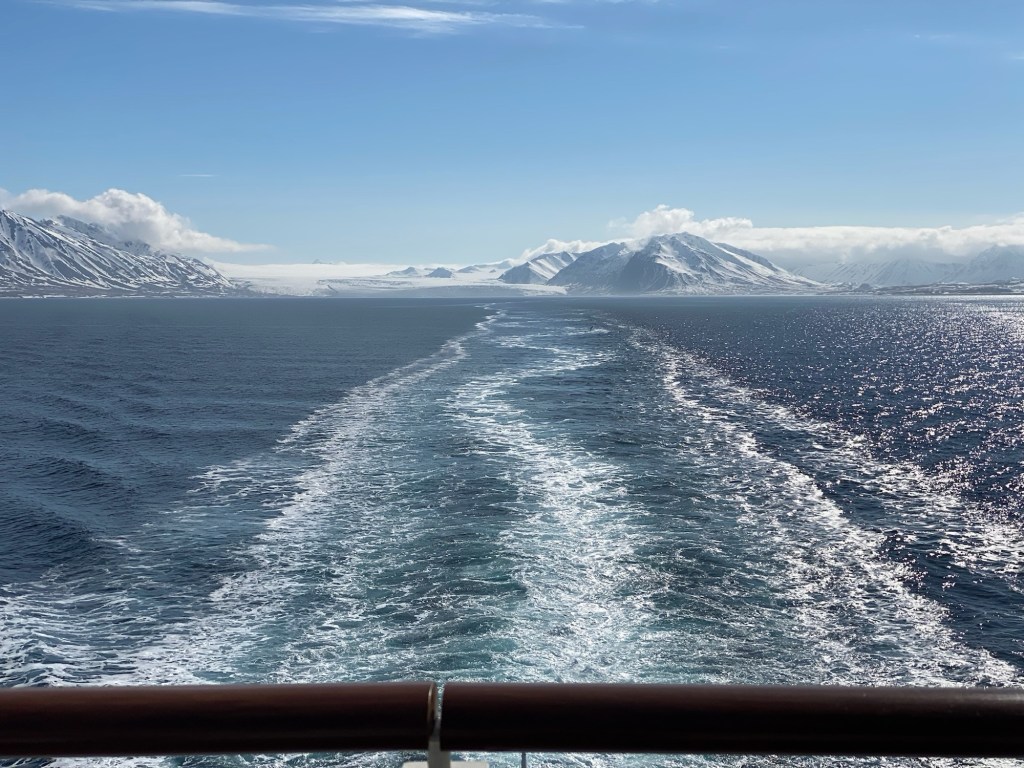
A view in the wake of our ship.
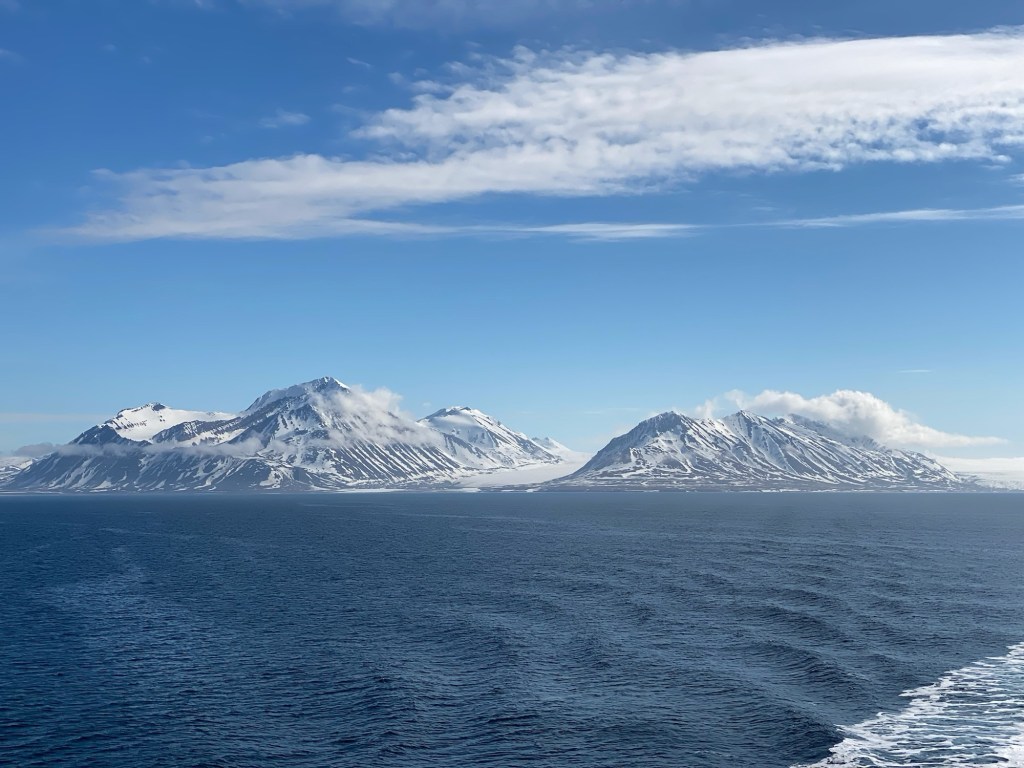
Cloud adorned mountains.
Many of the mountains are step and jagged.
A panorama of the area around that same mountain.
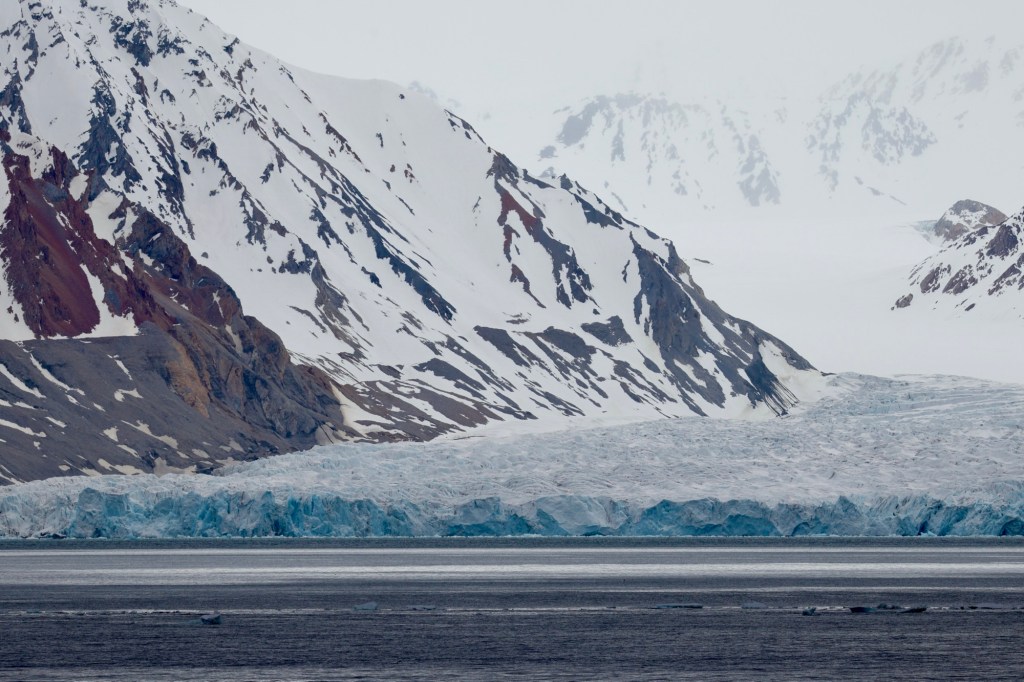
Blue ice at the terminus of a large glacier.

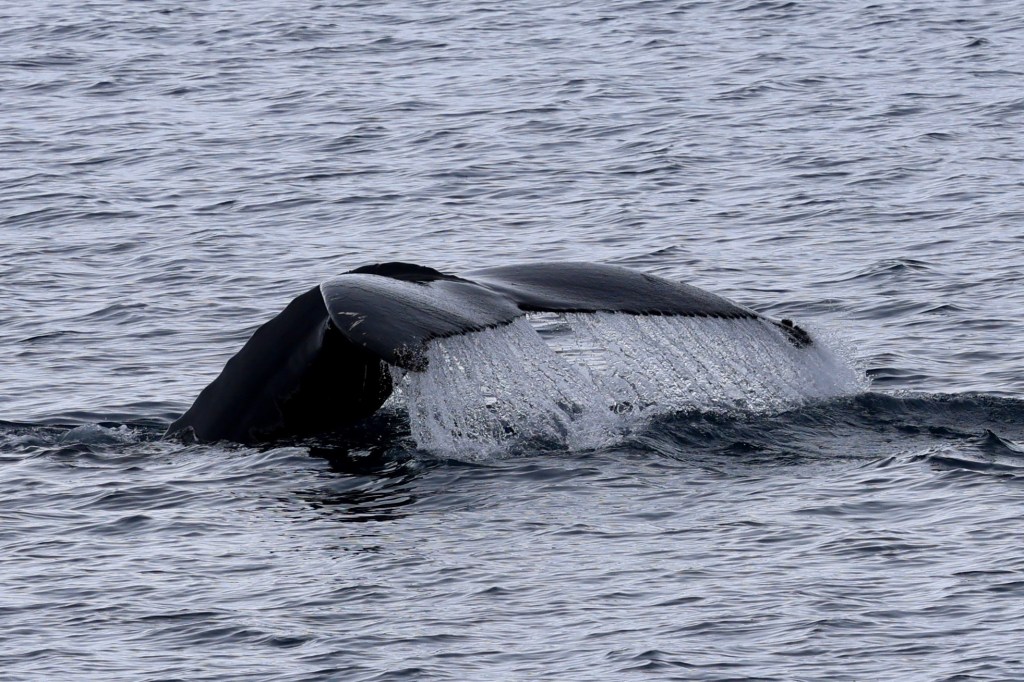
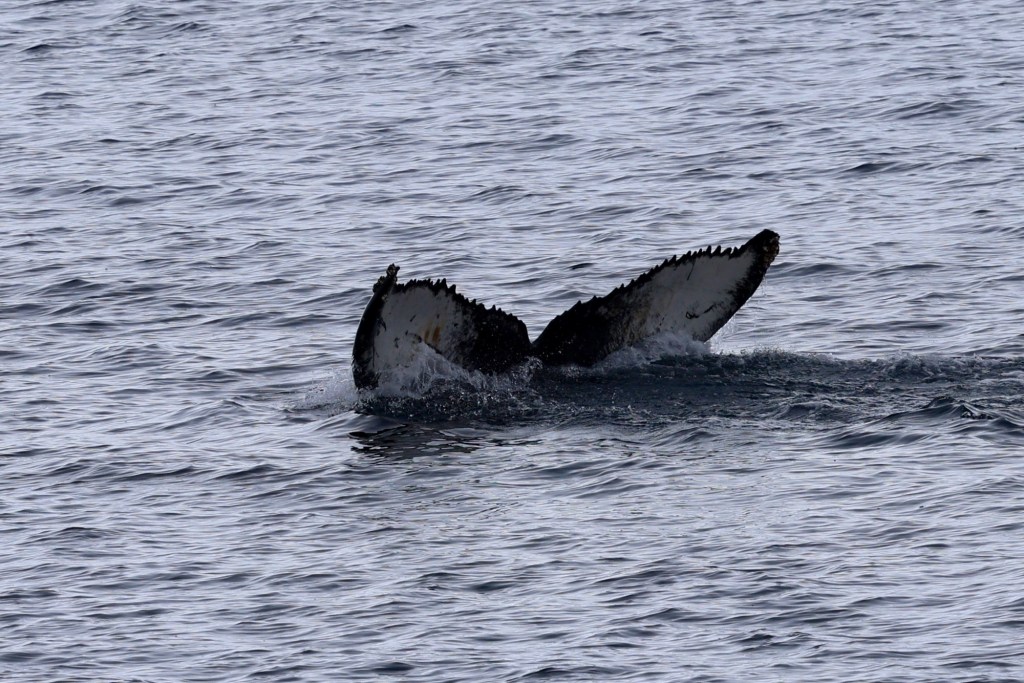
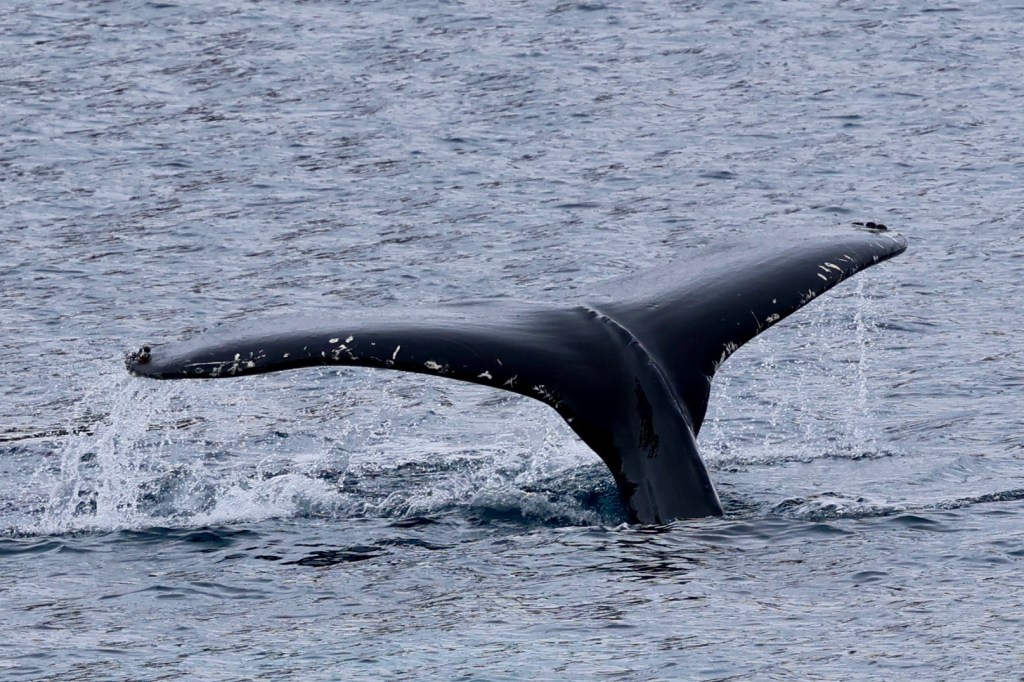
And, finally, this morning we had a chance to sail by a gray whale in one of the bays.

He came up and dove down for us several times. A beautiful animal.

We still haven’t found that elusive polar bear. We’ll hope to see one soon. When we do, you’ll be the first to know!

Categories: Arctic, Norway, Travel | Tags: , , , , , | 3 Comments

Sunset? We Don’t Need No Stinking Sunset.

We flew to Longyearbyen, Svalbard from Oslo today. The three hour flight took us north of the 78th parallel. Because the Earth tilts on its axis, days are longer the farther north one travels in the summer. It is the exact opposite in the winter. Days get shorter as you approach the winter solstice. I’m a geography geek so I began to ponder this concept (much to Lisa’s dismay).

Think about it this way: The equator is at 0 degrees latitude. The North Pole on the other extreme is at 90 degrees. Hawaii, in the tropics, is at 20 degrees latitude, San Francisco at 38 degrees, New York City and Boulder, Colorado are at 40 degrees.

We started this trip in Copenhagen. It is way up north at 56 degrees latitude. Oslo, where we spent the past two days is even farther north — 60 degrees.

The days at the equator are always the same. Exactly 12 hours of daylight and 12 hours of darkness. Hawaii days vary, but very little from winter to summer. Most of us live in 35 to 40 degree latitudes and we’re all familiar with those long summer days and the very early darkness in winter. Norway, on the other hand is known as the Land of the Midnight Sun in the summer and sees the sun set not long after noon in the winter.

Well, here in Svalbard, we will not see a sun set the entire week we are here. The sun will simply circle overhead, never even approaching the horizon. No Northern Lights for us. Our grandson Max asked us how we will know when to go to bed. I told him, “I have no idea.” I write this at 10 pm with the sun blazing overhead. Lisa and I are forcing ourselves to sleep.

The view from our deck at 9:30 PM. The sun will get no lower than this. It will simply circle around the sky.

Conversely, the sun will not rise at all in December. Darkness all day for days on end.

The Arctic Circle is defined by the point farthest south where there is at least one day where the sun does not set in the summer and does not rise in the winter. The Arctic Circle is at 66.34 degrees latitude. So, with Svalbard being so deep beyond the Arctic Circle it will experience many days with no sunset. Kinda cool. Kinda strange.

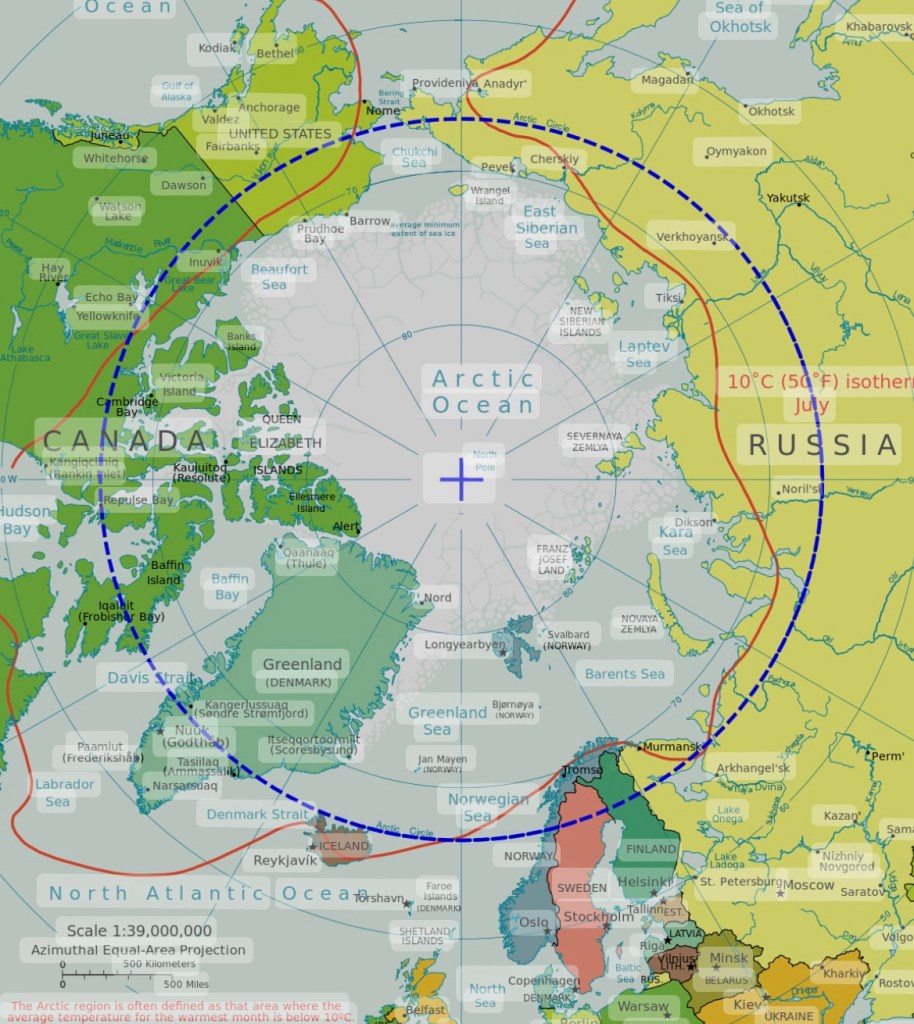
Svalbard is just south of the North Pole near the 80th parallel.

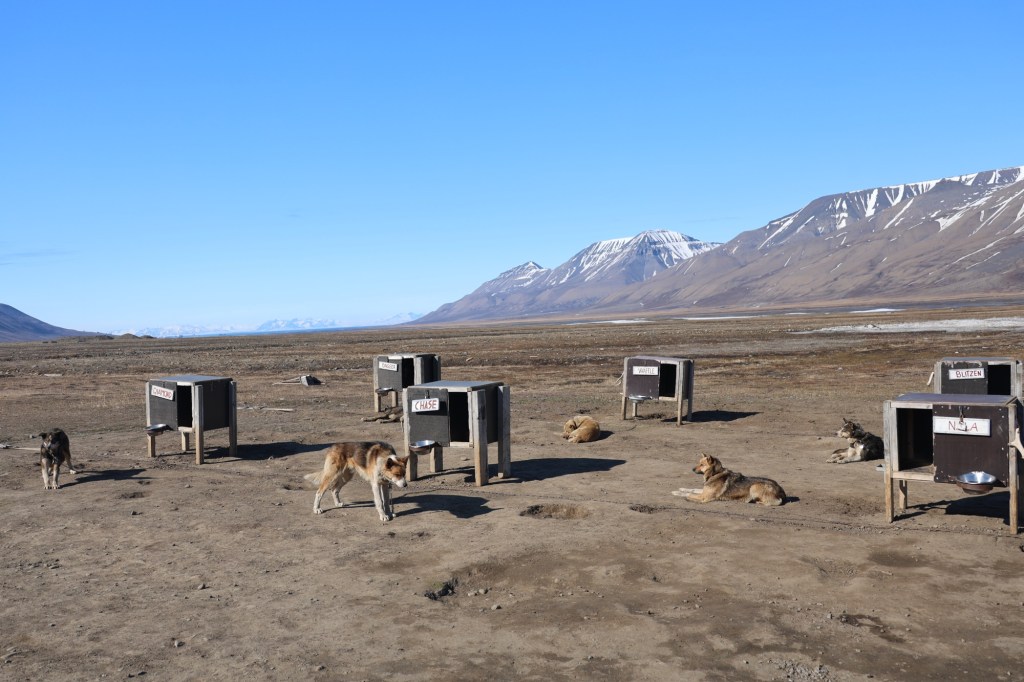
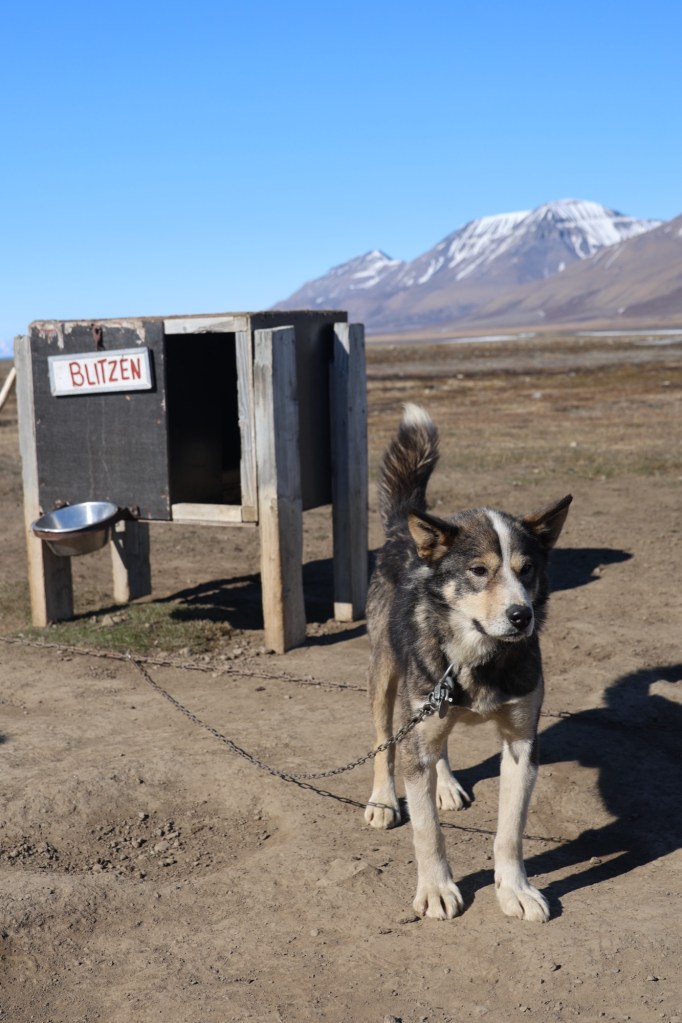
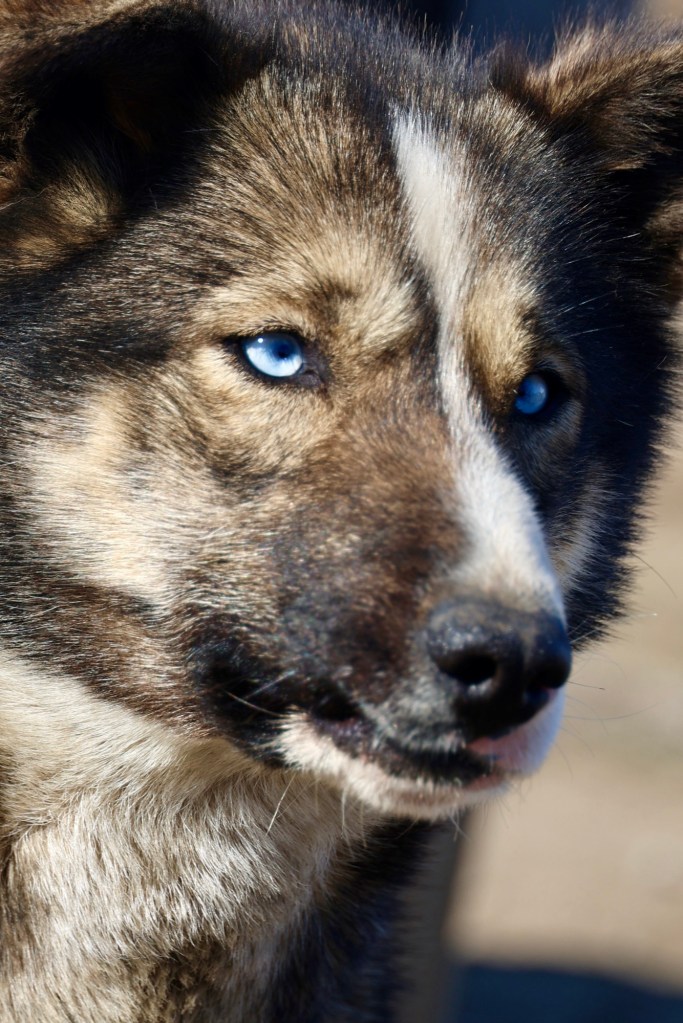
Anyway, we boarded the National Geographic Resolution, a new ship equipped with icebreaking capability and luxury accommodations. First, however, we spent a little time with husky dogs, the ones who pull the dog sleds around here. The weather was an unusually balmy 43 degrees. Very fun.

The dogs are out sunning themselves on this beautiful summer day.
Blitzen
Diamond

More to come as we embark on our search for polar bears, walruses, and arctic foxes. But first, we have to figure out how to go to sleep with the sun shining through our curtains all night long!

Categories: Arctic, Denmark, Norway, Scandinavia, Travel | Tags: , , , , | Leave a comment

Copenhagen: The Land of Almost Nearly Perfect People

We have never been to any of the Scandinavian countries. We decided, by seeing other people’s photos, watching the show the “Bear” that featured Copenhagen, and knowing that we enjoy good food and wine, that Copenhagen was top on our list.  My friend, Joan Stucka, sent me a book by Michael Booth about Scandinavia entitled “The Almost Nearly Perfect People” and it certainly had us intrigued.  Denmark has been named the Happiest Place in the World. Oprah even came to visit and agreed that the Danes were surely the world’s happiest. We were ready to go to Copenhagen and share in some of this happiness for 72 hours.

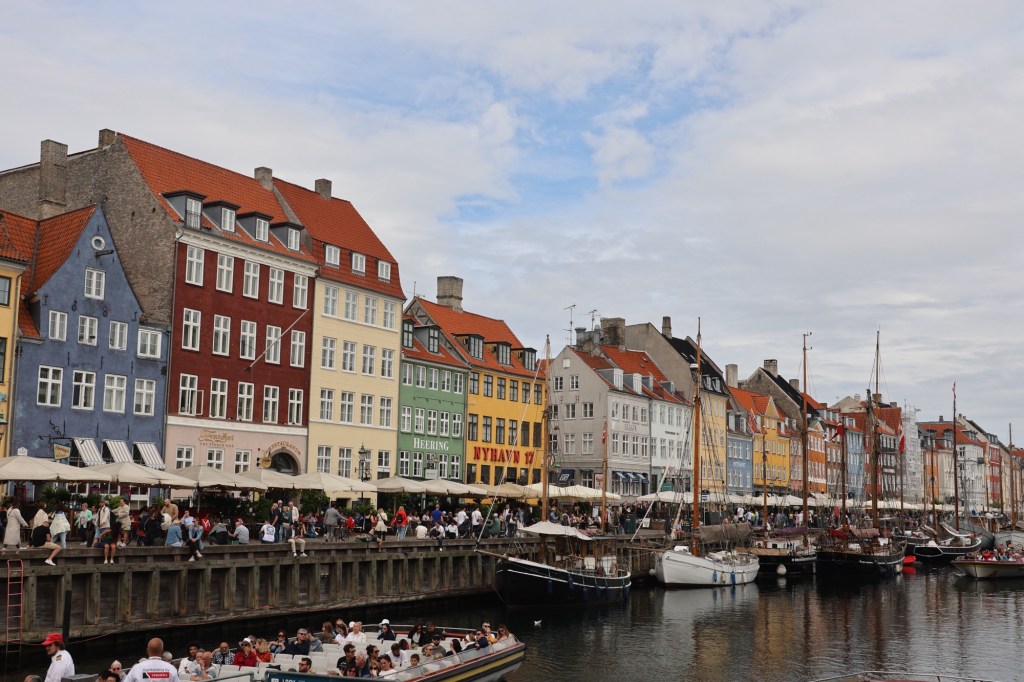
Although the weighty job of judging world-beating happiness in just three days is impossible, I will say the city is extremely vibrant, young, clean, and just plain contagious.  We arrived on a beautiful, warm sunny Sunday afternoon and the place was bursting with people enjoying the sunshine.  The famous canals and waterways were packed full of boats. People were swimming and sunning themselves.  Every café was filled to the brim along Nyhavn, a popular street full of colorful buildings and a variety of restaurants.  Jet lag was no longer a possibility with all of this energy around us.  We walked the famous shopping area, The Stroget and began to enjoy the vibrancy of Copenhagen.

Nyhaven Street. A historic area full of open air restaurants, colorful buildings, and old sailing vessels.
A beautiful day on the canals — pleasure craft on the water, cyclists on the bridge, and sunbathers on the shore.

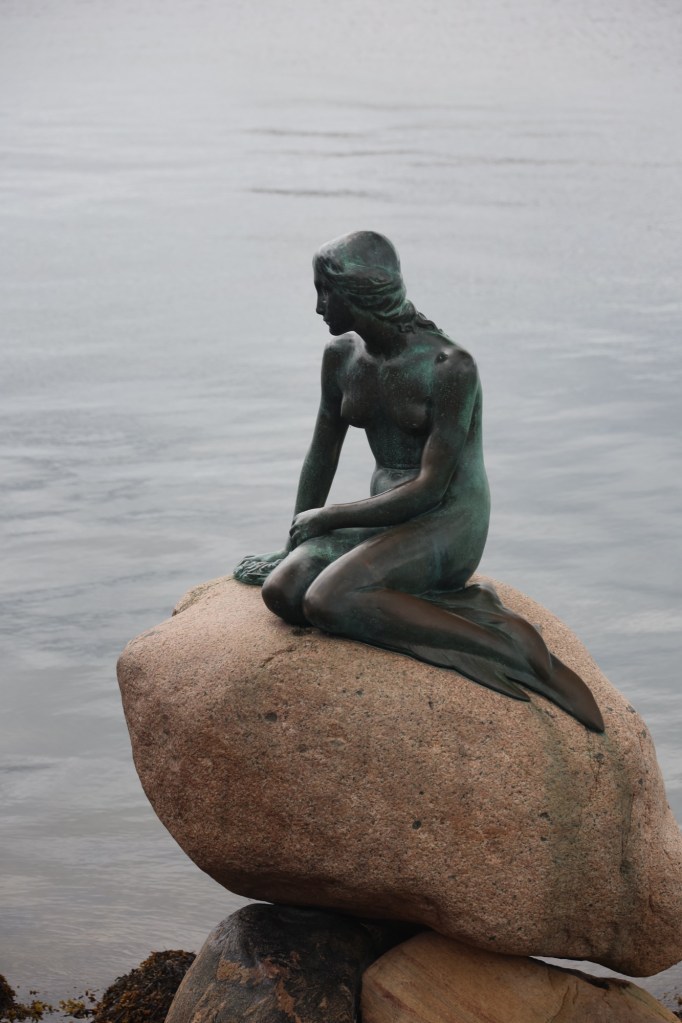
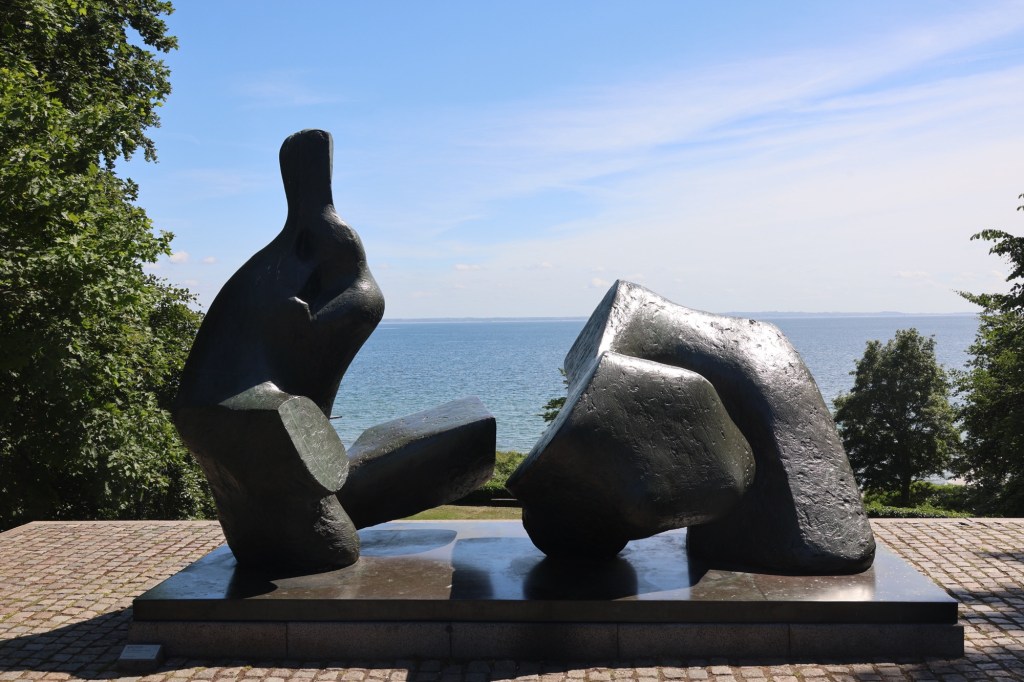
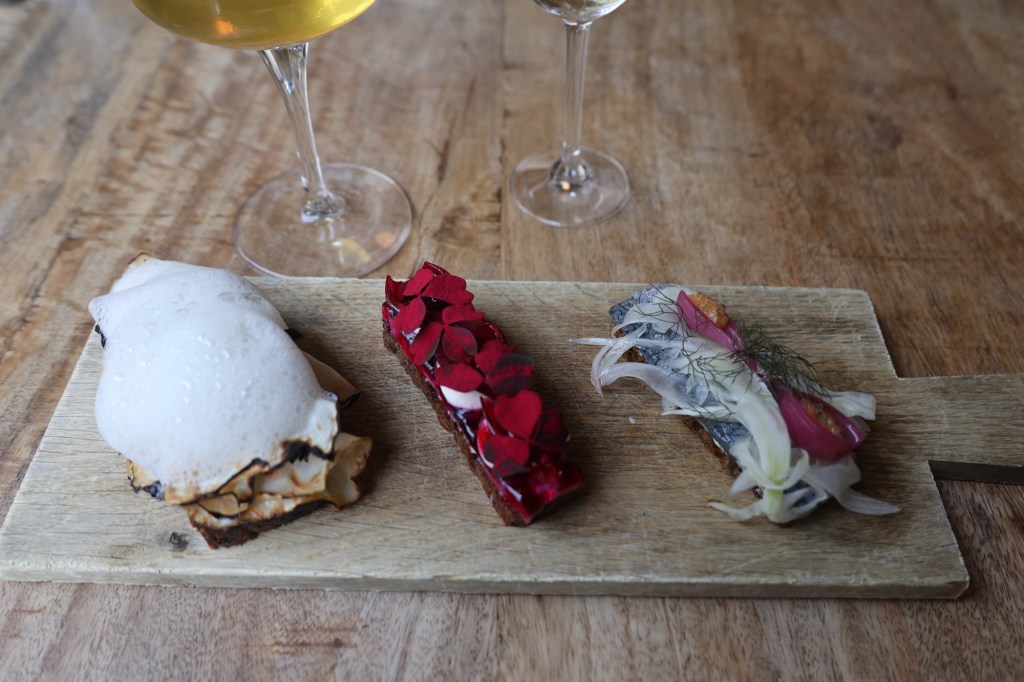
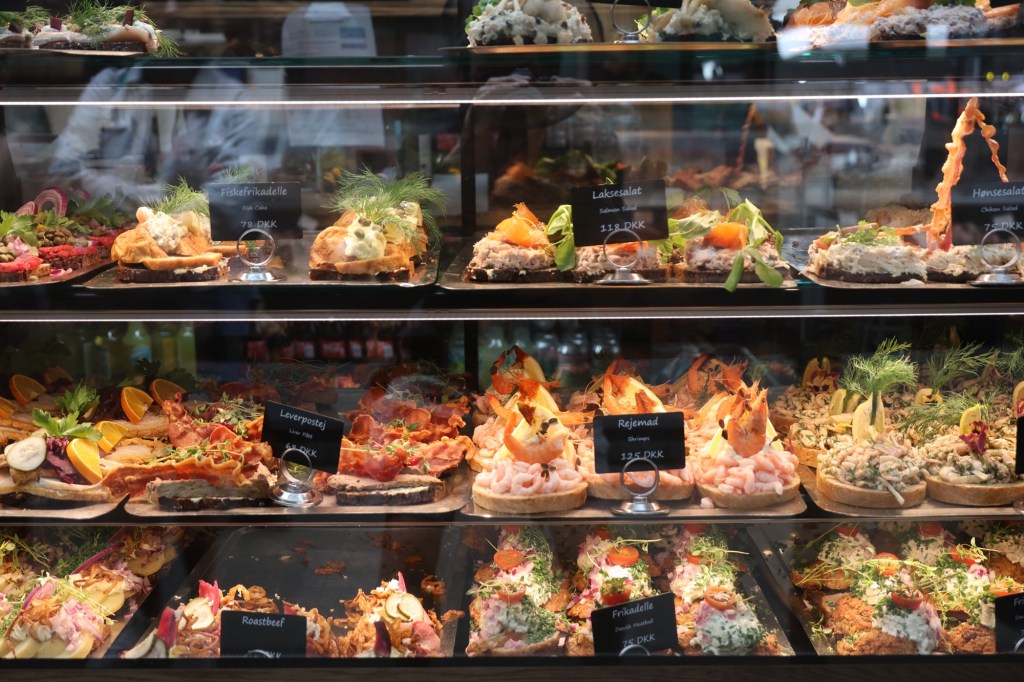
In the following three days, we learned a lot about Copenhagen’s history through a wonderful Old Town city and food tour and a boat trip out on the canals and waterways.  We took to the streets on our bikes and worked our way to the famed Little Mermaid statue (Copenhagen was the home of Hans Christian Anderson), and saw the current palace of the monarchy.  We figured out the subway and train system and went out to the Lousiana Art Museum in Humlebaek (Thanks to our friend Shelley Freeman who gave us the recommendation). We ate lots of open-faced sandwiches (smorrebrod) and dined on outstanding Danish-inspired French Cuisine.

The famous Little Mermaid statue. Hans Cristian Andersen, who wrote the fairy tale, was from Copenhagen.
A sculpture from the Louisiana Art Museum about 30 miles north of Copenhagen. We could see Sweden across the strait.
An upscale, modern take on smorrebrod, the traditional open-faced sandwiches of Denmark. These featured herring, beets, and cheese foam. All were delicious.
A more traditional display of smorrebrod.

After pondering the question of happiness, talking to as many people as we could and reading Michael Booth’s book, here is what we came up with:

— The Danish people seem to be a very content group.  The live in a society that values income equality.  There are very few people at the top or at the bottom of the income spectrum.  They have free quality education and health care and take good care of their senior citizens and their pre-schoolers.

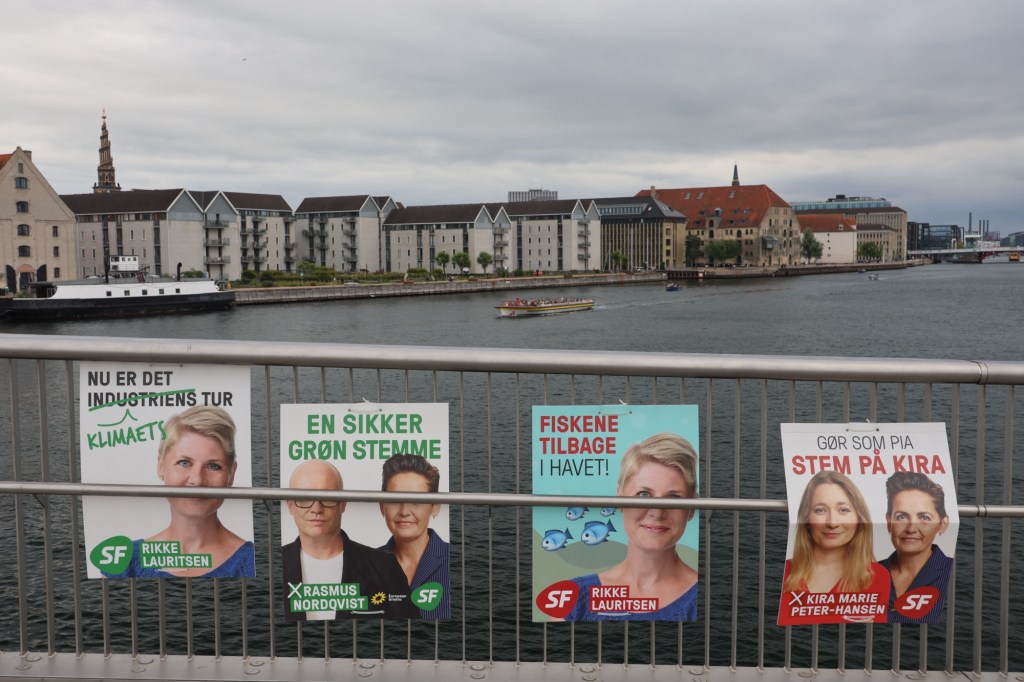
— The Danes trust each other and their politicians.  We were there during a run-up to an election and there must have been about ten different political groups represented.  Apparently, they get together as a coalition and represent the wills of the people so there is little divisiveness between parties.  They certainly are not envious of America’s current situation.

There were posters all over the city for the upcoming election to represent Denmark in the European Parliament.

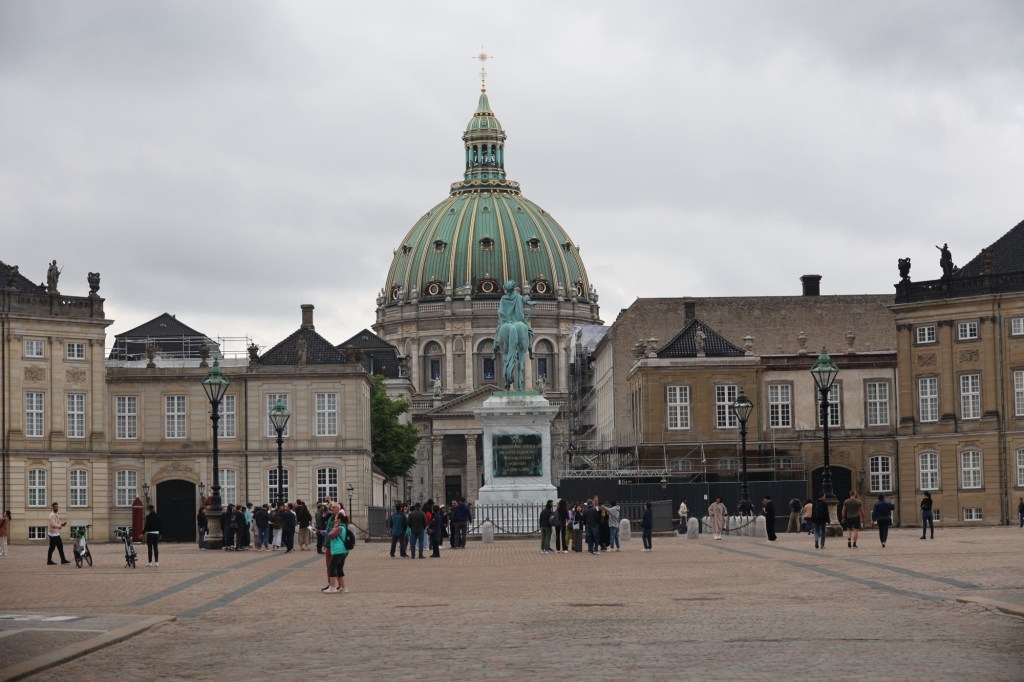
— The Danes love their Royal Family.  They feel that they are one of them and they are often seen in public (The King even sponsors – and runs in – a half marathon).  Their children even go to public schools. The Danish Queen, Queen Margrethe abdicated her throne in January of 2024 to let her son Frederik become King; an act that astonished the people because she was so beloved.  King Frederik is known to be a man of the people and even met his wife Mary at a bar in Australia rather than some arranged affair.

The Amalienborg Palace, the royal residence.
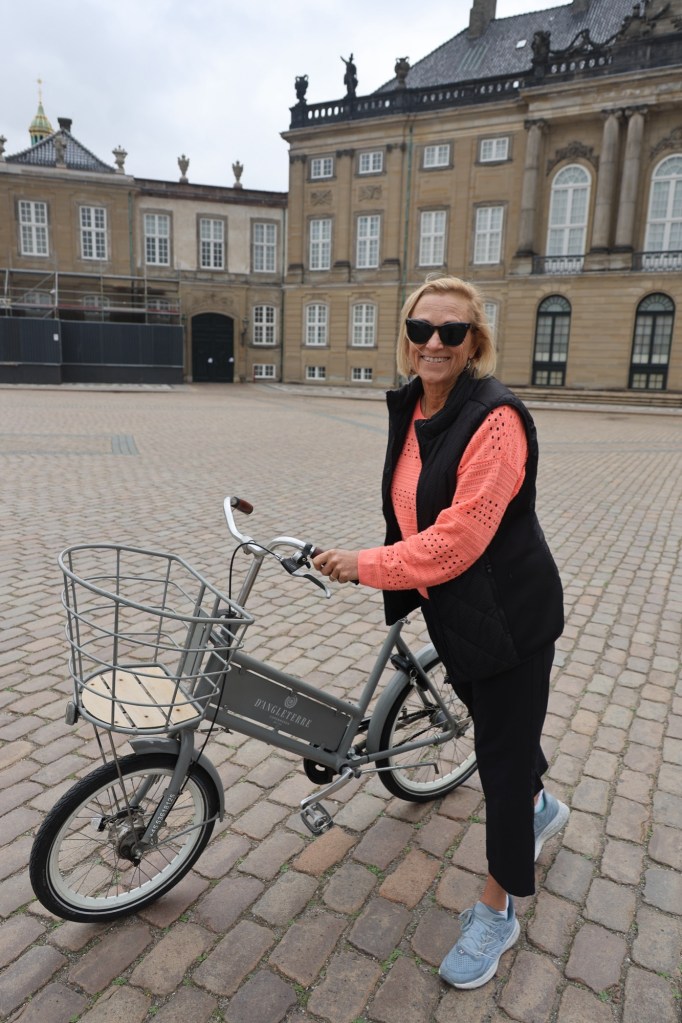
We rode our bikes over to the palace.

— The Danes pay a lot of money in taxes — up to 72%.  That means they work until Thursday before they earn their own money.  Amazingly, they seem to do it without complaining because it helps give them all a high standard of living.  90% of Danes can be considered middle class.  And, no one can cheat and pay less on their taxes like in other countries.

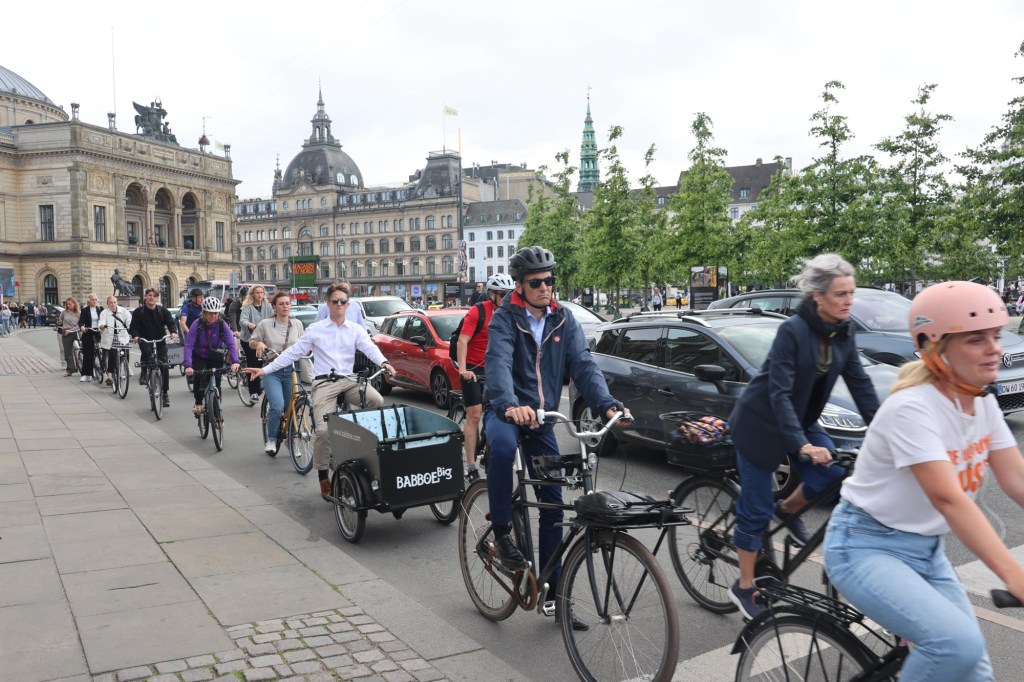
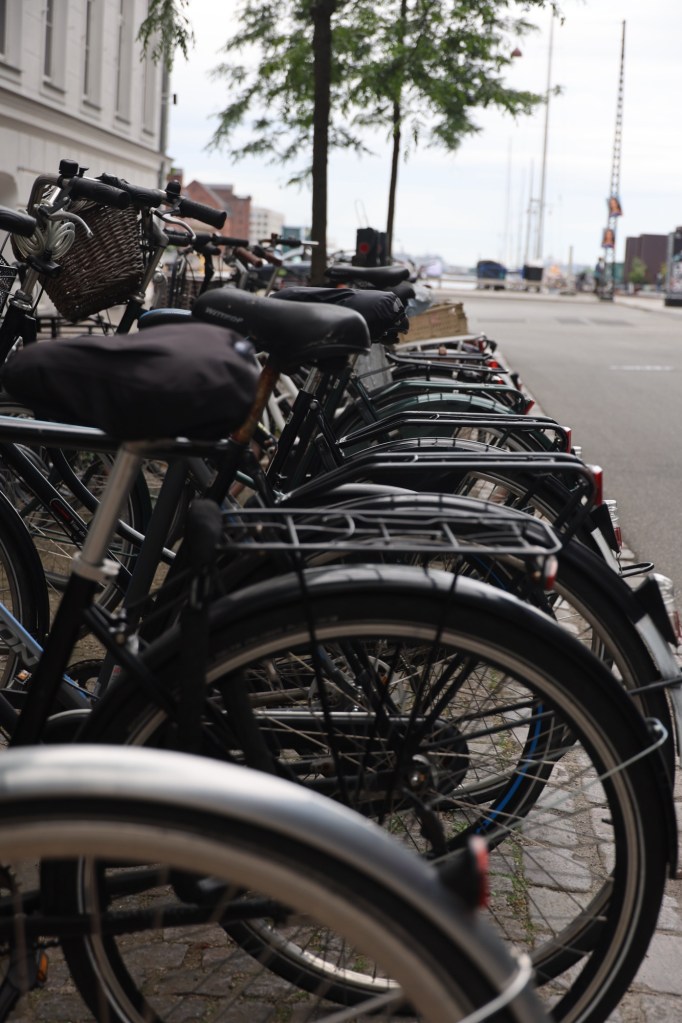
— The Danes love their bicycles. The streets are full of hundreds of bikes at all times!  60% of Copenhagen people ride their bikes to and from work.  There are a couple of reasons for that statistic.  There are bike lanes everywhere so it makes cyclists safer on the roads.  But most likely the main reason is that cars are taxed at 100% so owning a car is a very expensive proposition.

There are more bikes than cars on the road.
There are many of these contraptions out and about. Moms and Dads taking their kids along.
Entire parking lots of bikes were everywhere.

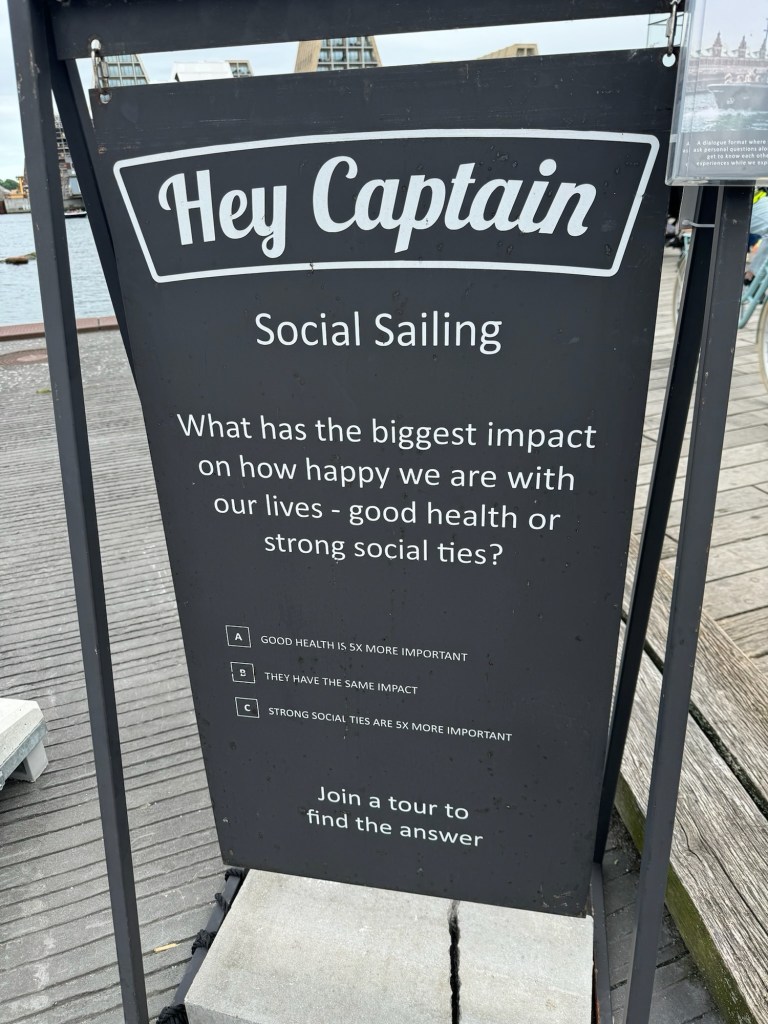
— Danes are very social and love being involved in clubs and groups of all kinds.  We saw many running clubs while we were walking around the city.  Apparently there are clubs for everyone and every interest.  The saying is that a Dane will go to a party and within eight minutes figure out three degrees of separation with everyone at the gathering.  Forget Kevin Bacon’s six degrees of separation.  They only need three!  Our boat tour was called a social sailing trip with the main objective of getting to know each other and share in experiences rather than simply hearing a lecture about history.
I think the answer is B but our captain says it’s C.
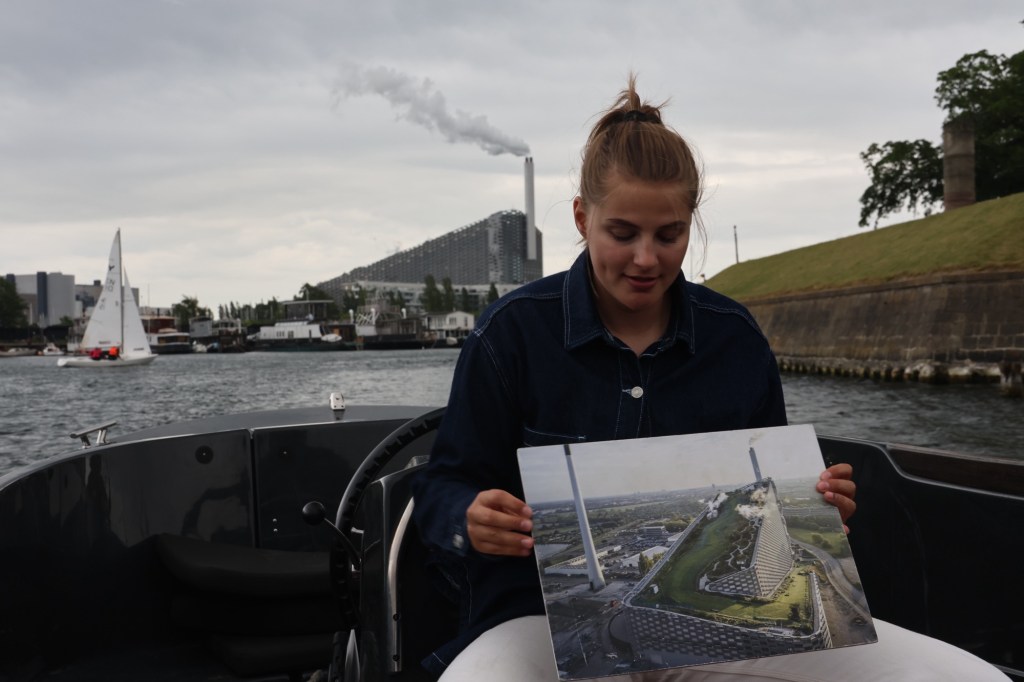
Our captain showing us the ski slope built into the recycling plant seen in the background.

— Recycling, electric cars, and environmental measures are very important to the Danes.  We saw nearly as many electric cars as gas-powered ones and the government is very proactive when it comes to the environment.  Their trains and subways are clean and efficient and a very popular way to commute.

— Sadly, they smoke a lot and they smoke at restaurants outdoors.  Our one big complaint. Apparently the Danish tobacco industry has a grip on its population.

— Their language is impossible to translate for Americans but everyone speaks English so it is easy to get information.  They have added three extra letters to their alphabet to make it even more confusing.

OK, we know what you’re thinking. But, this translates to “Your Speed.”

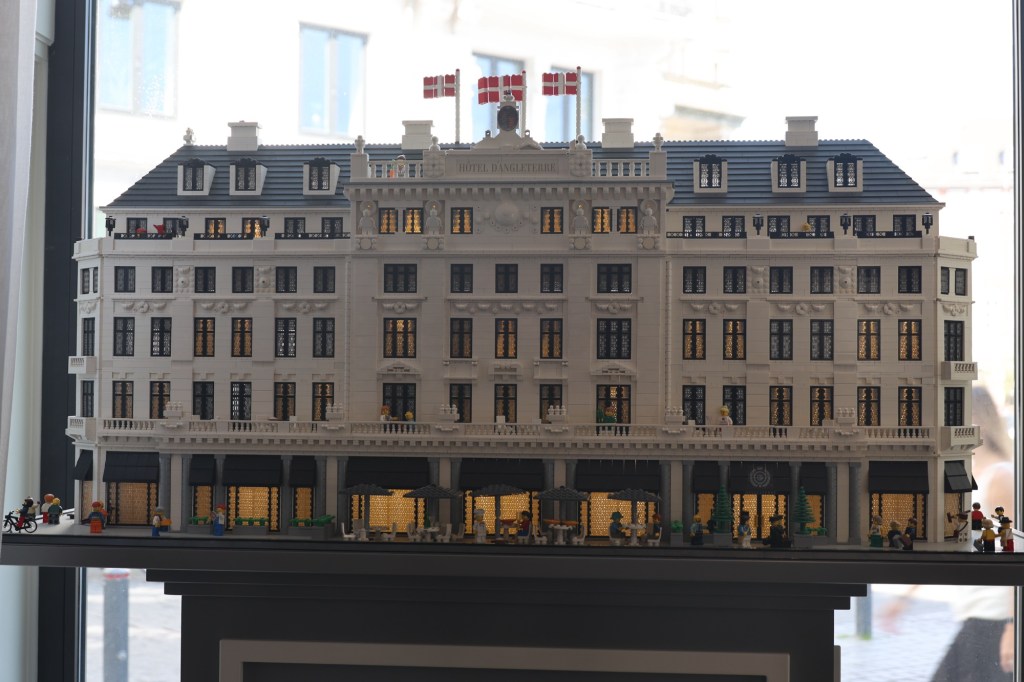
— If you are into Legos, the company started in Denmark in 1932. The word lego means, play well. They have the original Legoland about three hours out of the city! Our hotel had a replica in their lobby made completely out of Legos.
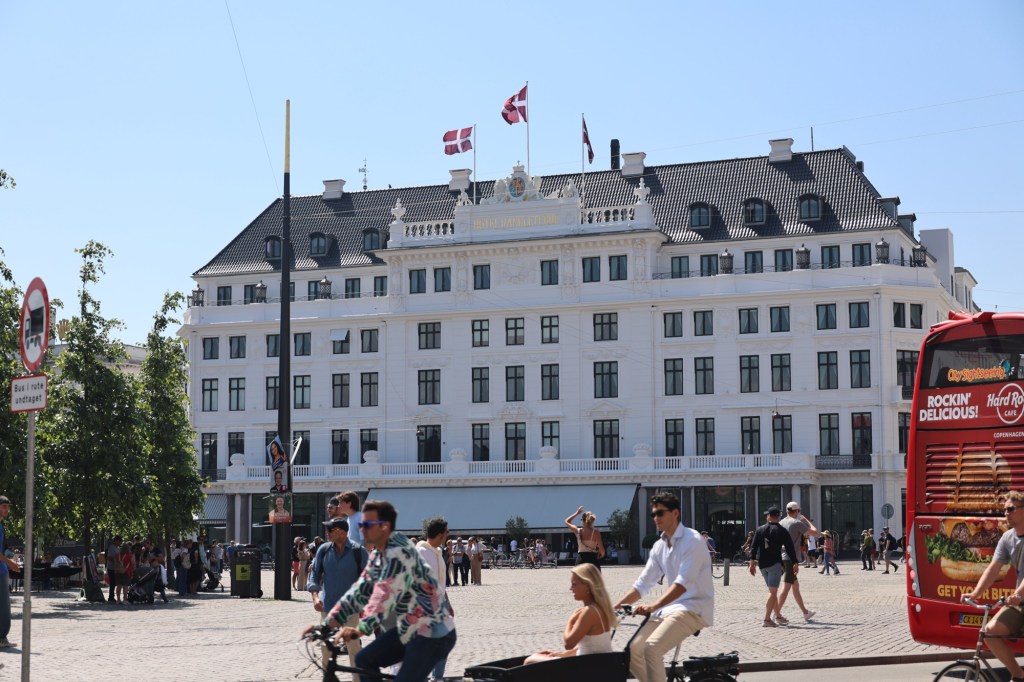
Our hotel, the Hotel D’Angleterre
It’s Lego replica in the lobby.

Copenhagen ended up on the very top of our list of favorite places to visit.  The city is walkable and bikeable, the people are vibrant, and there are no safety concerns, and it is a culinary paradise. We loved our 72 hours in this beautiful country.

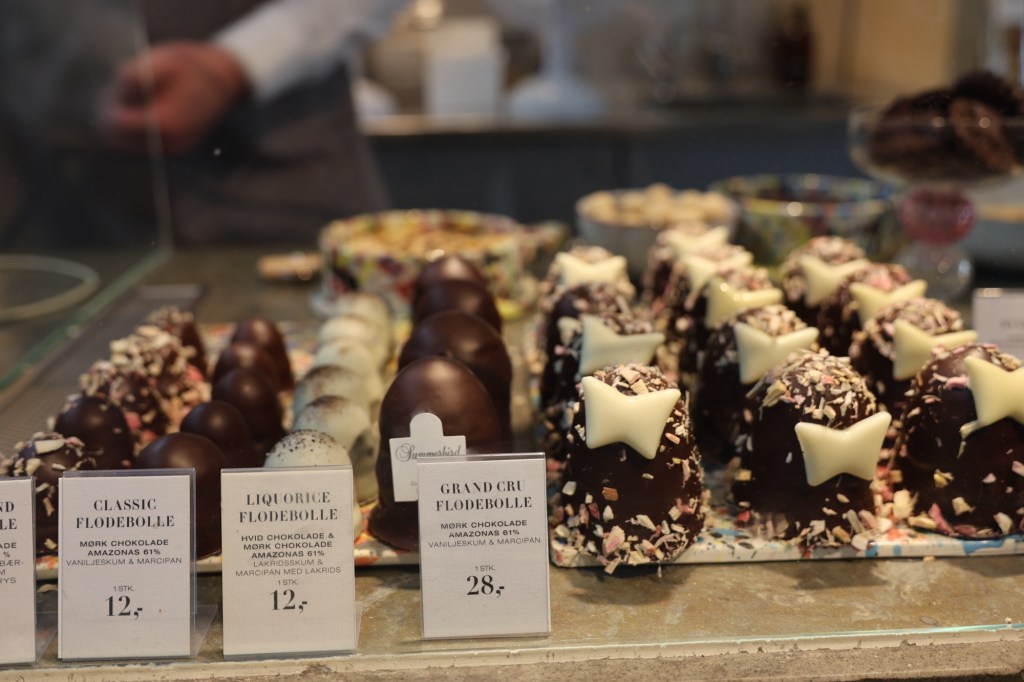
Chocolate is readily available.
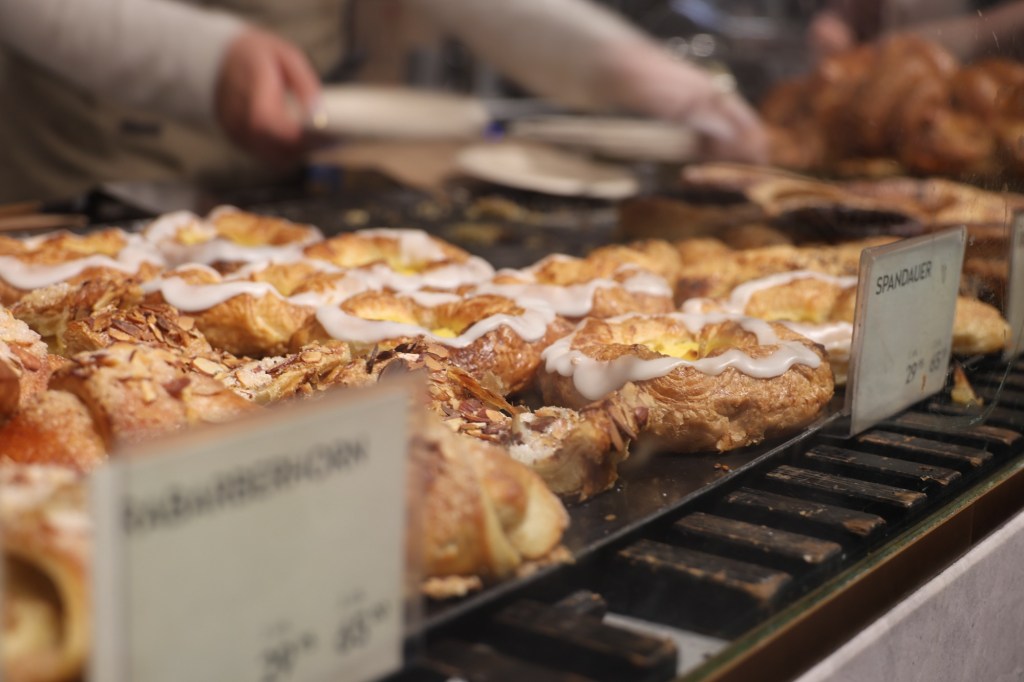
Another source of happiness in Denmark — the danish.
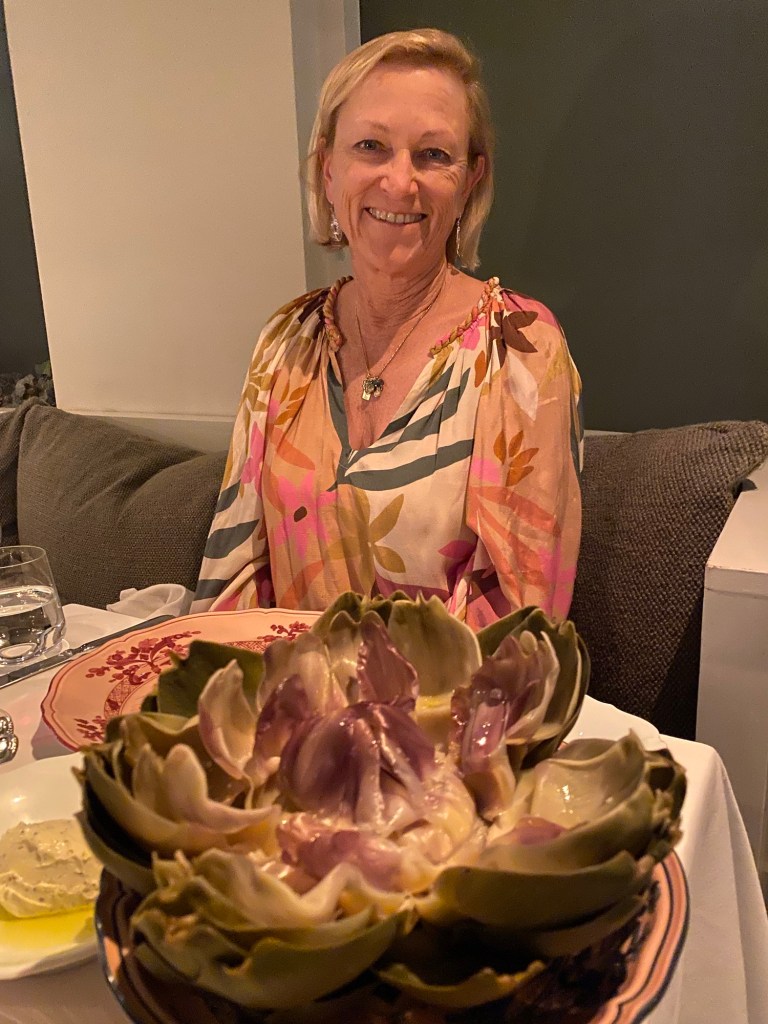
Lisa getting ready to enjoy our giant grilled artichoke.
The Danes love licorice. Here is a whole wall full of various licorice candies.
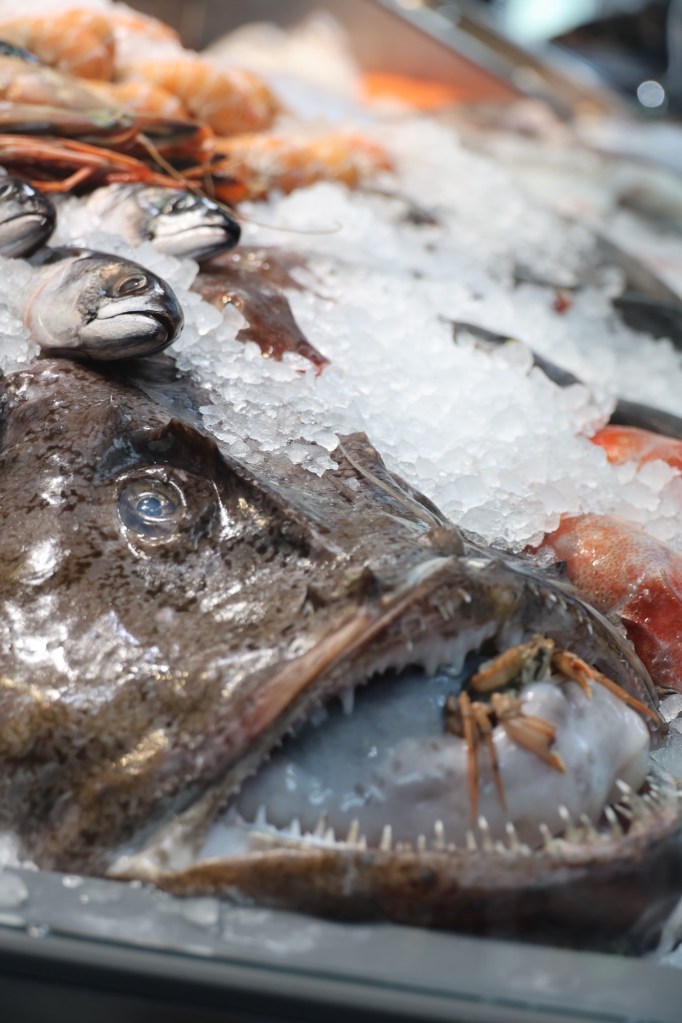
No place is Denmark is more than 32 miles from the coast. So fish is a staple of the Danish diet. This monkfish is ugly, but tastes delicious.
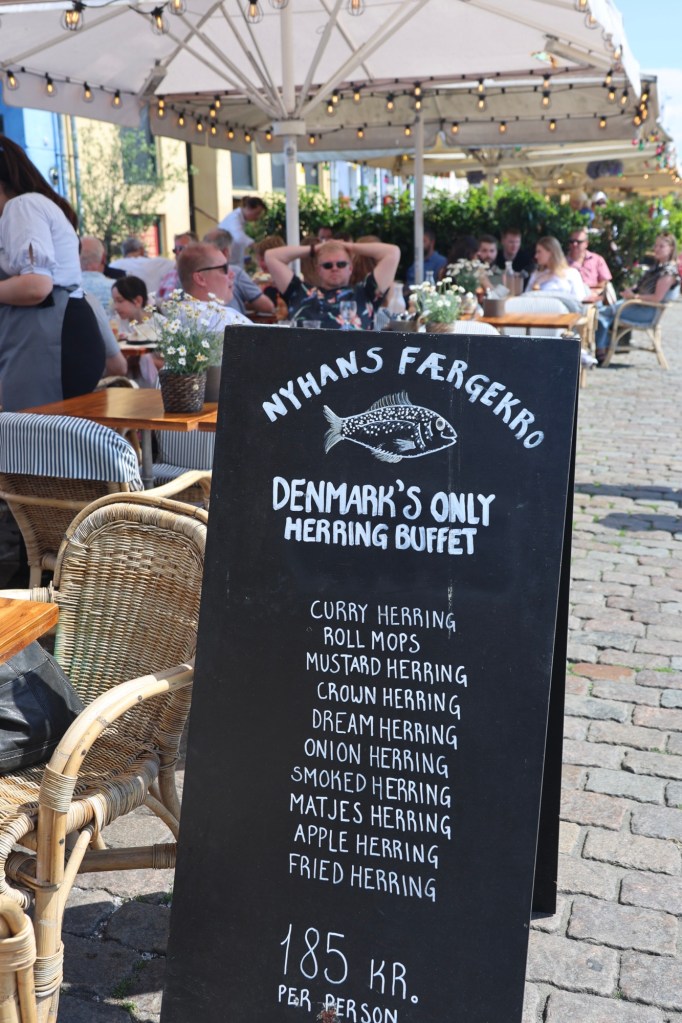
And, it’s pretty easy to find herring. This sign reminded me of the Forrest Gump scene about shrimp.
Categories: Denmark, Scandinavia, Travel | Tags: , , , , , | 2 Comments

The Arctic Circle: Land of the Ice Bears

North.

We are on our way to the Arctic Circle via Norway. Soon we will be as far north as one can go without an icebreaker ship — 350 miles north of Norway’s northernmost point. Svalbard is a group of islands punctuated by massive icebergs, deep fjords, and ice-capped mountains. And, it is the best place on the planet to see the master of the Arctic, the polar bear.

Lisa and I hope to capture photographs of those polar bears along with walruses, arctic foxes and a variety of arctic birds. We’ll share those with you as we capture them on our cameras.

Before we go north, we will make stops in Copenhagen, Denmark and Oslo, Norway. We’ll then fly to Svalbard and board the National Geographic ship, the Resolution.

Join us as we experience a world we have never before seen. You can subscribe to our blog by entering your e-mail on the right side of this page.

See you in Copenhagen!

Categories: Arctic, Norway, Travel | Tags: , , , , , | 4 Comments

Lisa’s Light-Hearted Lasting Impressions of Japan

  1. The polite people. The people of Japan are lovely and extremely polite. Every good-bye, whether in a store or a hotel, involves many thank yous and much bowing and waving. Purchasing an item at a retail store feels like a privilege and a bit of a ritual. There is no rushing through the transaction. Every item is inspected and wrapped. Your credit card is taken and returned with two hands and a bow. The shopkeeper will walk you to the door and bow and wave until you are no longer in view. The same thing happens when you leave a hotel or simply ask where the bathroom is. There is no pointing. You will be escorted and they will watch you go in to the facilities with a wave and a bow!
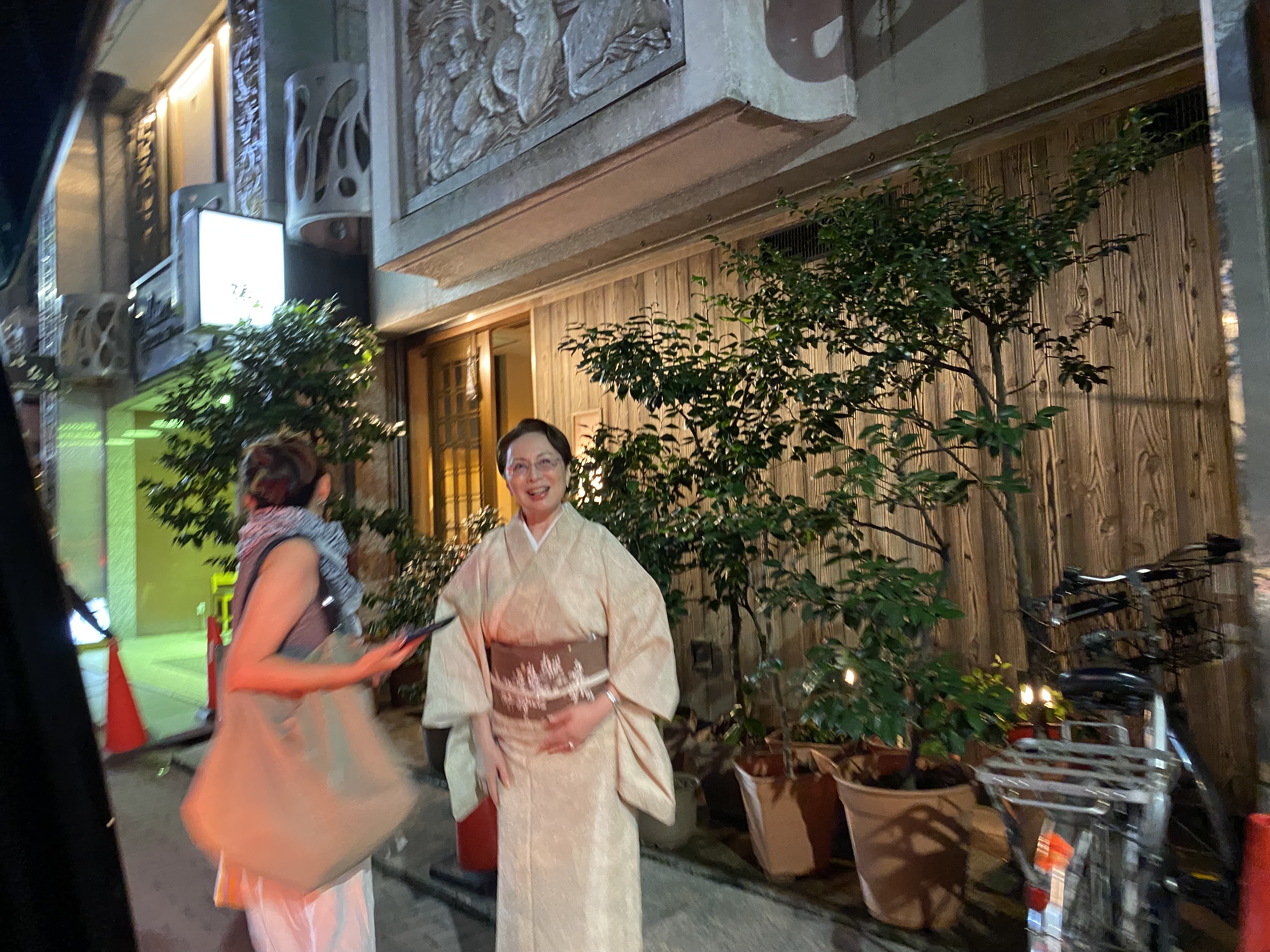
This lovely owner of a Sushi restaurant followed us out to our taxi with bows and thank you’s and gifts!
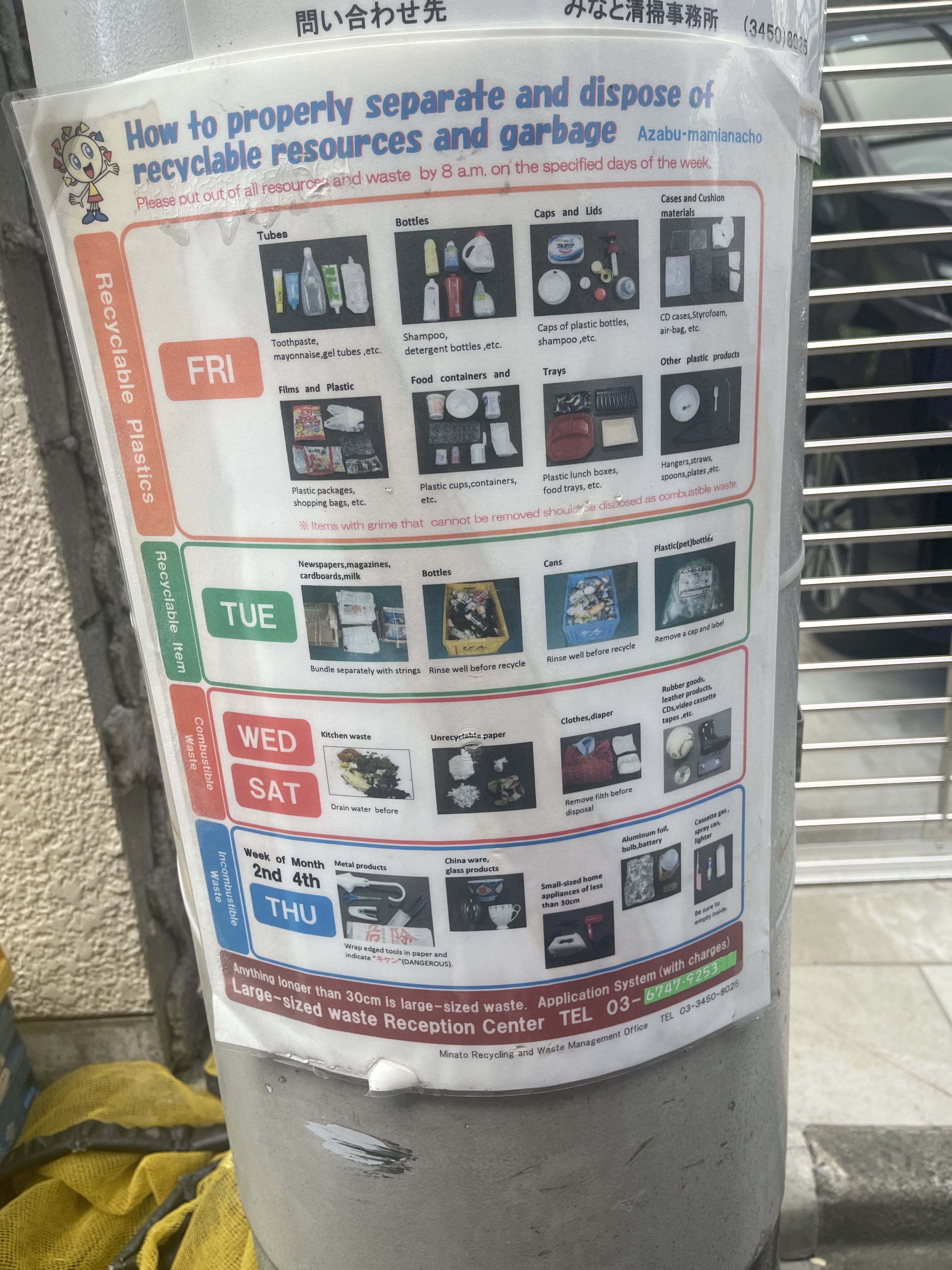
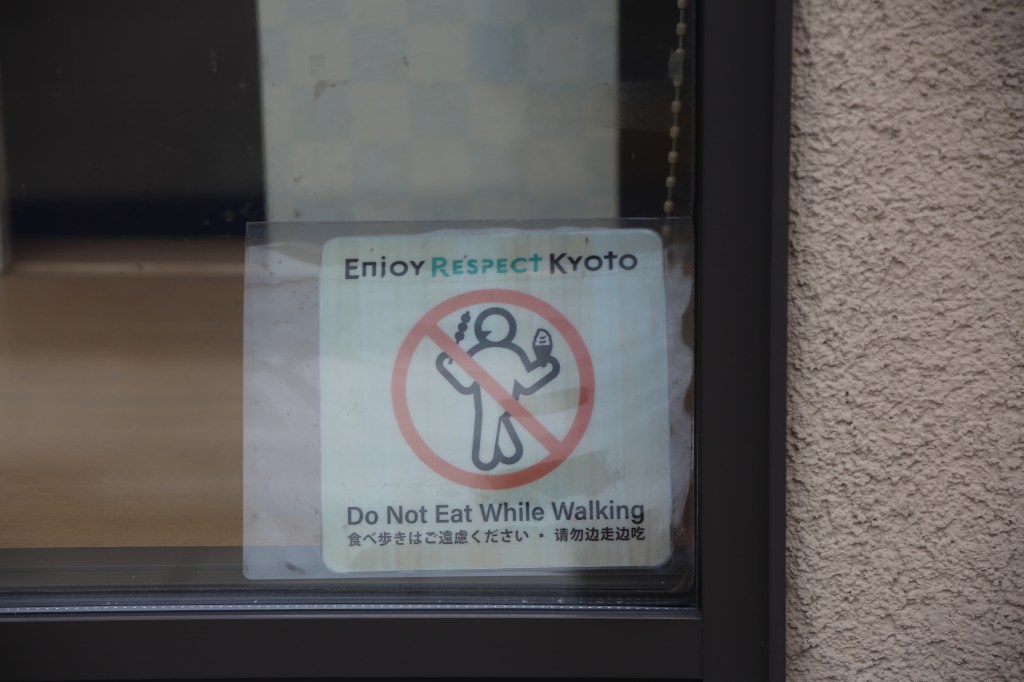
  • The cleanliness. We never saw trash on the city streets of Tokyo or the village of Hakone. We also saw very few trash receptacles. People are expected to bring a bag and take their trash back home with them. There is an elaborate recycling schedule. Here is a picture of what to separate and when each item is picked up. I am not sure how they sort each item and where they keep it in their apartments and small houses but I understand that everyone follows the recycling rules. Also, there are many signs asking you not to eat and drink while walking. It would be very bad form if you do!
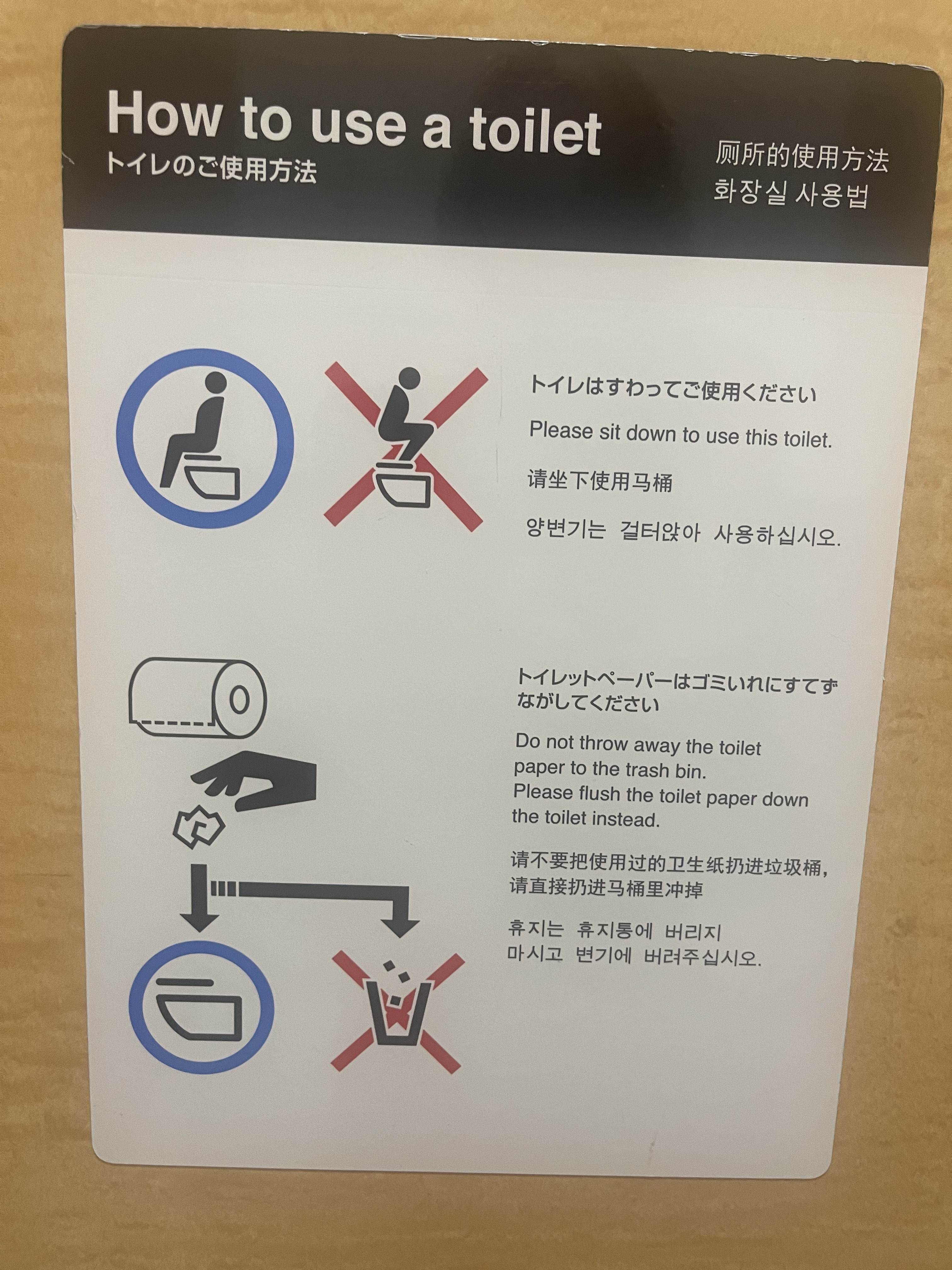
  • The bathrooms.  Speaking of cleanliness, the bathrooms are unbelievable.  Even the public bathrooms have fancy ToTo washlets.  We haven’t flushed a toilet in two weeks!  The washlets do it for us.  Also, there are again very many rules on how to use the toilets and what to do while in the bathroom in case you are new to the washlet situation.
One of the many signs to show us how to use a toilet
All bathrooms public and private had fancy ToTo Washlets (I even think I heard birds chirping with one!)
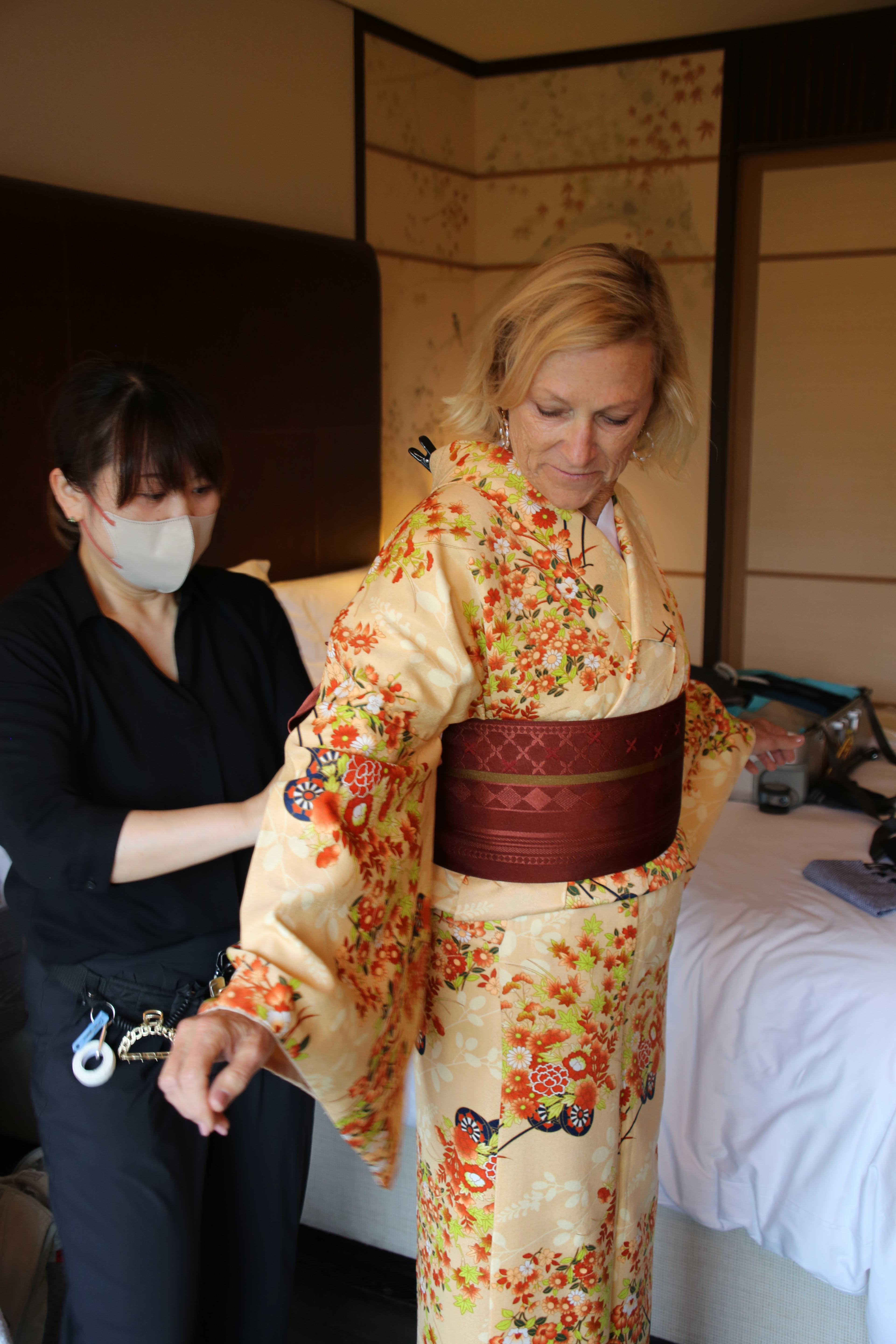
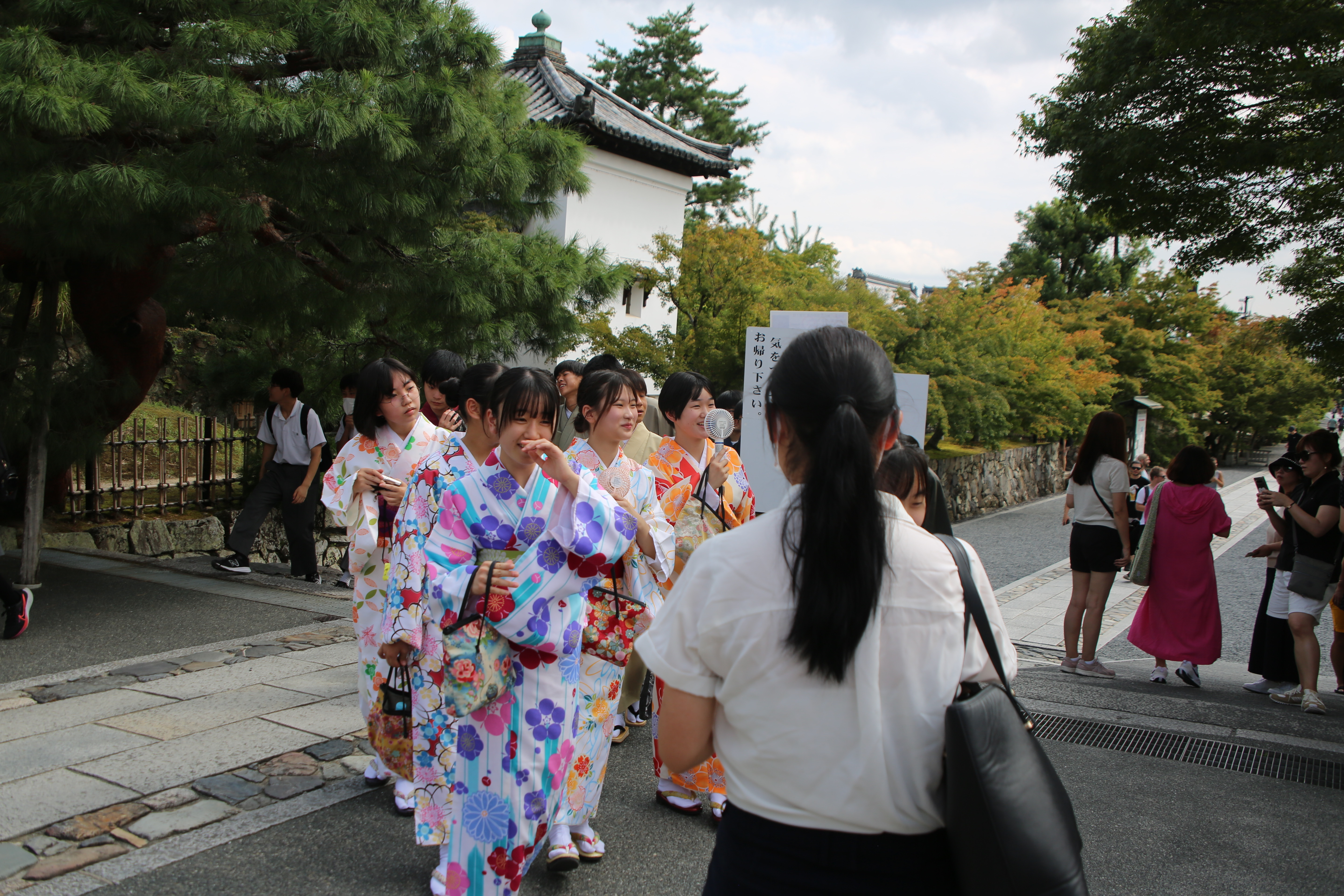
  • The heat and humidity. We now understand why the Japanese use fans so much. It was HOT and HUMID the whole time we were in Japan. It’s not a lot of fun but the fans do make it more pleasant. I still don’t understand how the women of Kyoto wear the multi-layered Kimonos with all that heat!
So Many Layers in 90 Degree Heat!
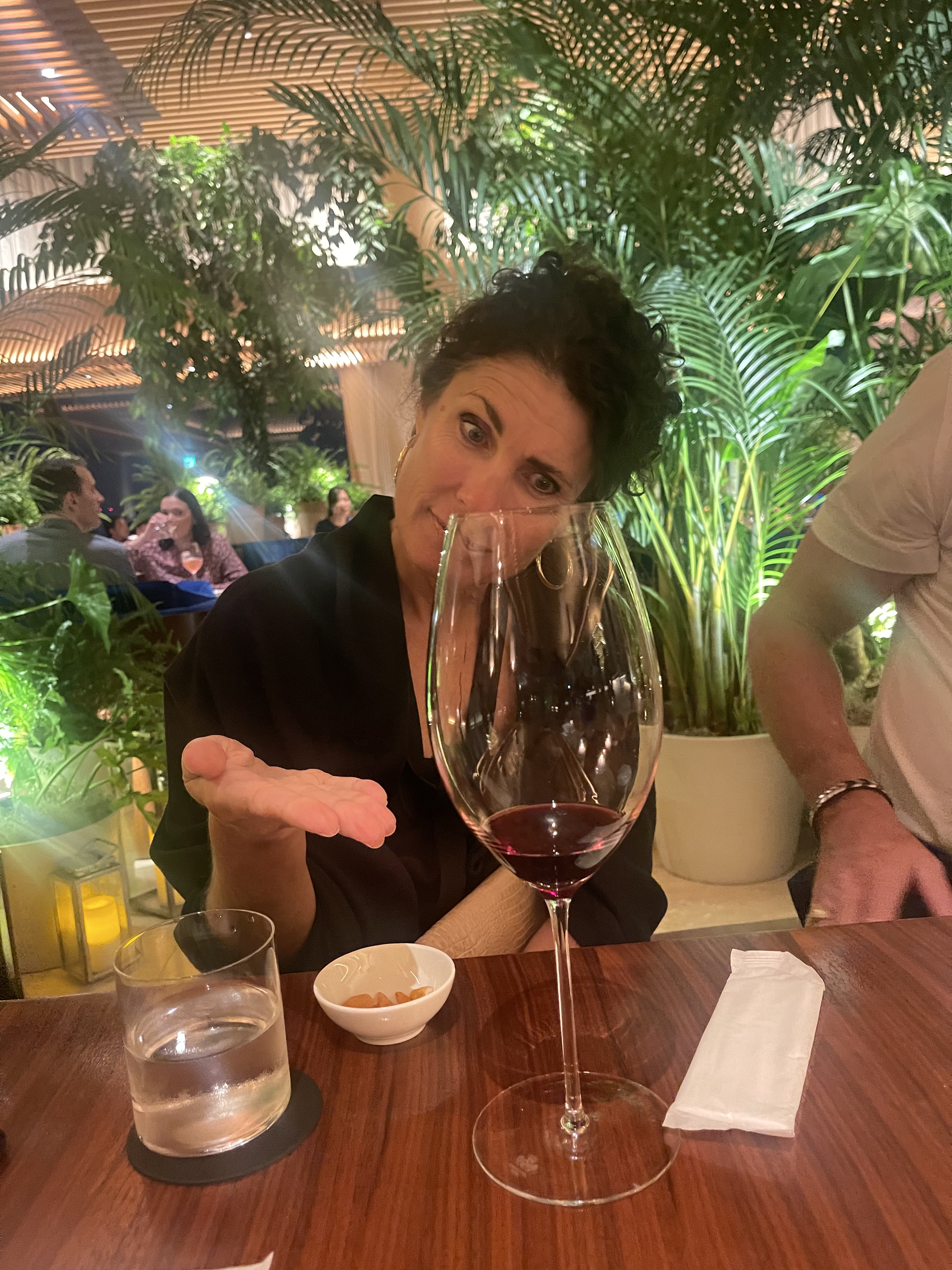
  • Lost in Translation Moments. Although Japan is an easy country to travel to and there is a lot of English on signs and in restaurants (and also there is Google Translate), we still had a few moments where we fumbled our understanding. One instance was our last night in Tokyo when Brad and Elizabeth ordered a very nice glass of red wine only to find out that they only got 2 ounces. Elizabeth thought it was just for tasting the wine and was a little surprised to find out that was her entire and quite expensive pour!
That’s a very big glass for such a small pour!

One of the members of our group was being fitted for his kimono in his room and had on gym shorts. The seamstress asked him to take off his shorts because she didn’t want the extra material to show. He asked several times if she wanted him to take them off right there in the room. She said yes. He obliged. Upon doing so, the seamstress let out a surprised shreak! I guess he should have changed in the bathroom after all!

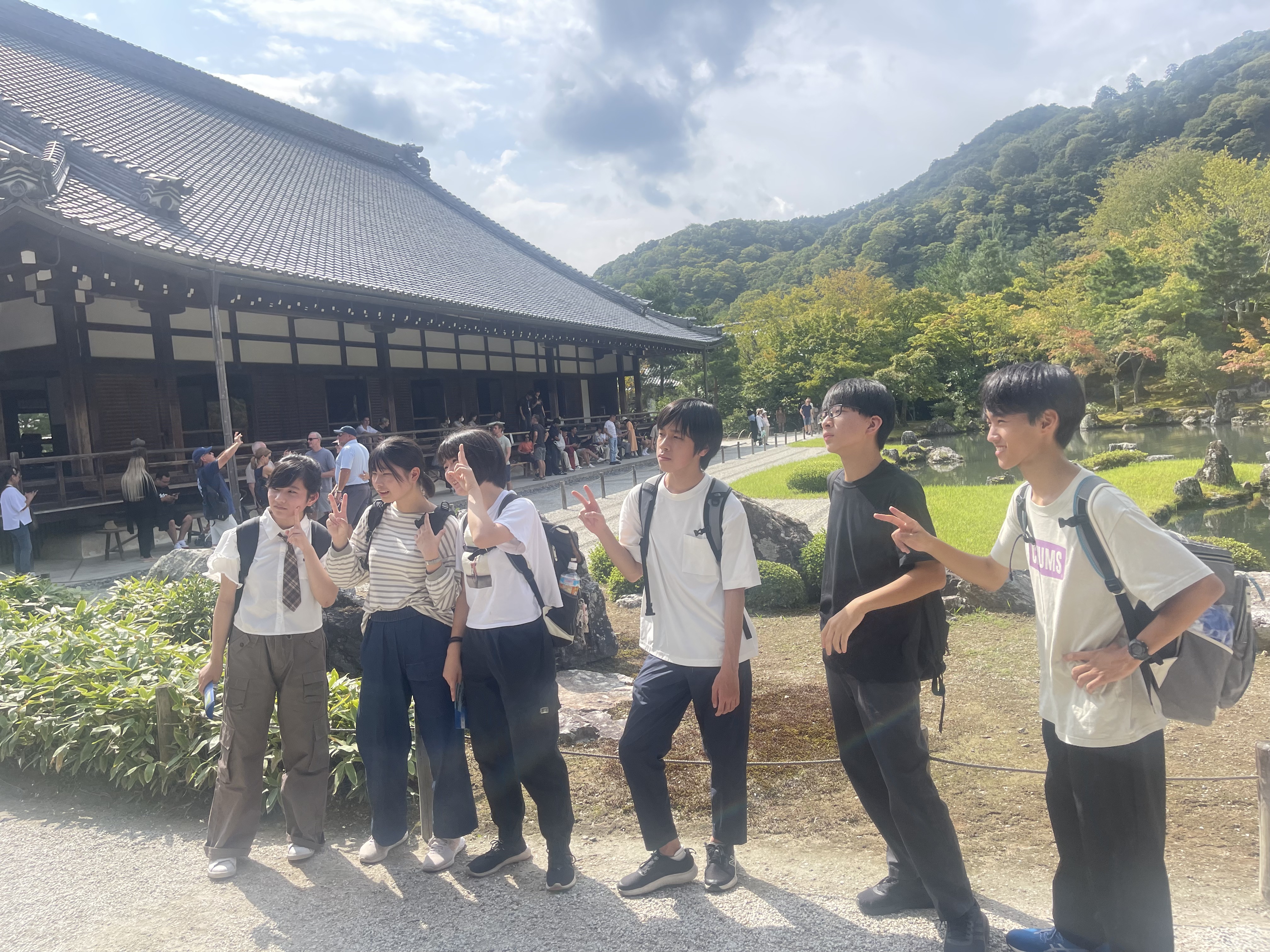
  • Japanese Children. Japanese children are quite an independent lot. They walk themselves to and from school beginning in Kindergarten without their parents. If they need to take a bus or a train, they do that by themselves as well. Our guide said it is safe because all of the adults on the train look after the children. Japanese children also spend a lot of their time at school. They typically go six or seven days a week. They take classes from about 8:30-3:30, take their chosen club (baseball, science, music) from 3:30-5:30 and then have homework from 5:30-7:30. Rinse and repeat at least six days a week. The process for getting into pre-schools, day cares, and regular public school is also an intense one with a rating system and only one time per year to apply. Sounds worse than college applications in the U.S.!
Some Japanese boys hamming it up on a school field trip.
Japanese girls were dressed in kimonos on their field trip.
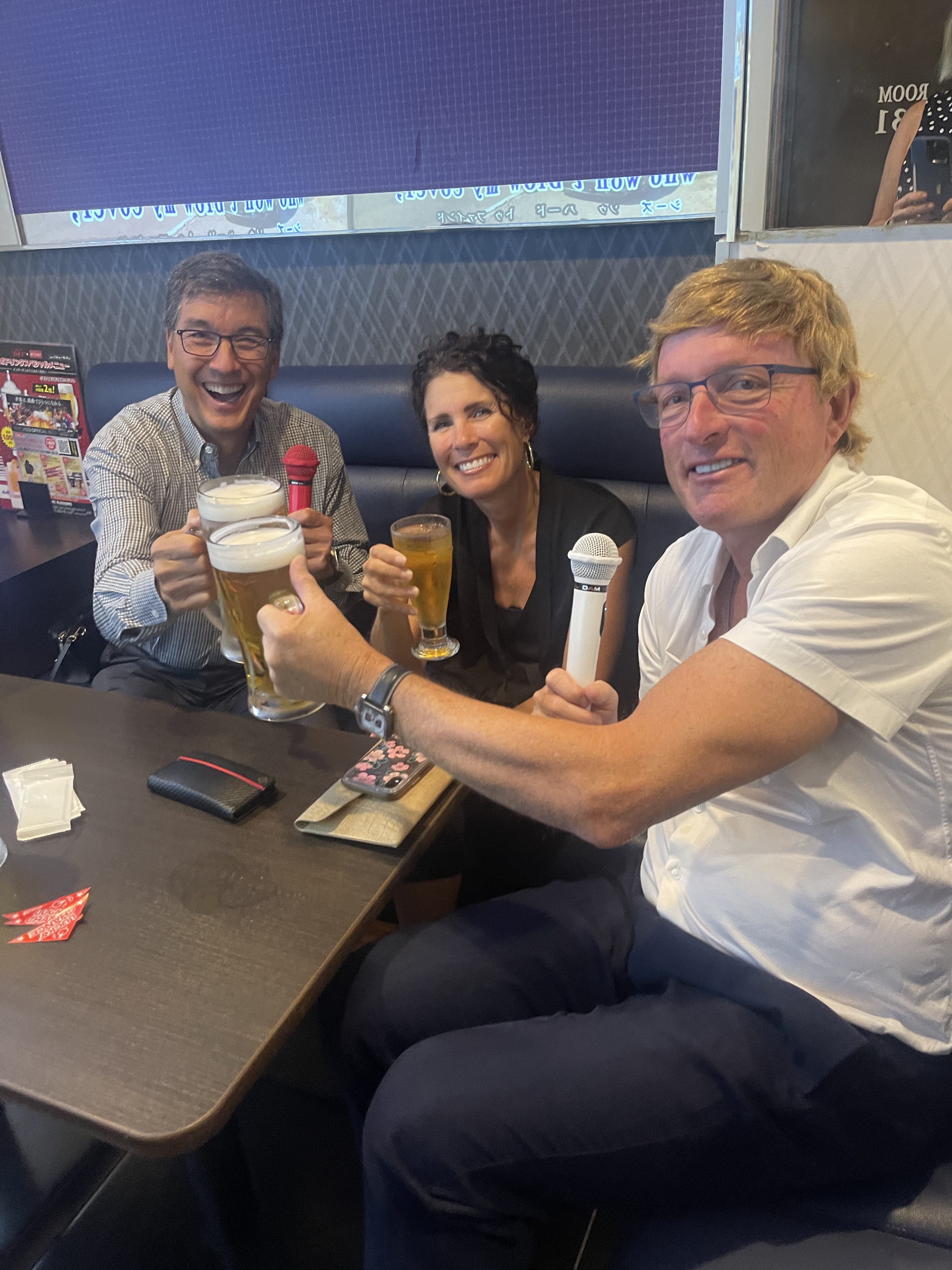
  • Karaoke is really a hoot especially with a king-sized beer and a private room.  The private room was key with my brother joining us!
“Sing Us A Song, You’re the Piano Man!” Karaoke in Tokyo was a blast.
  • Everything else is so quiet. We never heard a horn honk in Tokyo. In most restaurants there was barely a hush and many people are very soft talkers. Apparently, it is ill-mannered to talk on the subway. We only got in trouble once as a group for talking too loud and we didn’t even think we were loud at all. Americans as a culture are much louder and messier. (See Point #2)
  • Less than 1% of Japanese people own a gun.  Those who own a gun use it for shooting wild boar.  In the entire country of Japan with a population of 126 million, there were only 10 shootings last year.  Most of those were hunting accidents.  I’m just going to leave that right there.
  • The time change is confusing. We were sixteen hours ahead of our home in Danville. One of us watched sports at 1:00 am to see his beloved Buffs. Sunday Football is on Monday morning. We were finishing our last glass of wine when most of our friends and family were enjoying their morning coffee. We were always a day ahead of Brenda and Chris Dittmore in Wordle! If only we could also see into the future with the stock market, too. We lost a day coming here and currently our Monday is going to last 40 hours. We leave at 5:00 PM Monday, the 18th in Tokyo and arrive at 10:25 AM Monday, the 18th in San Francisco. Back to the Future or something like that!
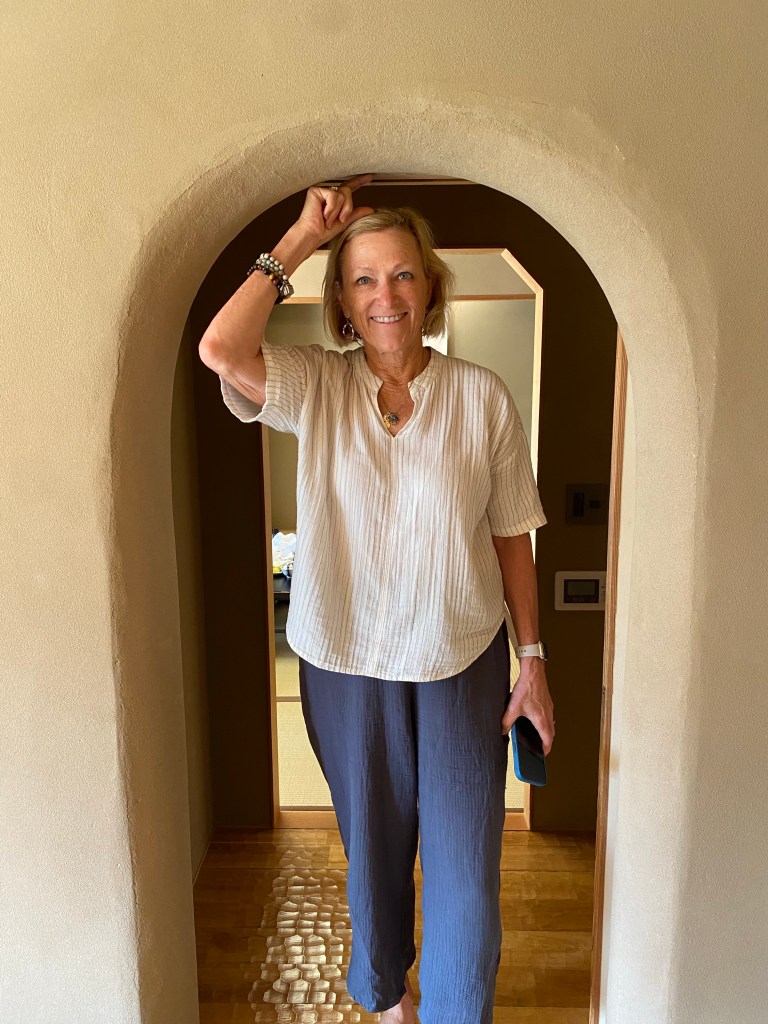
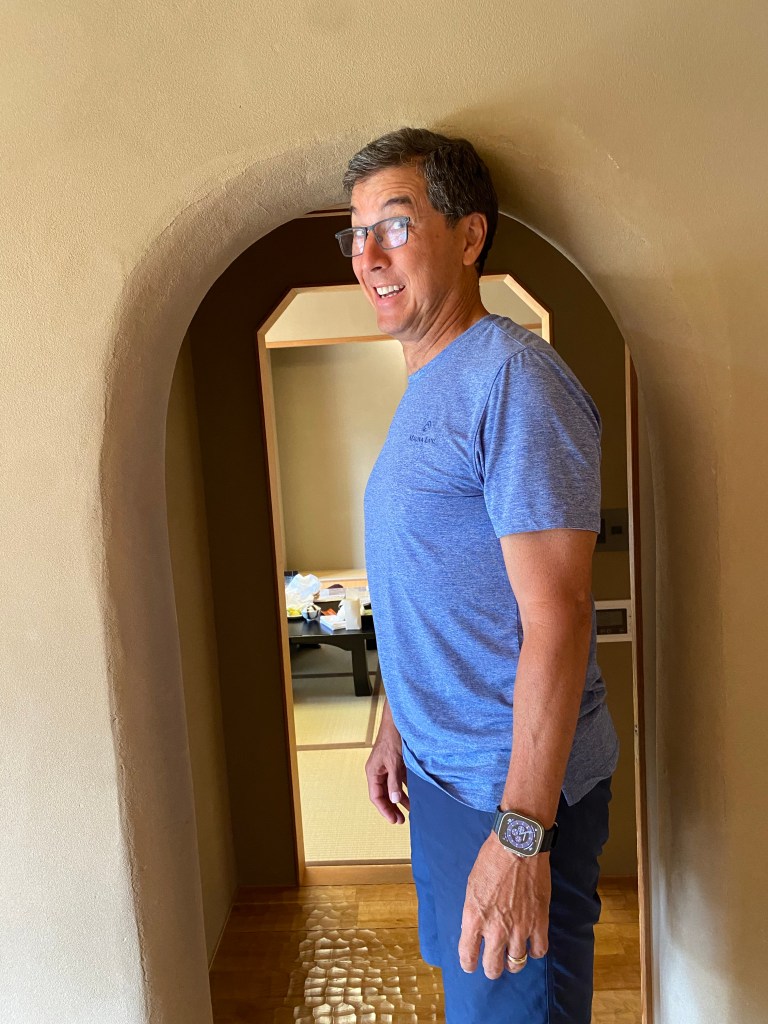
  • Watch Your Head. If you are over about 5’8″, you might come back with some bumps and bruises on your head. Ryokans — Japanese Inns are especially problematic for tall people. I could make it through the doors, Brad could not. Learning to sit on the floor to eat is also a bit of a challenge. Practice before you arrive by doing some stretching and yoga.

And one final thing, by all means travel to Asia if you get a chance! Don’t put off the opportunity if you are given it. If you do come to Japan, remember to pack a lot of black clothes (the standard color in Tokyo) , don’t eat or drink on the streets, speak softly, learn how to use your chop sticks, eat all the food even if you don’t know what you are eating, sing your heart out in Karoake, bring a fan, never litter, embrace Eastern culture and temples and shrines, and leave with a new way of seeing the World!

Categories: Asia, Japan, Travel | Tags: , , , , | Leave a comment

Brad’s Final Thoughts on Japan

“Wherever you go becomes part of you somehow.” — Anita Desai

A man once told me he didn’t travel because he could see everything he wanted to see in a National Geographic magazine. I believe he couldn’t be more wrong. Visiting a place — seeing it, smelling it, meeting the people, eating the food, being immersed in it — somehow it changes you in ways a simple photograph could never begin to accomplish.

Twenty years ago, Lisa and I had traveled throughout the US but had experienced very little international travel. Beginning in 2004 when we first visited Italy, the travel bug bit us hard and we have been taking every opportunity to see new places, both familiar and totally foreign.

We always leave a new place as slightly different people than when we left home. As we gain a deeper understanding of new cultures, as we meet interesting people who come from a different perspective, as we become immersed in a place so different from who we are, we emerge, I’d like to think, as a better version of ourselves. I am sure you have had this same experience as you have visited new places.

Japan has been special. It is home to ancestors I’ve never known. But, it has provided me with a window into who I am and who my family is. Here are few thoughts and observations of our trip.

Brett, our Tour Leader

Brett was born and raised in a small rural town in northwest Iowa — the last type of person you would expect to have as your tour expert in Japan. On our last day he told us about how he got here. He was six-years old and had he checked out a book on Japan from his elementary school library. He loved that book. He was particularly fond of a photograph of a giant Buddha. He wanted badly to see it. Once the book came due, he rechecked it out. He continue to recheck it throughout his elementary school years. It resided in his backpack the entire time, the pages becoming worn from flipping through it so often.

He moved on to middle school and, to his chagrin, the new library did not have that book. But, he found other books on Japan and he devoured them just as he did when he reached high school. At graduation he went back to his elementary school library to see if, by chance, he could buy that book with the big Buddha in it. They apologized and said the library no long had it.

At his graduation ceremony he was handed a package by the school principle. In it — the book he so coveted. They had removed it from the library to give to their prized student. He almost cried. Brett went to Iowa State (sorry for their football loss this week) and furthered his studies in Asian culture. In 2006 he got a job as a journalist in Japan — his dream. On his first week in Japan, he headed for Kamakura on the coast south of Tokyo to visit The Kotoku-in Temple where the big Buddha resides.

It was so much larger than his six-year-old self could have imagined, and the emotional impact of his journey to this point was overwhelming for him.

The Big Buddha in Kamakura

Brett stayed in Japan, married a Japanese woman and now has a 6-year-old daughter himself. He is the best guide and best storyteller we have ever met. He brought the country and its history alive for us. And, he is a living testament to following your heart and your dreams.

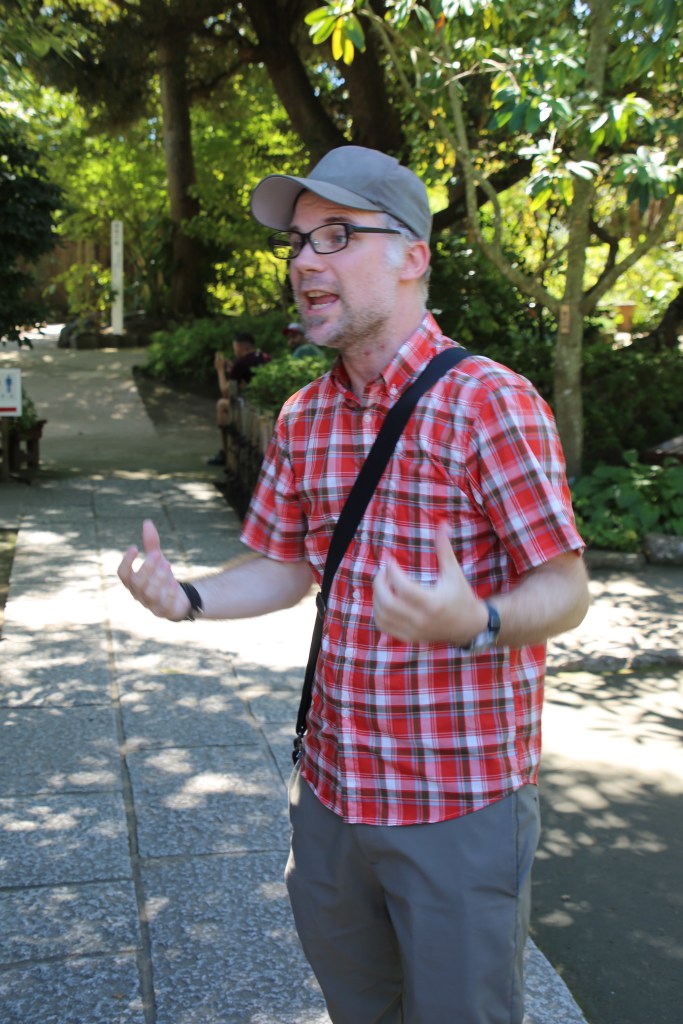
Brett passionately relating a story on Japanese history.

The People of Japan

Japanese people proved to be kind, polite, thoughtful, and, um, quiet. Yes, quiet. Restaurants are quiet as people eat and softly talk to one another. Trains are quiet, cars don’t honk, there is no shouting in the streets, I think this is another way they show consideration for others.

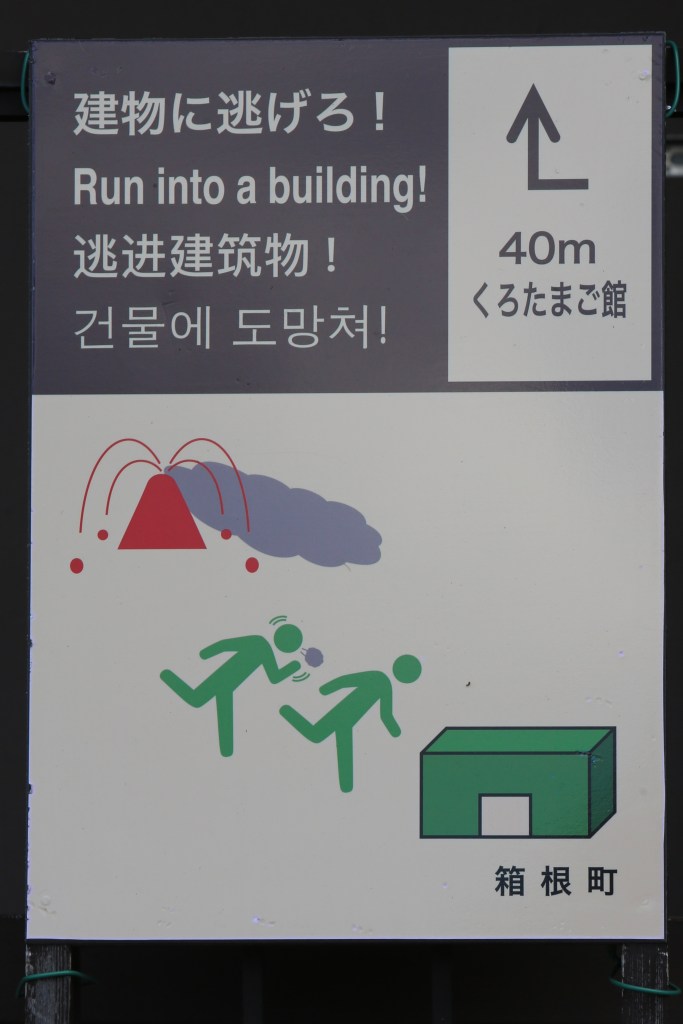
The culture also rewards rule following and conformity — two traits unfamiliar in America. There was no jay walking, signs on how to behave were everywhere. And, people heeded those signs.

No one eats while walking on the street.
Everyone probably heeds this one.

We found the Japanese people to be delightful. We call our family the loud family because everyone talks at high volume all at the same time. I don’t think this comes from the Japanese side of our heritage.

Religion is a big part of Japanese life. There are Shinto shrines and Buddhist temples everywhere. Huge ones that have been there for centuries and little tiny ones tucked into a side street that barely takes up more room than a parked car. Many Japanese people are not particularly religious. But, if this makes sense, religion is still a big part of their lives and their culture.

Japanese Food

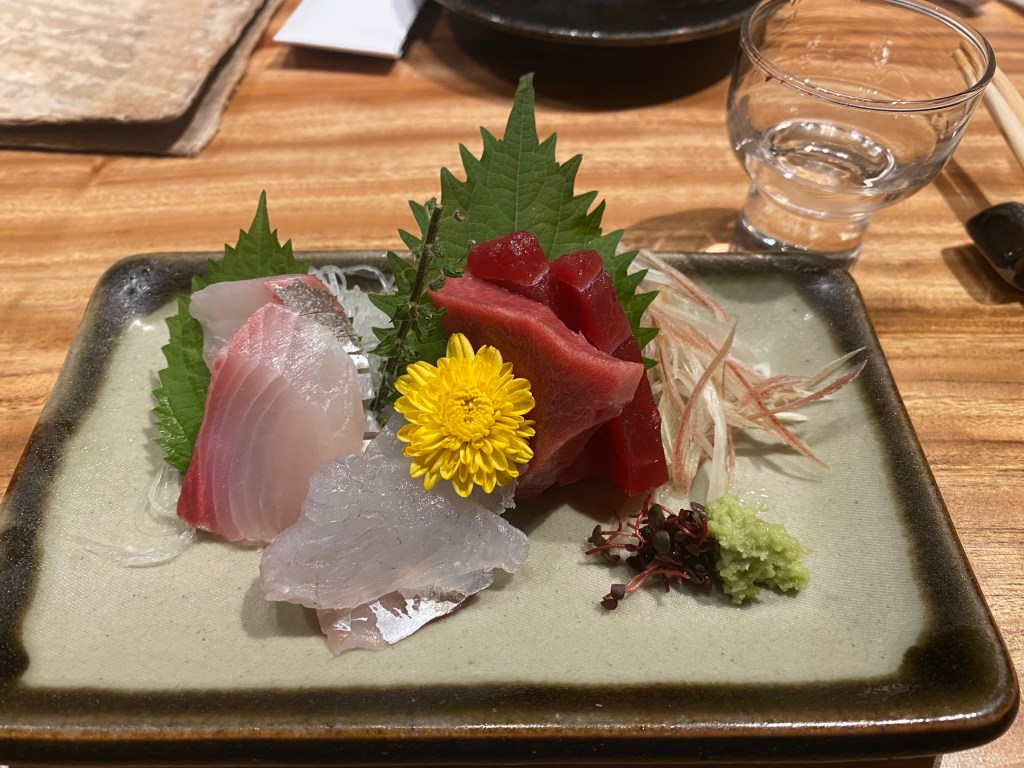
The food was wonderful. Japanese food selections are broad and delicious. There is a theme, though. Most dishes include fish. Sashimi was served at most meals. Rice is a staple. Every meal includes soy sauce.

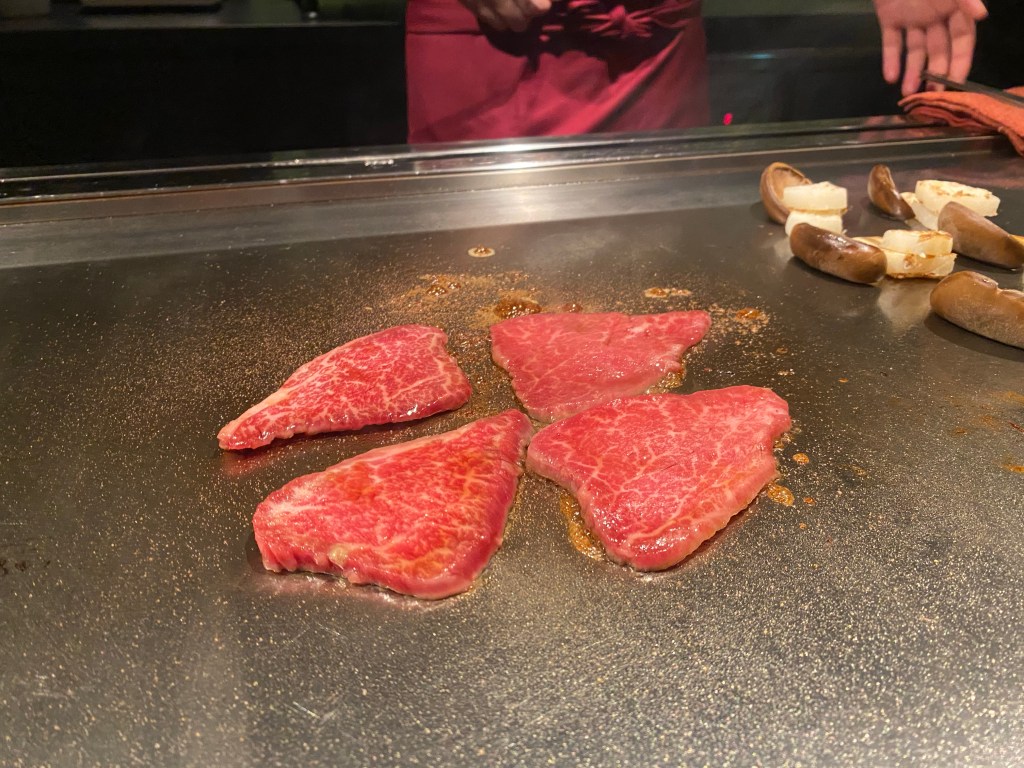
Japanese beef is some of the best in the world. We had the privilege of eating Kobe beef. Much of what is called Kobe beef in America isn’t authentic. Most Kobe beef never leaves Japan. Kobe beef literally melts in your mouth. It is very rich. Don’t eat too much in one sitting or you will feel it at 2:00 am. I say that from experience.

Kobe beef on a Japanese grill.

For the Japanese, food is art. Our meals were as beautiful to look at as they were delicious.

Delicious Art.

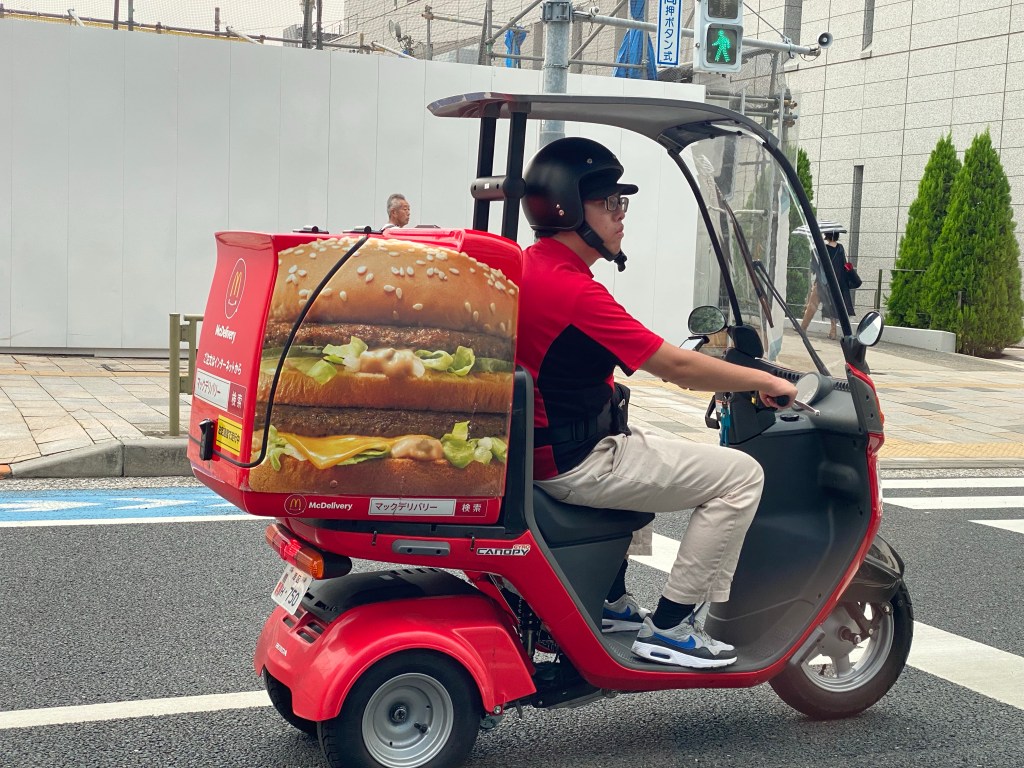
Now, this doesn’t mean that all food in Japan is this way. It seemed as if you could get anything delivered — even some of our American “favorites.“

McDelivery.

Bugs

The weather during our visit was very hot and humid. We were regularly out in 90 degree heat with 90 percent humidity. Yet, to our surprise, we didn’t get a single mosquito bite. In fact, except for the water bugs skipping along the ponds, we didn’t see many bugs at all.

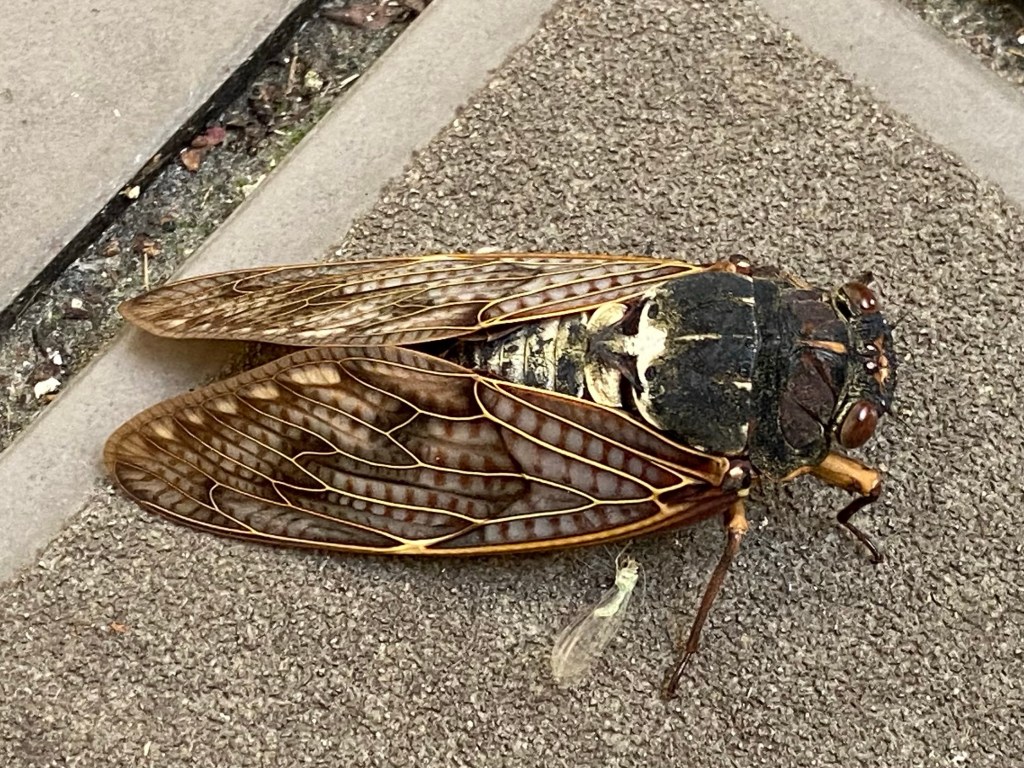
Now, the bugs we did see were very big. As we were walking around the ryokan in Hakone we saw a large Japanese cicada. It had an iridescence that made it beautiful. While it is harmless, this was no consequence to Lisa as it flew right at her.

Japanese cicada.

Our guide, Shin, had gathered the beer cans from our group and was taking them to a recycle bin when a Japanese giant hornet landed on one of the cans, apparently attracted by the beer (Japanese beer is quite good). These are the world’s largest hornets and their sting is said to be very painful. Shin didn’t seem to mind and neither did the hornet. So, no one got hurt. The hornet was very large, quite beautiful, and awe inspiring.

Japanese giant hornet.

The Future of Japan

The Japanese population has been shrinking since 2010. Growth rates have been very slow since the 1980s. Birth rates have been declining as a result of heavy work demands, a high cost of living, and other factors. The United States has two growth engines working for it — birth rates and immigration. The Land of Opportunity has always attracted hard working people from around the world with the promise of achieving the American Dream. This keeps our economy chugging along.

Japan’s history took a different path. The country was isolated from the rest of the world for 250 years, ending in 1868. And, while Japan has been reopened for over 150 years, the remnants of that policy has meant a severely restrictive immigration policy.

This combined with the low birth rate has led to an almost constantly stagnant economy for the last 40 years. And, with an aging population, Japan will not be able to support health care and retirement income for its seniors in the future. As one of the people in our group said, there will be a day of reckoning before too long.

The Japanese people are innovative, resourceful, and pragmatic. I expect them to find solutions to this problem. It won’t, however, be without difficulty.

So Long, Japan

We left Japan this Monday afternoon and went to the airport for a 5:10 pm departure. We landed in San Francisco on Monday morning at 9:45. We arrived 7 1/2 hours before we left — at least that’s what the clock told us. Our Monday will be 40 hours long.

Yes, as Anita Desai said, wherever you go does become a part of you. And, while being half Japanese has meant that Japan has always been a part of me, traveling to this beautiful country, meeting its wonderful people, and experiencing the culture of this foreign land means that it is is much more a part of me today. It’s now a part of Lisa, too.

Categories: Asia, Japan, Travel | Tags: , , , , | 4 Comments

Hakone: Volcanoes, Hot Springs, Shogun, and the Elusive Mount Fuji

As we left Kyoto for the mountainous town of Hakone via bullet train, Brett, our guide told us that we might be able to catch a glimpse of the iconic Mount Fuji as we rode the rails north. It was a beautiful sunny day and our hopes for a glimpse of the sacred volcano were high.

I pulled my camera out of its bag and attached the telephoto lens hoping for that photo the all who visit Japan long to capture. Brett went out of the front of the rail car to a large window in order to check on the mountain’s visual status. We waited for word to join him.

As he trundled back to his seat he said, “It isn’t visible. Covered in clouds.” Disappointed, I put my camera back in its case.

We got off the bullet train and got on the bus for our 30 minute ride to Hakone. Hakone is a town of 11,000 people that sits right in the middle of Fuji -Hakone-Izu National Park — one of Japan’s largest and busiest national parks. While the town is small in population, it is graced with 20 million visitors each year, 18 million of whom are Japanese tourists.

They come for the hot springs. Hakone is surrounded by active volcanoes. While none are currently erupting, the geothermal activity heats up underground water creating plentiful hot water rife with healing and soothing minerals. The onsen, or Japanese hot baths, are highly popular and, with Hakone being only a 90-minute drive from Tokyo, people flock here for weekends and holidays.

The Hakone Open Air Museum

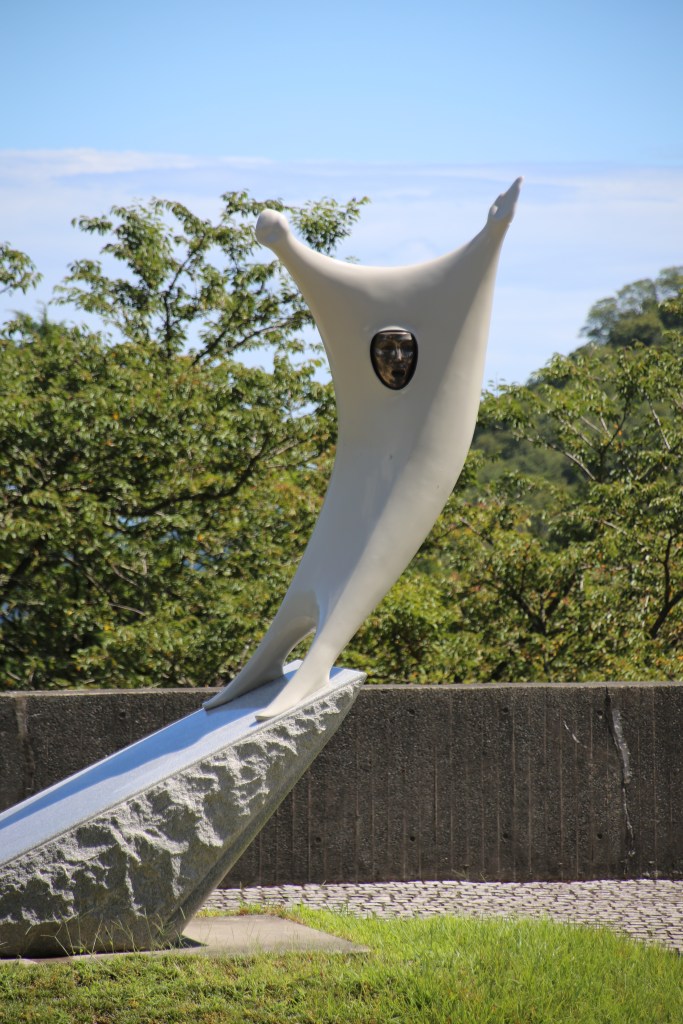
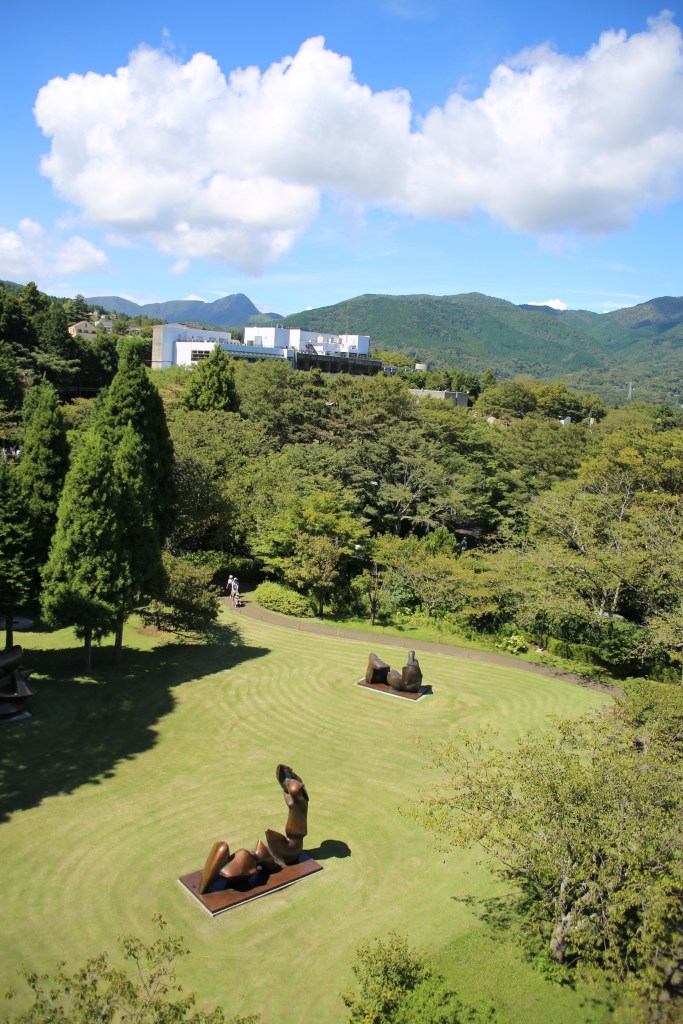
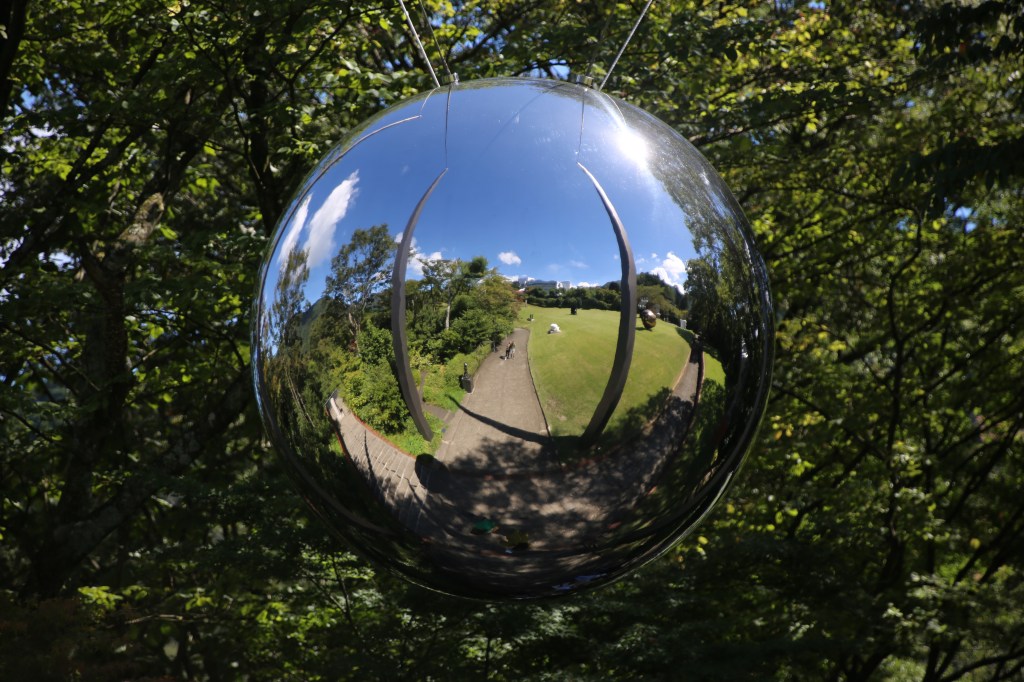
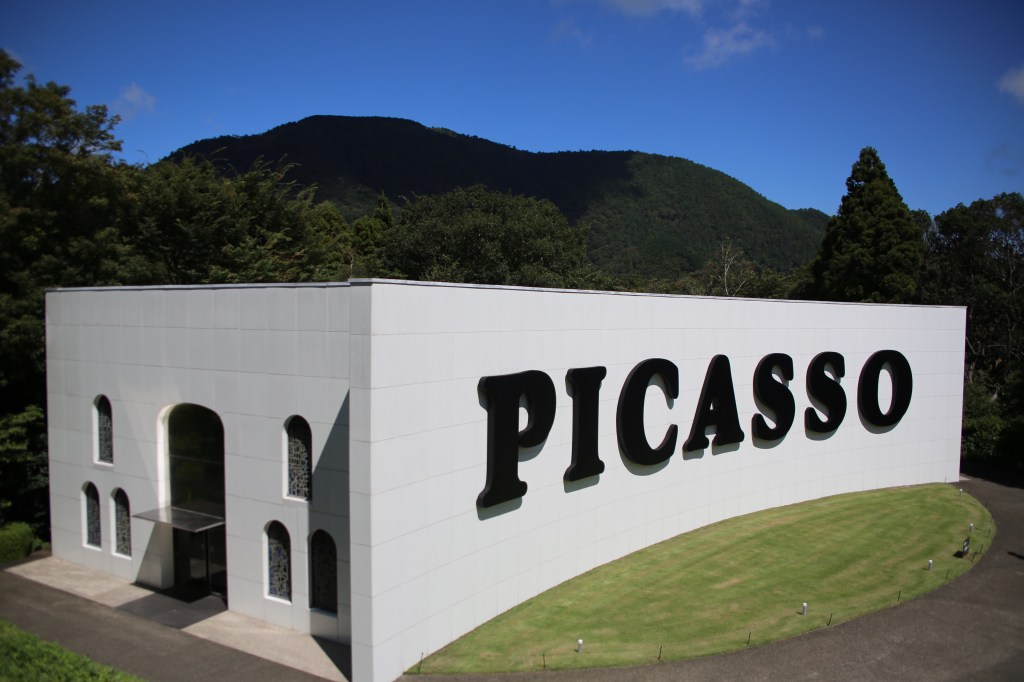
Before we got our shot at an onsen, we stopped in to the Hakone Open Air Museum. The multi-acre exhibit held pieces by both Japanese and worldwide artists. Even if you aren’t an art lover you would love strolling the meandering paths though the grounds. There was a two-story building full of Picasso’s works and many outdoor sculptures.

A suspended ball reflecting back on us.
The building housing many of Picasso’s works.
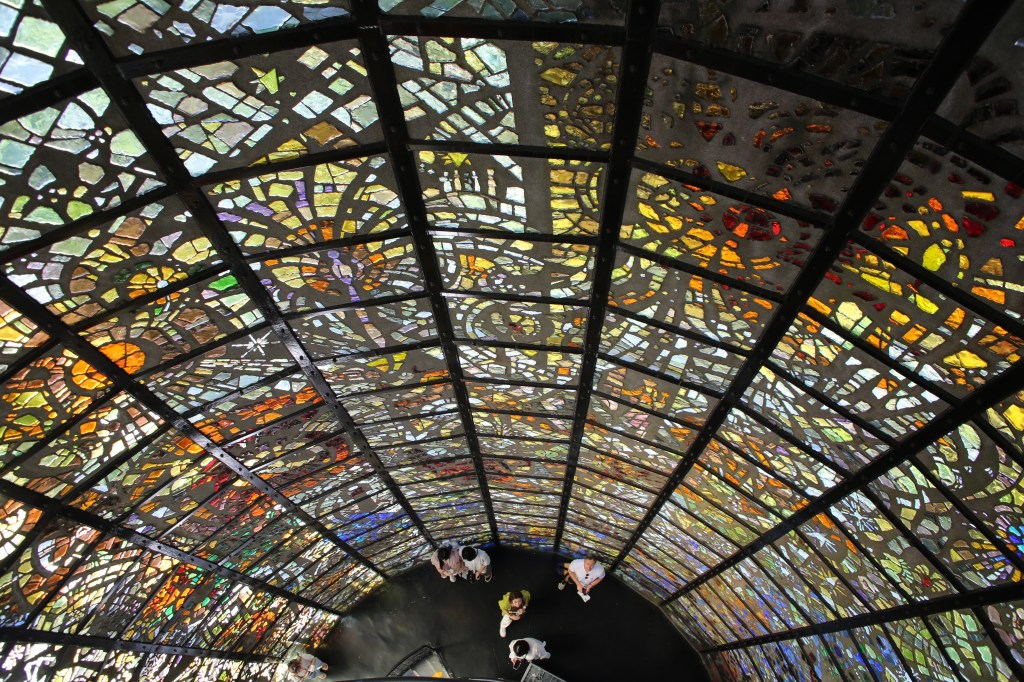
A towering sculpture of stained glass.
Sculptures in the spacious grounds of the museum.

The Gora Kadan Ryoken

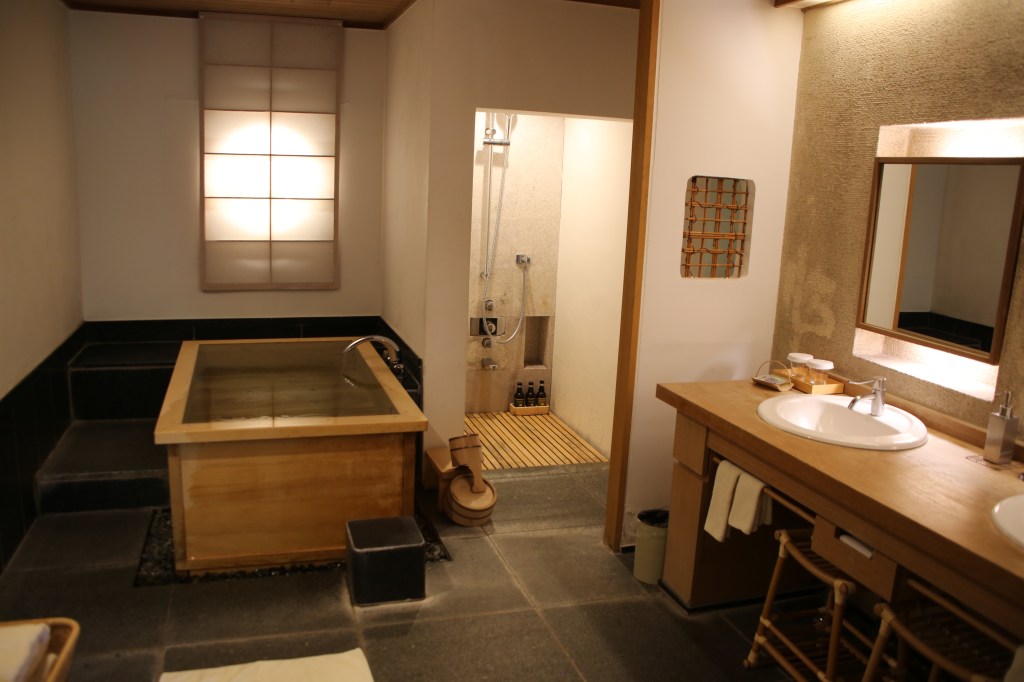
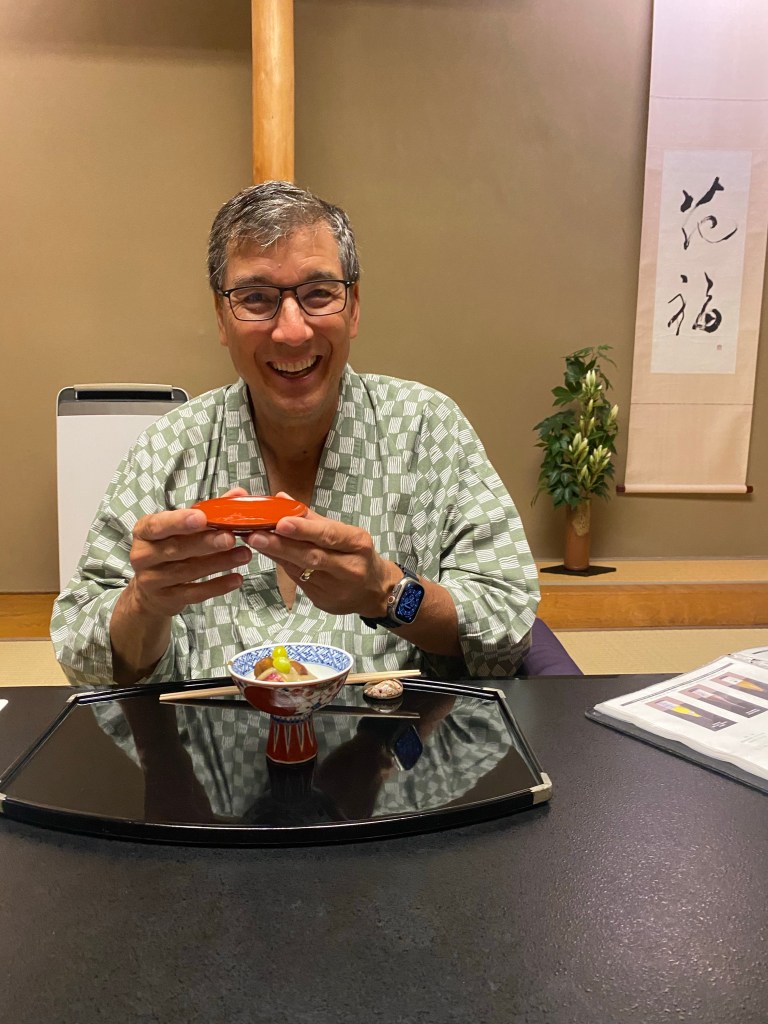
After lunch we checked into our ryoken. A ryoken is a traditional Japanese-style inn. We’re about to experience a couple of nights the Japanese way! Our inn, the Gora Kadan (https://www.ryokancollection.com/ryokan/gora_kadan/) was formerly a retreat for the Emperor in the mid-1700s. Rooms in a ryoken are sparse with clean lines, tatami floors, and futons for beds (not the college dorm type, very plush comfortable ones). Ours had a private onsen (Japanese hot tub) with hot water that constantly flowed in from a hot spring. We wore yukatas, which are a simpler version of a kimono. More like a comfortable, classy bathrobe.

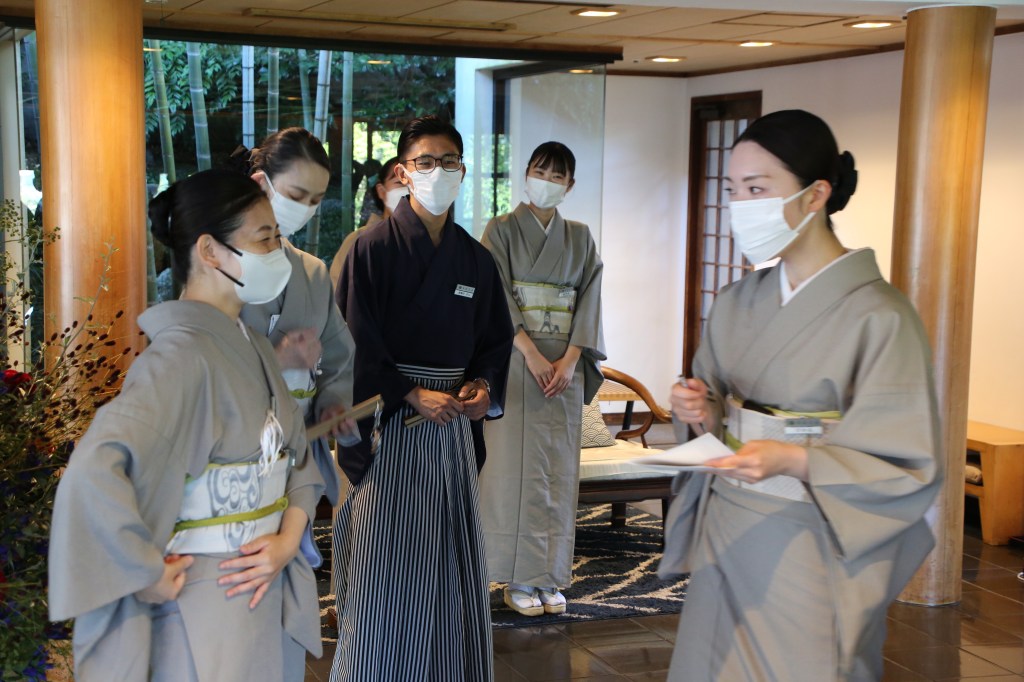
We were greeted by many staff members dressed in kimonos at our ryokan.
The hallway was stunning.
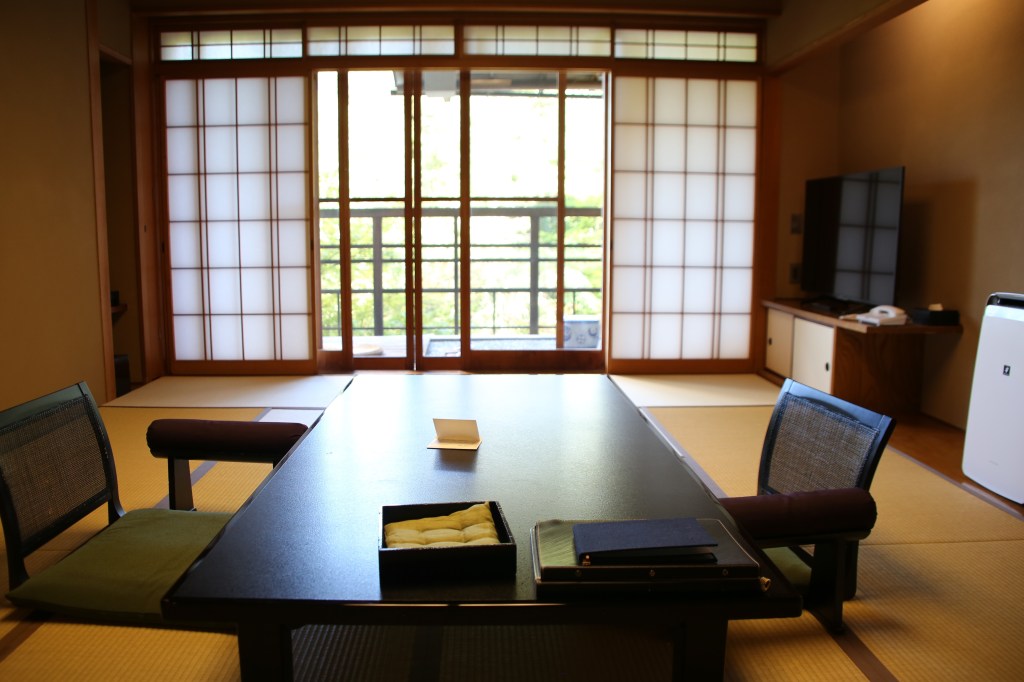
Our living room had a table at which we sat on the floor.
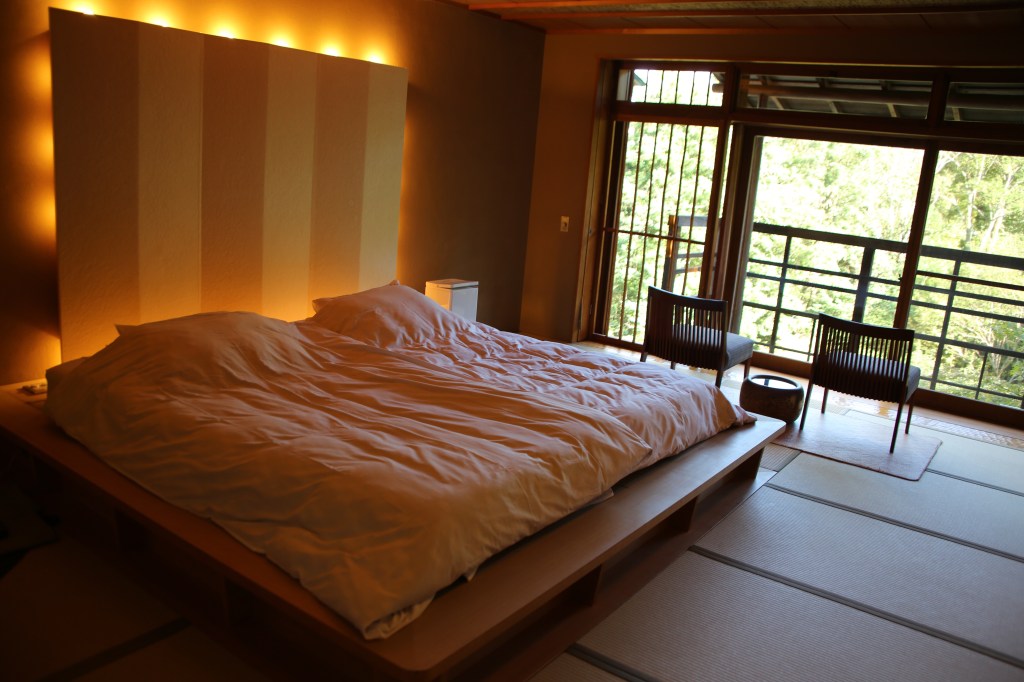
Our bedroom sported futons on the floor.
Our bathroom had an onsen (hot tub with water flowing in from a hot spring), a shower, and a sauna. The toilet is in a separate room in a ryokan.

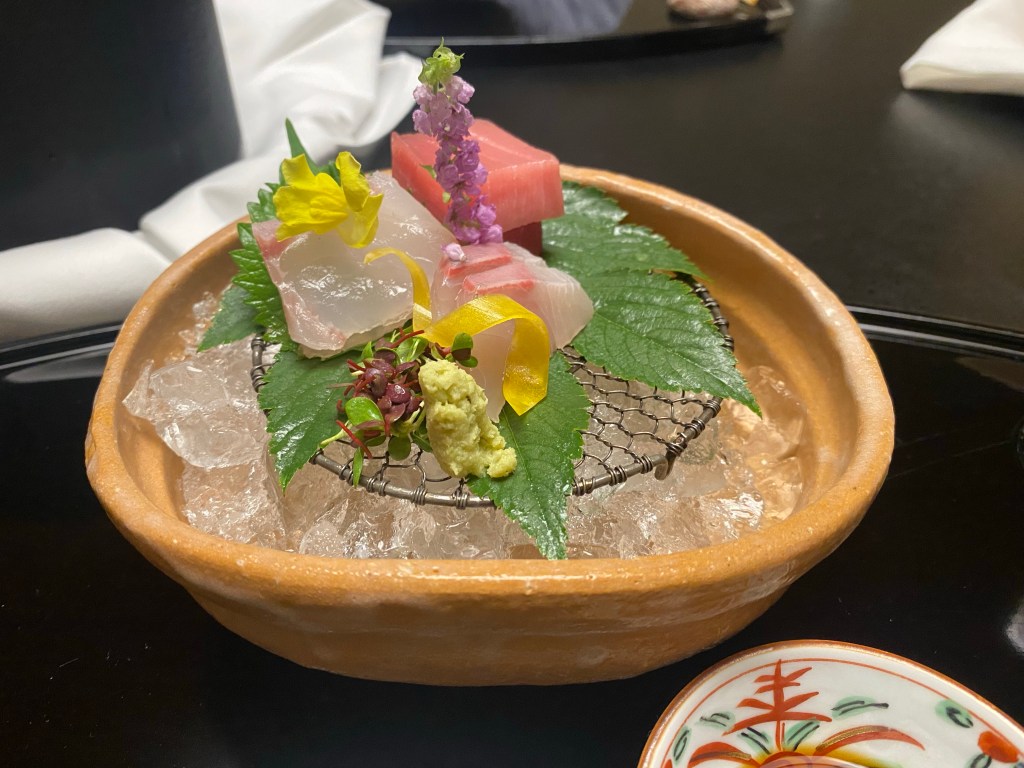
We were served a Kaiseki dinner (traditional multi-course Japanese meal) in our room. Kaiseki focuses on the art of food as well as the taste. Each course was beautifully crafted making our dinner both attractive and delicious.

The first course.
Me in my yukata drinking plum wine with another course.
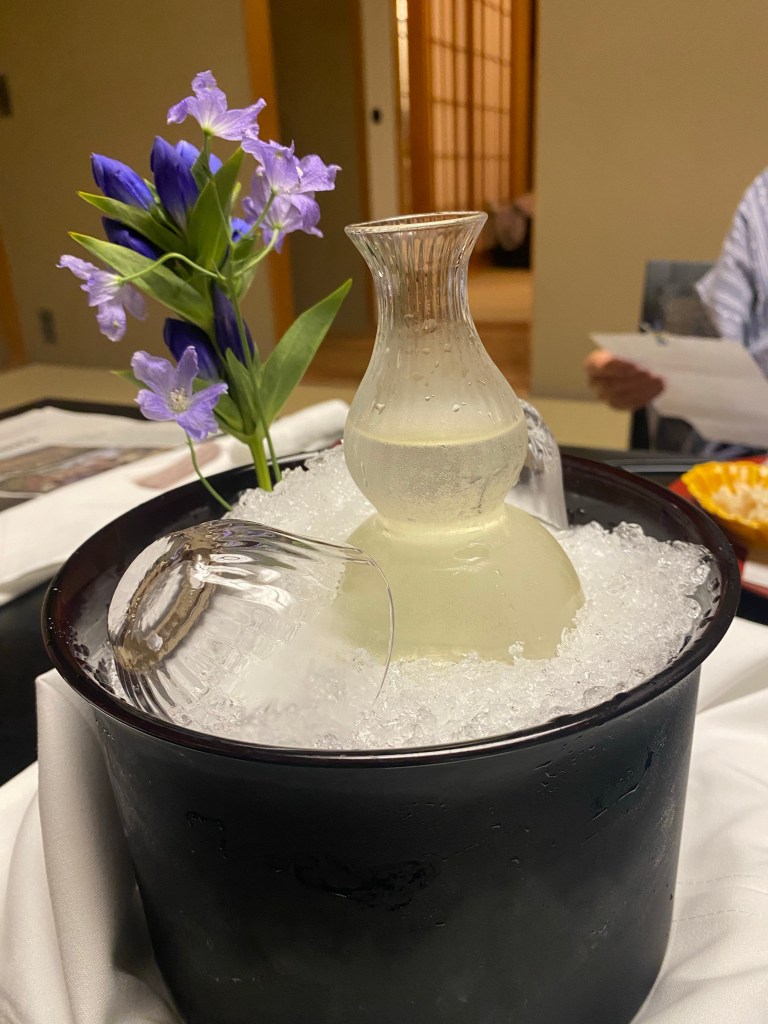
Of course, we had sake with our meal.

After two hours enjoying a wonderful meal, Lisa and I were full and a bit stiff from sitting on the floor. I think this style of eating takes some practice.

The Owakudani Volcano and the Search for Mount Fuji

The next morning we left for a gondola ride over an active volcano. We met our local guide Shin to help us learn about the area. The gondola took us up the mountain. As we climbed toward the volcanic crater we noticed many dead trees. Shin said the volcano erupted in 2015 and the fumes killed many of the trees. Comforting.

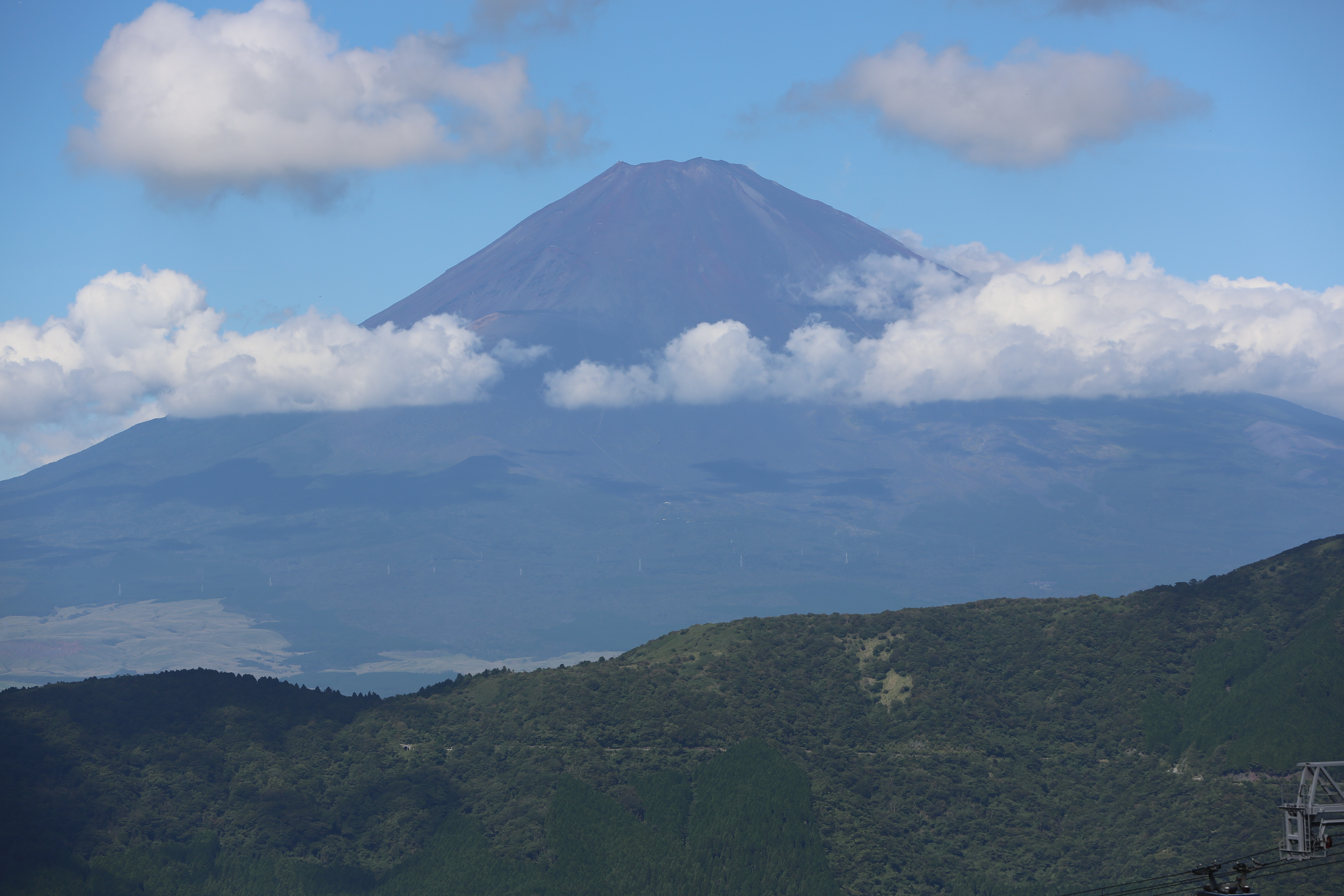
It was another beautiful day. Shin said that as we crested the mountain there was a chance we would see Mount Fuji. In September Mount Fuji is only visible in about one in every ten days. So he didn’t want to get our hopes up. As we approached the top we all waited anxiously, if not cautiously as we had been disappointed on the bullet train the day before. Slowly we climbed an then as we came over the peak . . .

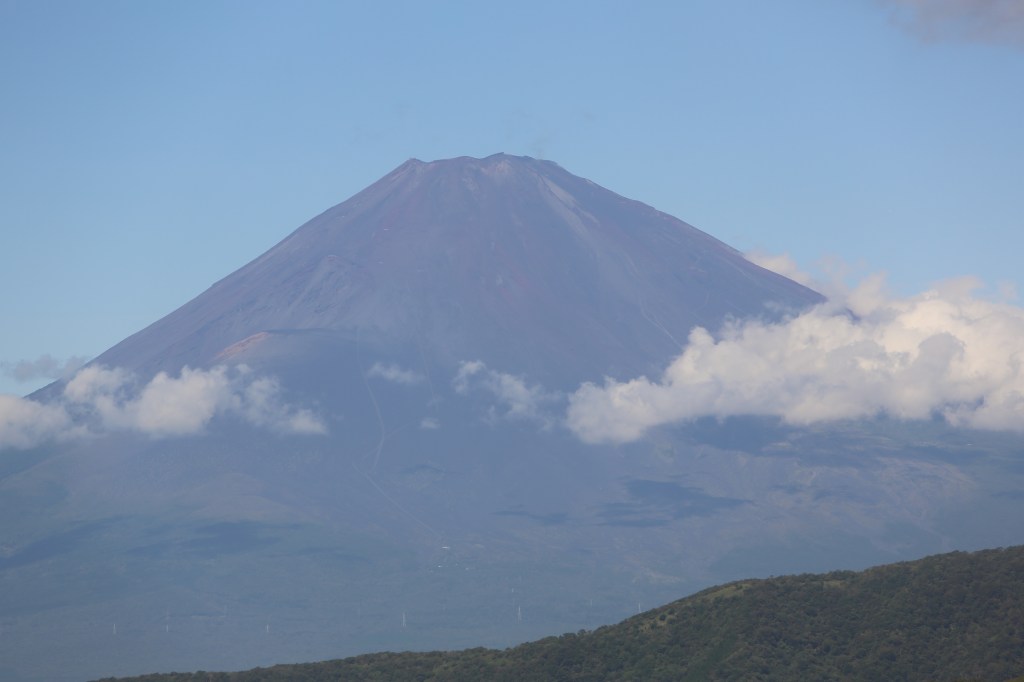
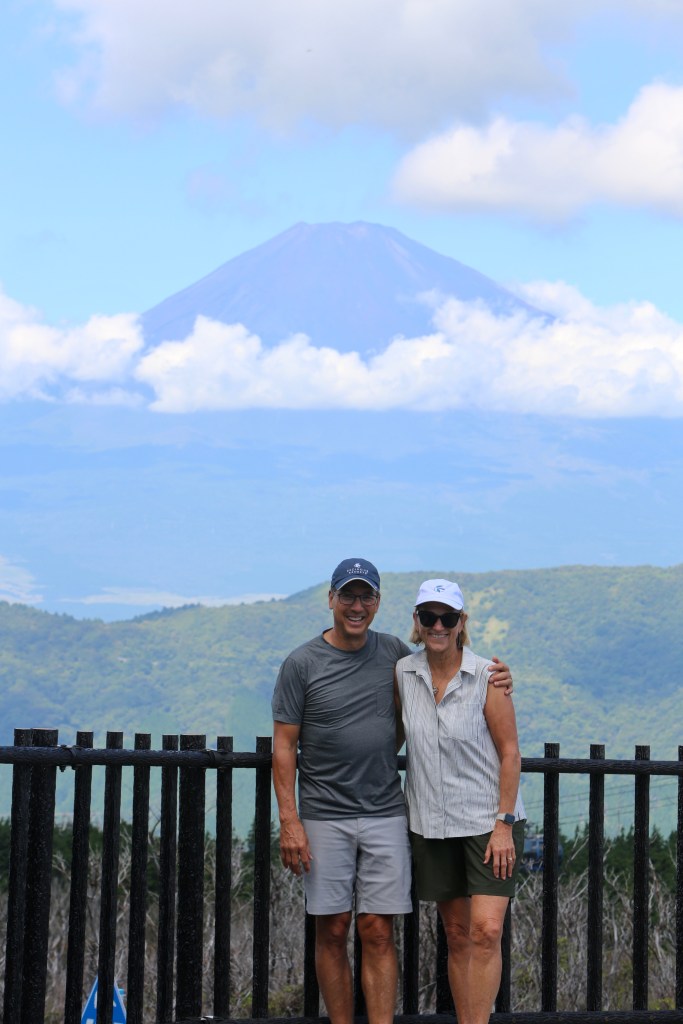
Mount Fuji!!

There it was in all of its glory. It was beautiful. We usually see photos of Fuji with snow on it. But, being September, there wasn’t any snow. Still its symmetrical shape and towering strength make it awe inspiring to see. Mount Fuji rises only to about 12,300 feet bone sea level. But, with the land around it being much lower, it sits alone at these heights.

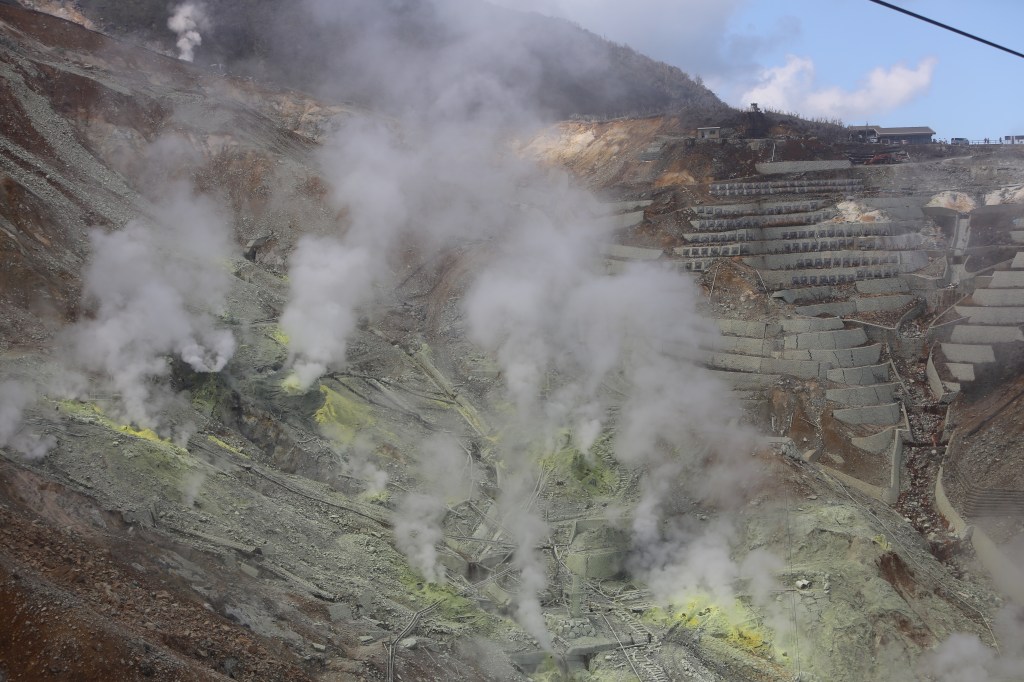
Once we digested the view of Mount Fuji, we retrained our focus on the volcanic crater immediately below us. It has steam rising from vents and areas of yellow sulfur splayed throughout. The volcano has been commercially tapped to supply all the onsen in Hakone. They pump water into the volcano to heat it and absorb the minerals and then send it down the mountain. Apparently it is a very lucrative business.

The Owakudani crater.

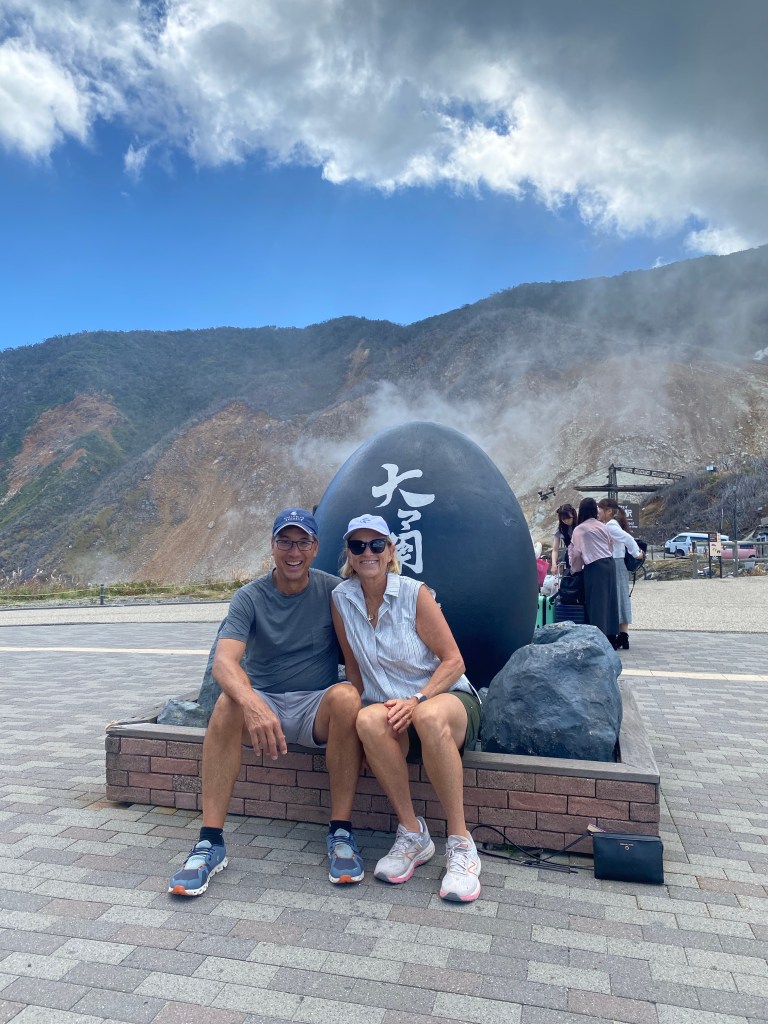
We got off the gondola and walked around to look at the crater, go to a viewing spot for Mount Fuji to take photos and to eat black eggs. Yes. Black eggs. They boil regular chicken eggs in a steam vent in the volcano. The sulfur mixes with the iron in the egg and turns the shell black. It is said that if you eat one it will add seven years to your life.

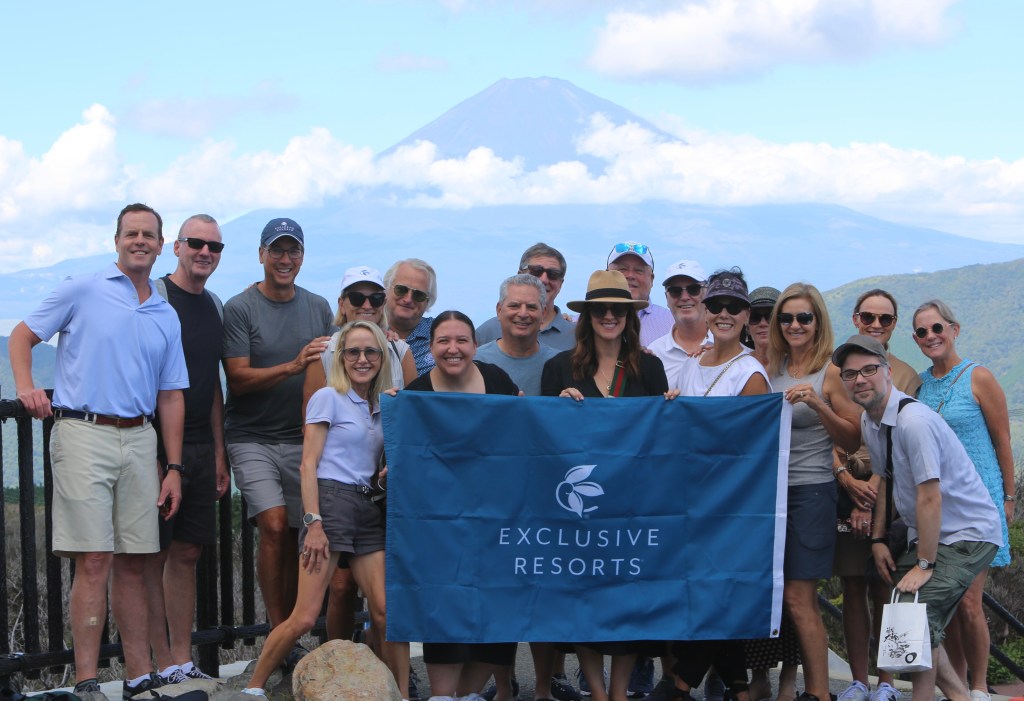
Our whole group in front of Mount Fuji.
A black egg. Lisa and I split one so I guess we’ll each add 3 1/2 years to our lives.
Sitting in front of a giant black egg.

We then went down to Lake Ashi right below the volcano. We rode a pirate ship across the lake — yes, a pirate ship. Apparently the man who started the boat company in the 1960s had recently visited Disneyland and loved how it made the children happy. He wanted to make the local children happy and it stuck. Children have been happily sailing Lake Ashi for the past 60 years.

A pirate ship on Lake Ashi.

The Hakone Checkpoint

We got to the other side of the lake, ate lunch and then headed to the Hakone Checkpoint. Bear with me while I explain (with apologies to historians for the simplified version).

Tokugawa was a Shogun (military general) in the 1600’s who defeated the army from the east and united Japan. He wanted Japan to be at peace for the first time in centuries. In times past, the victor would simply kill the other Shogun and that would be the end of it.

Tokugawa didn’t want to make martyrs of his enemies that could inspire revolution. So, once he relocated the Japanese capital from Kyoto to Edo (now Tokyo), he told the losing Shogun to relocate to Edo. They refused because they would have to forfeit all of their land and wealth. So, Tokugawa kidnapped their wives and oldest sons and brought them to Edo. He told them that if they wanted to see their families they would need to come the roughly 300 miles on the Tokaido Highway to Edo and spend every other year there.

Of course the men, being of much importance, couldn’t travel without a large contingent of servants, security, supplies, etc. All travel was on foot then, so, they walked. Up sprung inns, suppliers, and other businesses along the route. This meant the generals had to spend much of their wealth to make the two-week trek to Edo. Poor generals can’t mount a coup. Smart guy, that Tokugawa.

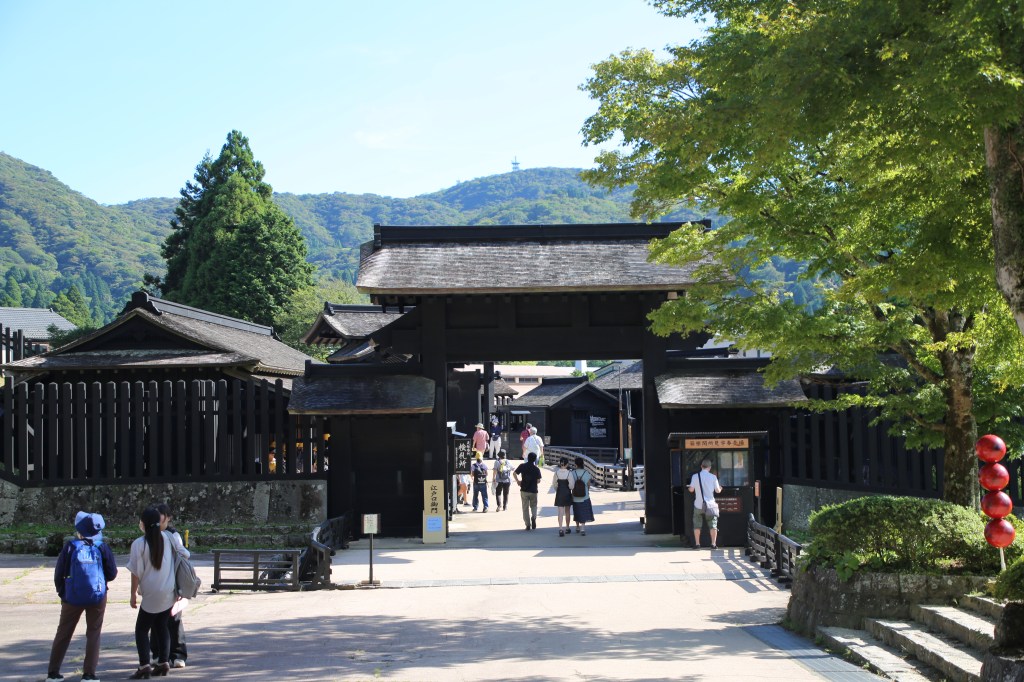
He also put in checkpoints on the Tokaido Highway, the most important one being at Hakone whose valley was a strategic choke point in the mountains. Hakone checkpoint was on the shore of Lake Ashi and required all who passed to have papers that showed permission to travel the route. Most focus was placed on women and children to ensure the wives and sons of the shogun weren’t escaping back to Kyoto. Get caught trying to escape — off with your head.

The Hakone Checkpoint

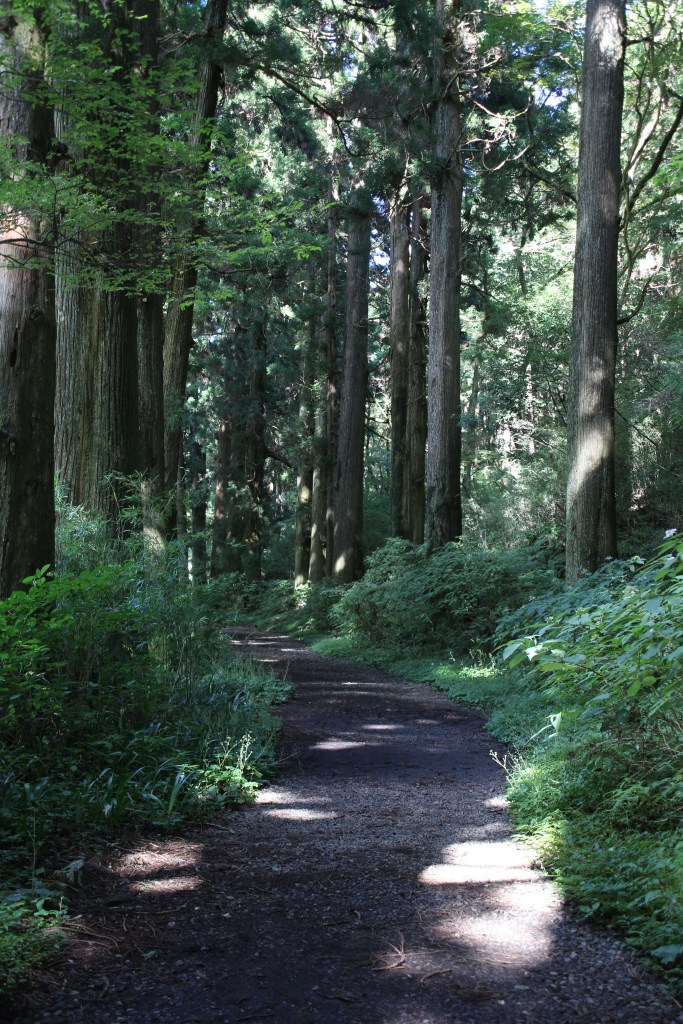
Tokugawa also had a softer side. Since the Tokaido Highway was such a traveled route between Kyoto and Tokyo, he had cedar trees planted all along the way to provide shade for travelers. Those trees, now 400 years old, still grace the road today.

A section of the Tokaido Highway with 400-year old cedar trees on both sides.

How Do You Open This Box!?!

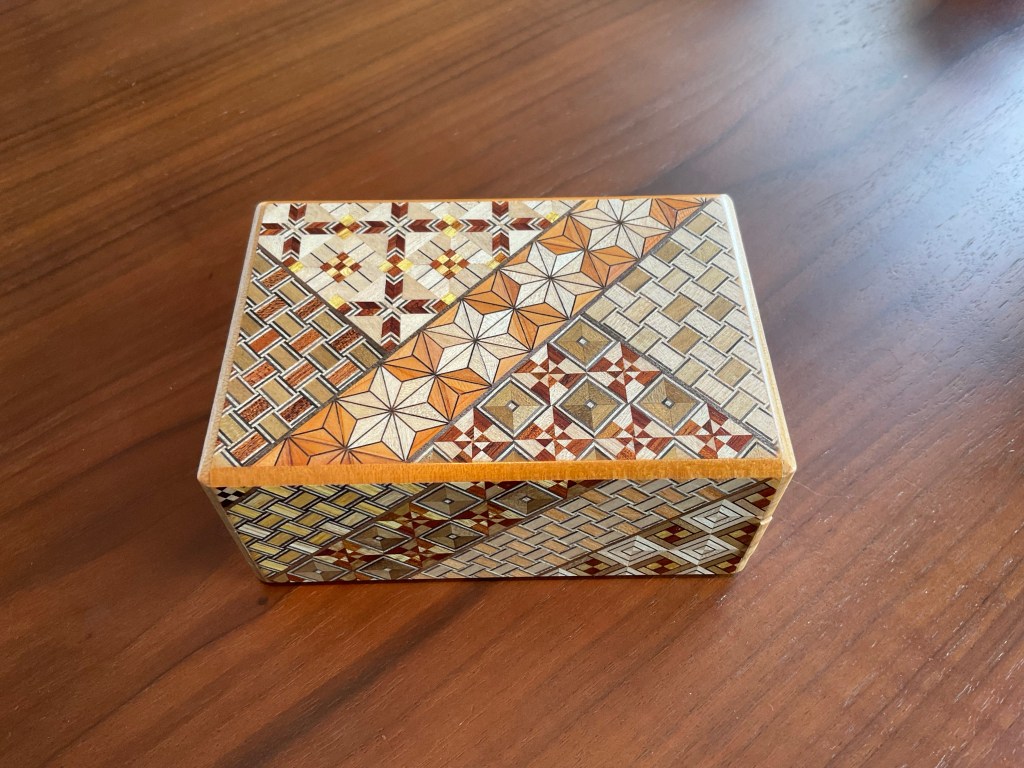
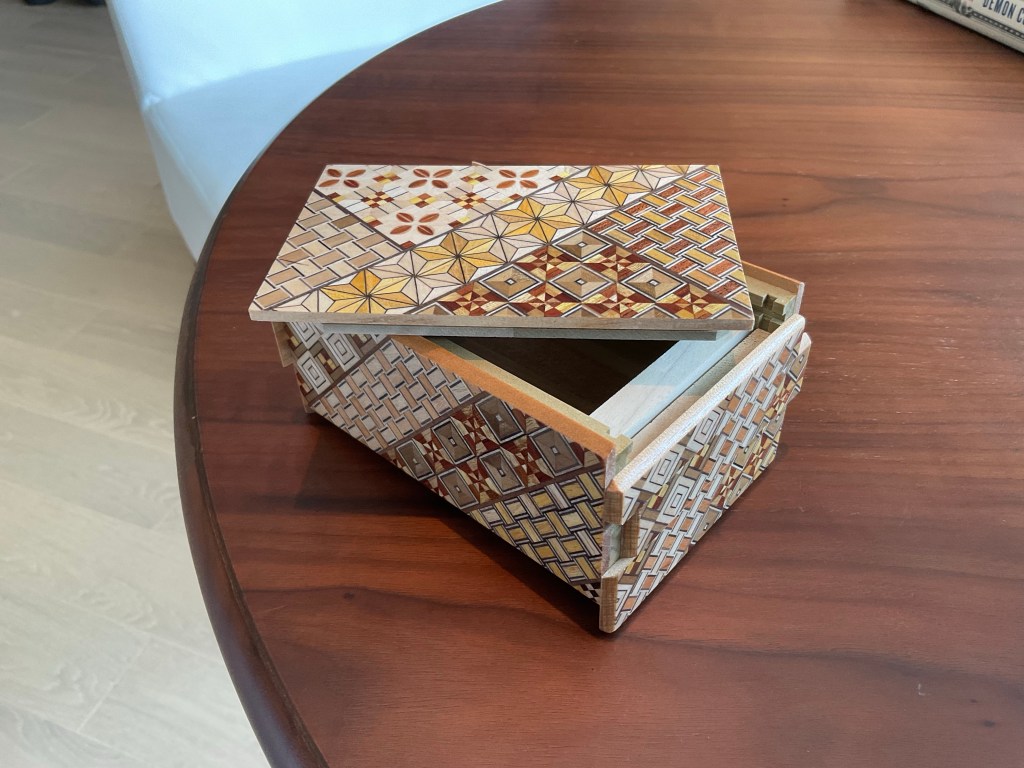
Hakone is also know for the famous trick box. They are beautiful wooden boxes that appear to have no opening. Fiddle with it long enough and you will find hidden panels that, when manipulated in a specific order, will open the box. So cool.

We got one in our room at the ryokan when we checked in. I worked on it for 45 minutes before I figured out how to open it. It took another 30 minutes or so before I could replicate the moves I made the first time. My box takes 10 moves. There are boxes that can take dozens or even hundreds of moves to open. I don’t have time for that!

How do you open it?
Voila!

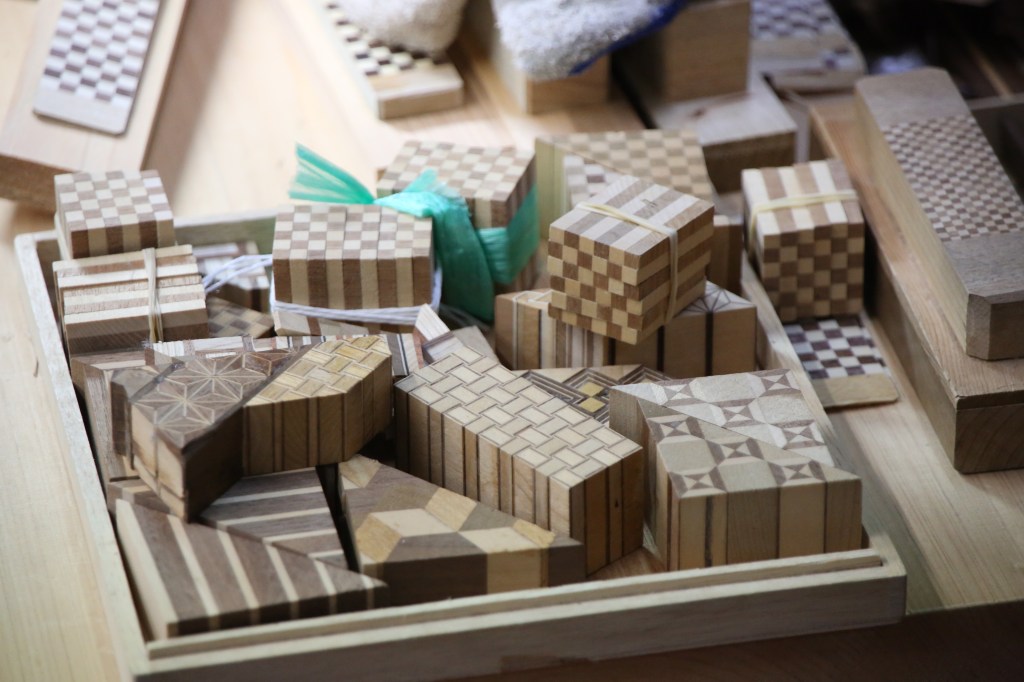
We went to the store where the boxes are made. They aren’t painted. Each different color is actually a different type of wood. The craftsman who makes them showed us how they take the pieces, glue them together, then shave off a panel for the box. Fascinating.

Different types of wood glued together in a cube.
Shaving off the top of one of the cubes to get a veneer for the box.

We might be coming home a with a few of these boxes to give to grandkids. Simpler ones, of course.

That’s it for today. We are heading back to Tokyo with a stop in a beach town on the way. We’ll wrap up with our final thoughts on Japan in our next installment.

Categories: Japan, Travel | Tags: , , , , | Leave a comment

Blog at WordPress.com.